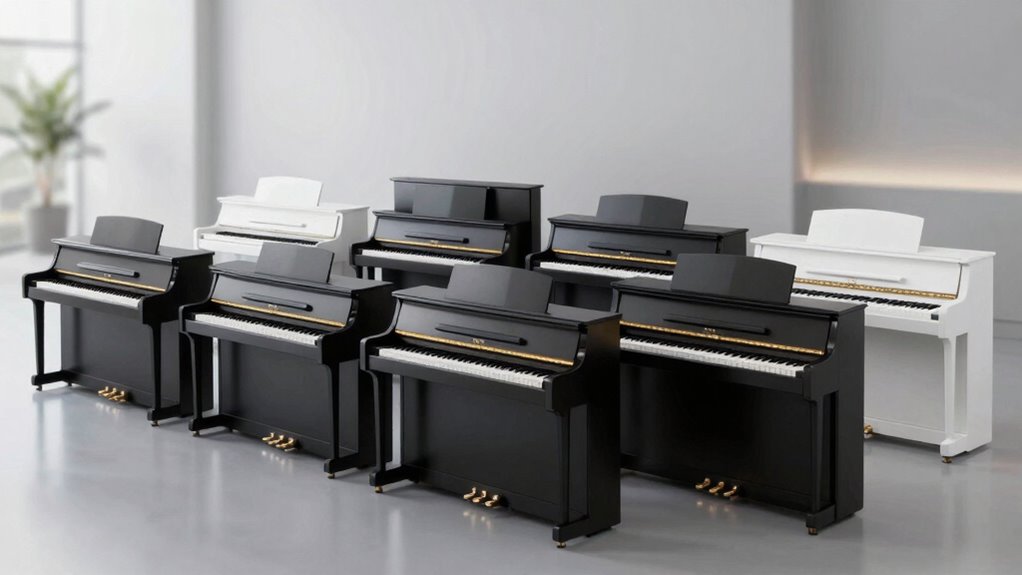

For musicians seeking a high-end digital piano, choosing the right model involves balancing sound quality, touch, features, and price. The Yamaha P125B stands out as the best overall due to its exceptional keyboard feel and authentic sound. Nord Stage 4 offers superior versatility and advanced features for professional players, while the Yamaha Arius YDP-166WB provides a classic upright aesthetic with premium sound quality. The main tradeoffs in this category include higher costs against improved realism and durability. Keep reading to see how each model stacks up and which one might be your perfect match.

Get the latest gadgets delivered free with Prime
- Fast, free delivery on millions of items
- Prime Video, Amazon Music and more included
- Member-only deals all year
Complete the kit



Key Takeaways
- The top models combine weighted hammer action with high-quality sound engines for authentic piano feel.
- Connectivity options like Bluetooth and MIDI are common in premium models and add versatility for modern musicians.
- Build quality and aesthetic design vary, with some models offering traditional piano looks and others more modern finishes.
- Price differences often reflect additional features such as advanced touch sensitivity, speaker systems, and control interfaces.
- Choosing the right model depends heavily on your skill level, intended use, and whether you prioritize realism or additional features.
| Yamaha 88-Weighted Wooden Key Digital Piano Keyboard, Premium Sound and Touch, Music Rest, Sustain Foot Switch, Black (P525B) |  | Best Overall for Authenticity and Versatility | Number of Keys: 88 | Key Action: GrandTouch-S wooden keys | Sound Samples: CFX, Bösendorfer | VIEW ON AMAZON | See Our Full Breakdown |
| Nord Stage 4 88-Key Digital Piano |  | Best for Live Performance and Layered Sound | Number of Keys: 88 | Action: Triple sensor weighted hammer | Sound Layers: Up to 7 | VIEW ON AMAZON | See Our Full Breakdown |
| Donner OURA S100 Digital Piano – 88 Key Graded Hammer Weighted Keyboard with Bluetooth and Three Pedals, Black |  | Best for Beginners and Compact Home Use | Number of Keys: 88 | Keyboard Type: Graded hammer weighted | Connectivity: Bluetooth, USB | VIEW ON AMAZON | See Our Full Breakdown |
| Donner DDP-400 Digital Piano, 88-Key Progressive Weighted Keyboard, Brown |  | Best for Progressive Feel and Feature-Rich Practice | Keys: 88 progressive weighted | Polyphony: 128 | Tones: 138 | VIEW ON AMAZON | See Our Full Breakdown |
| 88-Key Digital Piano with Hammer-Action Weighted Keyboard |  | Best for Space-Saving Versatility and Rich Tones | Number of Keys: 88 | Polyphony: 128 | Tones: 800 | VIEW ON AMAZON | See Our Full Breakdown |
| Yamaha Arius Series 88-Key Weighted Digital Piano Keyboard, Full Size, GrandTouch-E Action, CFX Concert Grand Piano Sound, 3-Pedal Unit, Bench Included, Classic Upright Design, YDP-166WB |  | Best Overall for Authentic Piano Experience | Number of Keys: 88 | Sound System: Built-in stereo speakers | Pedals: 3 Pedal unit | VIEW ON AMAZON | See Our Full Breakdown |
| Yamaha P71 88-Key Weighted Action Digital Piano with Sustain Pedal and Power Supply |  | Best for Beginners and Budget-Conscious Players | Keys: 88 weighted, touch-sensitive | Voices: 10 | Includes: Sustain pedal, power supply | VIEW ON AMAZON | See Our Full Breakdown |
| Kawai CN201 Digital Piano – Premium Satin Black |  | Best for Authentic Grand Piano Feel and Modern Design | Number of Keys: 88 | Key Action: Responsive Hammer III | Sounds: 19 | VIEW ON AMAZON | See Our Full Breakdown |
| Roland RP701-LA 88-Key Digital Home Piano |  | Best for Learners and Home Practice with Modern Features | Number of Keys: 88 | Sound Technology: SuperNATURAL | Keyboard: PHA-4 Standard | VIEW ON AMAZON | See Our Full Breakdown |
| Alesis Recital Digital Piano 88-Key Semi-Weighted |  | Best Value for Beginners and Intermediate Players | Number of Keys: 88 | Key Type: Semi-weighted | Voices: 5 (Acoustic Piano, Electric Piano, Organ, Synth, Bass) | VIEW ON AMAZON | See Our Full Breakdown |
| Roland RP107 Digital Piano |  | Best for Authentic Tone and Compact Design | Keyboard: 88-note PHA-4 Standard | Polyphony: 256 notes | Speaker System: Onboard stereo speakers | VIEW ON AMAZON | See Our Full Breakdown |
| Yamaha DGX-670B 88-Key Weighted Digital Piano, Black |  | Best for Versatile Performance and Learning Features | Keys: 88 weighted keys | Key Action: Graded hammer action | Piano Sound: CFX Stereo Sampling | VIEW ON AMAZON | See Our Full Breakdown |
| premium digital piano | Connectivity | Number of Keys |
|---|---|---|
| Yamaha 88-Weighted Wooden Key | USB, Bluetooth | 88 |
| Nord Stage 4 88-Key Digital Pi | USB MIDI, multiple outputs | 88 |
| Donner OURA S100 Digital Piano | Bluetooth, USB | 88 |
| Donner DDP-400 Digital Piano | Bluetooth, USB | — |
| 88-Key Digital Piano with Hamm | USB/MIDI | 88 |
| Yamaha Arius Series 88-Key Wei | Bluetooth Audio/MIDI | 88 |
| Yamaha P71 88-Key Weighted Act | None | — |
| Kawai CN201 Digital Piano | — | 88 |
| Roland RP701-LA 88-Key Digital | Bluetooth | 88 |
| Alesis Recital Digital Piano 8 | — | 88 |
| Roland RP107 Digital Piano | Bluetooth, MIDI | — |
| Yamaha DGX-670B 88-Key Weighte | — | — |
More Details on Our Top Picks
Yamaha 88-Weighted Wooden Key Digital Piano Keyboard, Premium Sound and Touch, Music Rest, Sustain Foot Switch, Black (P525B)
This Yamaha model stands out for its GrandTouch-S wooden keys, which faithfully mimic the nuanced touch of an acoustic grand, making it ideal for serious pianists seeking both expressive control and a realistic feel. Compared with the Nord Stage 4, it offers a more traditional piano experience, though it lacks the extensive layering and live-performance features of the Nord. The CFX and Bösendorfer samples elevate its sound quality to concert hall levels, while Virtual Resonance Modeling ensures authentic resonance, giving players a rich, immersive experience. Its robust features, including the Smart Pianist app and registration memory, make it a versatile choice for practice and performance alike. The tradeoff is that it is less portable than models like the Donner OURA S100, and its price reflects a premium investment.
bestFor: Advanced players or professionals needing a high-fidelity, expressive digital piano for studio or stage use.
notIdealFor: Beginners or those on a tight budget who may find the price prohibitive and features overly complex.Pros:- GrandTouch-S wooden keys for superior touch response
- Exceptional sound quality with CFX and Bösendorfer samples
- Advanced expressive technologies like VRM
Cons:- Higher price point may deter budget-conscious buyers
- Less portable due to its weighted wooden keys and size
- Number of Keys:88
- Key Action:GrandTouch-S wooden keys
- Sound Samples:CFX, Bösendorfer
- Connectivity:USB, Bluetooth
- Dimensions:52.6 x 14.8 x 5.71 inches
- Weight:48.5 pounds
Our verdict“This model is perfect for experienced pianists who want authentic feel and advanced sound features in a premium package.”
Nord Stage 4 88-Key Digital Piano
The Nord Stage 4 makes a compelling case for professional performers, thanks to its triple-sensor weighted hammer action that provides an authentic grand piano feeling. It excels in versatility, offering up to seven independent layers and 512 program slots, making it ideal for live gigs and studio sessions where layered sounds are essential. Compared with the Yamaha P525B, it provides more extensive sound layering and flexible performance controls, though it comes at a significantly higher price. Its comprehensive connectivity options, including USB MIDI and multiple outputs, support complex setups and seamless integration with other gear. The main tradeoff is the learning curve; its advanced features may overwhelm beginners or casual players.
bestFor: Professional musicians and performers needing a highly versatile, layered sound setup.
notIdealFor: Beginners or casual players seeking simplicity and affordability.Pros:- Authentic grand piano feel with triple sensor weighted keys
- Up to seven independent sound layers for creative flexibility
- Includes extensive connectivity for professional use
Cons:- Premium price may be prohibitive for hobbyists
- Complex interface requires time to master
- Number of Keys:88
- Action:Triple sensor weighted hammer
- Sound Layers:Up to 7
- Storage:512 programs
- Connectivity:USB MIDI, multiple outputs
- Weight:Unknown (heavy)
Our verdict“This keyboard is best suited for seasoned performers who require advanced layering and connectivity in a premium instrument.”
Donner OURA S100 Digital Piano – 88 Key Graded Hammer Weighted Keyboard with Bluetooth and Three Pedals, Black
The Donner OURA S100 offers a realistic graded hammer weighted keyboard, making it an excellent choice for beginners or intermediate players aiming for authentic touch without the complexity of high-end models. Its Bluetooth functionality for wireless MIDI and audio adds modern convenience, and the included three-pedal unit enhances realism. Compared with the Donner DDP-400, it provides a more portable, space-saving design suitable for smaller rooms or apartments. However, at 21.1 kg, it is still relatively heavy for moving frequently. Its lighter key action may not satisfy advanced players seeking more nuanced control, and it offers only a few demo songs, limiting practice variety.
bestFor: Beginners or casual pianists who want a realistic feel in a stylish, space-efficient package.
notIdealFor: Advanced players or those looking for a wide range of onboard sounds and features.Pros:- Graded hammer keys simulate acoustic piano touch
- Wireless Bluetooth for MIDI and audio streaming
- Compact and stylish Scandinavian design
Cons:- Heavy for a portable instrument, less ideal for frequent transport
- Limited onboard sounds and features for advanced users
- Number of Keys:88
- Keyboard Type:Graded hammer weighted
- Connectivity:Bluetooth, USB
- Power Source:Corded electric
- Weight:21.1 kg
- Color:Black
Our verdict“This model is best for beginners or casual players seeking a realistic, space-efficient digital piano for home practice.”
Donner DDP-400 Digital Piano, 88-Key Progressive Weighted Keyboard, Brown
The Donner DDP-400 excels with its progressive hammer-action keys, designed to closely mimic the feel of an acoustic grand, making it suitable for learners and intermediate players. Its upgrade to the French Dream sound source and 138 tones, along with 100 rhythms, provides a broad palette for musical exploration, while Bluetooth and USB MIDI enable seamless app-based lessons and recording. Compared to the Donner OURA S100, it offers a richer feature set at a similar weight, but its 49.5 kg weight can make it less portable. The 15W dual amps deliver decent volume, yet may be insufficient for larger spaces. Its classic vintage-inspired wood cabinet adds aesthetic appeal to any room.
bestFor: Intermediate players and students seeking a realistic touch combined with extensive features.
notIdealFor: Those who need ultra-portable options or are on a strict budget.Pros:- Progressive weighted keys for authentic feel
- Rich sound library with 138 tones and 100 rhythms
- Bluetooth and USB connectivity for versatile use
Cons:- Heavy weight limits portability
- Powerful enough for home use but less suited for large venues
- Keys:88 progressive weighted
- Polyphony:128
- Tones:138
- Rhythms:100
- Connectivity:Bluetooth, USB
- Dimensions:138.5 x 89 x 40 cm
Our verdict“This piano offers an excellent balance of realistic touch and comprehensive features for dedicated learners and intermediate players.”
88-Key Digital Piano with Hammer-Action Weighted Keyboard
This digital piano provides full-size weighted keys and a vast array of 800 tones, making it a solid choice for versatile home use. Its ability to transform into a spacious desk adds practical value for small living spaces or work areas. Compared with the Donner DDP-400, it simplifies the interface, appealing to users who want straightforward operation without sacrificing sound quality. Lacking detailed specifications, it is less clear how its touch and build quality compare to higher-end models, but its 128-note polyphony and broad tone library make it attractive for various musical styles. The absence of detailed connectivity options could limit professional integration.
bestFor: Home musicians who want a multi-purpose, space-efficient digital piano with a wide sound palette.
notIdealFor: Advanced performers seeking high-fidelity touch or complex performance features.Pros:- Full-size weighted keys for realistic feel
- Transformable design for space efficiency
- Large selection of 800 tones
Cons:- Limited detail on build quality and touch nuances
- No specific information on connectivity beyond USB/MIDI
- Number of Keys:88
- Polyphony:128
- Tones:800
- Connectivity:USB/MIDI
- Weight:Unknown
Our verdict“This model is a versatile choice for home users needing a broad tone selection and space-saving design without complex features.”
Yamaha Arius Series 88-Key Weighted Digital Piano Keyboard, Full Size, GrandTouch-E Action, CFX Concert Grand Piano Sound, 3-Pedal Unit, Bench Included, Classic Upright Design, YDP-166WB
This Yamaha Arius model stands out for delivering a remarkably authentic acoustic feel thanks to its GrandTouch-E keyboard action, which surpasses the GHS action found in the Yamaha P71. Its CFX concert grand sound offers a lush, resonant tone suitable for serious practice and performance. The full upright design with three pedals, including a damper pedal, provides a complete home piano setup, unlike more compact options. Seamless Bluetooth connectivity and built-in speakers make it versatile for both practice and casual listening. The inclusion of a bench and 3-pedal unit enhances its value for dedicated players. However, this model is larger and heavier than the P71, making it less portable and more suitable for permanent setups. The high-quality build and features come with a higher price point, which may be a consideration for budget-conscious buyers. This pick is ideal for serious students and homeowners seeking a premium, realistic piano experience.
Pros:- Authentic GrandTouch-E keyboard action mimics acoustic feel
- Rich, expressive CFX concert grand sound
- Includes a 3-pedal unit and bench for a complete setup
- Bluetooth Audio/MIDI for seamless connectivity
Cons:- Heavier and larger, less portable than compact models
- Higher price point may be prohibitive for casual buyers
Best for: Intermediate to advanced home players who want an authentic grand piano feel with a classic upright aesthetic.
Not ideal for: Beginners on a tight budget or those needing a portable or space-saving solution.
- Number of Keys:88
- Sound System:Built-in stereo speakers
- Pedals:3 Pedal unit
- Connectivity:Bluetooth Audio/MIDI
- Design:Classic upright
- Includes:Bench, 3-pedal unit
Our verdict“This model suits players seeking a premium, realistic piano experience with a traditional upright appearance.”
Yamaha P71 88-Key Weighted Action Digital Piano with Sustain Pedal and Power Supply
Compared to the Yamaha Arius YDP-166WB, the P71 offers a simplified, more affordable entry point with weighted keys that emulate acoustic feel, though it lacks the advanced GrandTouch-E action. Its 10 high-quality Voices, including a sampled Yamaha grand piano, provide enough variety for casual playing and practice. The straightforward one-button operation helps focus on playing rather than menu navigation, making it well-suited for beginners. The included sustain pedal and power supply add value, especially for new players setting up a home practice space. However, it doesn’t feature the sophisticated sound engineering or connectivity options of higher-end models, and its limited features could feel restrictive for progressing players. The compact size is ideal for small spaces but less suitable for those seeking advanced features or recording capabilities. This model makes the most sense for beginners or those seeking a simple, reliable digital piano without extra frills.
Pros:- Weighted, touch-sensitive keys for realistic feel
- Includes sustain pedal and power supply
- 10 high-quality Voices, including Yamaha grand piano
- Simple operation ideal for beginners
Cons:- Limited advanced features and customization
- Availability restricted to Amazon, limiting purchase options
Best for: Beginner players or casual enthusiasts wanting a basic, affordable weighted-key digital piano.
Not ideal for: Advanced players or those looking for extensive features and connectivity options.
- Keys:88 weighted, touch-sensitive
- Voices:10
- Includes:Sustain pedal, power supply
- Mode:Dual Mode (layer sounds)
- Connectivity:None
- Size:Compact
Our verdict“This piano is perfect for newcomers who want a reliable, straightforward weighted keyboard without extra complexity.”
Kawai CN201 Digital Piano – Premium Satin Black
The Kawai CN201 stands out for its Responsive Hammer III action, which offers a highly nuanced, concert-grand-like touch that outperforms the GHS action in the Yamaha P71. Pairing this with Kawai’s Harmonic Imaging (HI) system, it captures the expressiveness of the SK-EX grand, making it a favorite for serious students and performers. Its sleek satin black finish and modern look appeal to those who want a stylish, professional-looking instrument. The 19 sounds include electric pianos and strings, offering versatility beyond pure acoustic emulation. The 3-song recorder and practice features support both learning and performance. However, the CN201’s higher price and more complex features may be overwhelming for beginners, and its size makes it less ideal for small spaces. It is best suited for players seeking high-end responsiveness and sound quality. This pick is tailored for advanced students and musicians demanding a premium, authentic piano experience with a modern aesthetic.
Pros:- Kawai’s Responsive Hammer III action for superb touch
- Harmonic Imaging sound system captures detailed nuances
- Elegant satin black finish and modern design
- Includes 19 versatile sounds
Cons:- Higher price point than entry-level models
- Complex features may be unnecessary for beginners
Best for: Experienced players and serious students seeking a realistic, expressive piano with a premium look.
Not ideal for: Beginners or casual hobbyists who prefer simpler, more affordable models.
- Number of Keys:88
- Key Action:Responsive Hammer III
- Sounds:19
- Size:58 x 21.5 x 19.5 inches
- Finish:Satin Black
- Includes:3-song recorder
Our verdict“This instrument suits demanding players who prioritize authentic feel and sound in a stylish, modern package.”
Roland RP701-LA 88-Key Digital Home Piano
Compared with the Kawai CN201, the Roland RP701-LA emphasizes user-friendly features like its intuitive interface, Bluetooth streaming, and included adjustable bench, making it more accessible for beginners and casual players. Its SuperNATURAL technology and PHA-4 Standard keyboard deliver a convincing acoustic feel, similar to Yamaha’s GHS but with Roland’s signature expressiveness. The built-in 3D Ambience and headphones enhance practice sessions, especially in shared spaces. While it offers a comprehensive package with free lessons and an adjustable bench, the RP701-LA lacks some of the advanced tonal options and connectivity features found in higher-end models like the Arius YDP-166WB. Its straightforward design makes it ideal for home use but less suitable for performers seeking extensive recording or stage features. This model is best for learners and home players seeking ease of use with authentic feel and integrated learning tools.
Pros:- SuperNATURAL sound technology for realistic tone
- PHA-4 Standard keyboard for authentic touch
- Includes adjustable bench and free lessons
- Bluetooth streaming for music playback
Cons:- Higher cost for casual players
- Limited advanced features for professional use
- Designed primarily for home, not stage or studio
Best for: Beginner to intermediate players wanting a feature-rich, easy-to-use digital piano for home practice.
Not ideal for: Advanced performers or those needing portability or extensive recording capabilities.
- Number of Keys:88
- Sound Technology:SuperNATURAL
- Keyboard:PHA-4 Standard
- Includes:Adjustable bench, free lessons
- Connectivity:Bluetooth
- Size:55.95 x 21.22 x 16.22 inches
Our verdict“This Roland model is ideal for learners and home users who want a balanced combination of authentic feel, modern features, and ease of use.”
Alesis Recital Digital Piano 88-Key Semi-Weighted
This option stands out for offering a full 88-key setup with semi-weighted keys, making it accessible for those just starting out or exploring intermediate skills. Compared to the Yamaha DGX-670B, it lacks the graded hammer action, which means the key feel isn’t as close to an acoustic piano, but it compensates with versatile voices and interactive lessons. Its powerful 20W speakers ensure sound fills a room without external amplification, which is ideal for practice or small performances. However, the power supply isn’t included, and the keys may not satisfy more advanced players seeking a realistic weighted action. The built-in educational features and multiple voices add great value for learners, though additional accessories like the sustain pedal must be purchased separately. Overall, this makes the most sense for budget-conscious beginners who want a feature-rich instrument with room to grow.
Pros:- Full-sized 88 semi-weighted keys with adjustable touch response
- Multiple voices including piano, electric piano, organ, synth, and bass
- Powerful 20W speakers for clear, room-filling sound
- Built-in educational modes and interactive lessons
Cons:- Power supply sold separately, increasing initial cost
- Keys are semi-weighted, which may feel less realistic than fully weighted options
- Additional accessories like the sustain pedal are needed for complete functionality
Best for: Beginners and intermediate players seeking a versatile, budget-friendly digital piano with educational support
Not ideal for: Advanced players or professionals who need fully weighted, high-fidelity keys and comprehensive recording features
- Number of Keys:88
- Key Type:Semi-weighted
- Voices:5 (Acoustic Piano, Electric Piano, Organ, Synth, Bass)
- Built-in Speakers:20W
- Polyphony:128 notes
- Power Options:AC adapter or 6 D cell batteries
Our verdict“This is a solid choice for beginners or intermediates looking for an affordable, feature-packed digital piano with educational support.”
Roland RP107 Digital Piano
The Roland RP107 makes a compelling case for those wanting a realistic piano feel without the bulk of larger models. Its PHA-4 Standard keyboard provides an authentic touch that surpasses many entry-level models like the Alesis Recital, especially for players seeking a more natural playing experience. The onboard SuperNATURAL Piano technology delivers rich, dynamic sound that satisfies casual players and learners alike, although it doesn’t offer the advanced features or extensive voice library of high-end models like the Yamaha DGX-670B. Its compact design fits comfortably in small spaces, and Bluetooth connectivity simplifies pairing with apps and devices. However, it lacks built-in recording features and isn’t aimed at professional performers, which could be a limitation for more serious musicians. This pick is ideal for home use where space and realism matter most, making it a smart step up from beginner instruments.
Pros:- 88-note PHA-4 Standard keyboard for an authentic piano touch
- Rich sound with onboard stereo speakers and SuperNATURAL technology
- Compact, space-saving design suitable for small rooms
- Bluetooth and MIDI connectivity for easy app integration
Cons:- No built-in recording or sequencing features
- Limited high-end features for professional or advanced use
- Requires external devices for more complex playback or editing
Best for: Beginners and casual players who prioritize authentic feel and space efficiency
Not ideal for: Professional musicians or those requiring advanced recording and performance features
- Keyboard:88-note PHA-4 Standard
- Polyphony:256 notes
- Speaker System:Onboard stereo speakers
- Connectivity:Bluetooth, MIDI
- App Compatibility:Roland Piano App
- Headphone Jacks:Dual
Our verdict“This is a strong option for beginners or casual players seeking a realistic, space-efficient digital piano with modern connectivity.”
Yamaha DGX-670B 88-Key Weighted Digital Piano, Black
The Yamaha DGX-670B stands out for its comprehensive feature set, combining high-quality weighted keys with a massive sound library, including the acclaimed CFX Stereo Sampling. It’s clearly aimed at serious learners and hobbyists who want an instrument capable of covering a wide musical range, thanks to 630 instrument voices and 263 accompaniment styles. Its graded hammer action delivers a feel close to an acoustic instrument, especially for those who want a realistic touch without the cost of premium models like the Nord Stage 4. Built-in learning tools, vocal effects, and included accessories make it a versatile package, although the stand and bench are sold separately, which adds to the total investment. Its size and weight make it less portable, but for dedicated home use, it offers unmatched value and performance for the price. This is ideal for dedicated learners who want a full-featured, expressive instrument.
Pros:- 88 weighted keys with graded hammer action for realistic feel
- Extensive library of 630 instrument voices and 263 styles
- Built-in learning features with sheet music display
- Vocal effects and microphone jack for performance versatility
Cons:- Stand and bench sold separately, increasing overall cost
- Heavy and less portable than smaller digital pianos
- Some advanced features may require a learning curve for new users
Best for: Intermediate to advanced students and hobbyists wanting a feature-rich, weighted keyboard with performance and learning capabilities
Not ideal for: Travelers or those with limited space seeking a lighter, more portable option
- Keys:88 weighted keys
- Key Action:Graded hammer action
- Piano Sound:CFX Stereo Sampling
- Voices:630 instrument voices
- Accompaniment Styles:263
- Microphone:Built-in mic jack with vocal effects
Our verdict“This is a perfect fit for dedicated learners and performers who want a versatile, full-featured digital piano for home use and practice.”
How We Picked
Our evaluation focused on key factors that matter most to serious players and dedicated hobbyists. We prioritized keyboard action, sound quality, build durability, and feature set, ensuring each model delivers a convincing piano experience. Ease of use, connectivity options, and overall value also influenced the rankings. We compared similar price points and feature sets, aiming to highlight models that offer the best balance of performance and longevity. The ranking reflects which options excel in these areas while also considering user feedback and industry reputation.Factors to Consider When Choosing Premium Digital Pianos
Choosing a premium digital piano requires careful thought about several key aspects to ensure the instrument meets your needs and justifies the investment. Beyond basic features, consider how the keyboard action feels, the sound engine quality, and the instrument’s compatibility with your setup. It’s also important to assess the build quality and aesthetic fit for your space. This guide covers the main factors to keep in mind, helping you avoid common pitfalls like overpaying for unnecessary features or selecting an instrument with less realistic touch and sound.Keyboard Action and Feel
For a premium digital piano, the keyboard’s responsiveness and feel are paramount. Graded hammer action mimics the weight of an acoustic piano, which is essential for serious practice and performance. Some models feature wooden keys, adding to the authentic touch. Be wary of semi-weighted or synth-action keys if you want a true piano experience, as these can feel less natural and hinder skill development.
Sound Quality and Sampling
The sound engine is the heart of a digital piano. High-quality sampling from renowned concert grands, like Yamaha’s CFX or Steinway, significantly enhances realism. Look for models that offer multiple layers, velocity sensitivity, and rich resonance. Cheaper models may cut corners here, reducing the immersive experience. Prioritize instruments with well-reviewed sound libraries for future-proofing your investment.
Build Quality and Aesthetics
Premium digital pianos should feel solid and durable, with high-quality materials that withstand regular use. The aesthetic matters too—whether you prefer a traditional upright look or a sleek modern finish. Consider placement in your space; a bulky model might look out of place in a small room, while a compact design could limit some features. Always check for a stable stand and quality pedals to match the instrument’s premium status.
Connectivity and Additional Features
Modern digital pianos often include Bluetooth, MIDI, and USB connections, expanding their capabilities with apps, recording, and external sound modules. These features are particularly valuable for recording or integrating with other gear. However, more features usually mean a higher price and increased complexity—assess your comfort level with tech and what you’ll actually use to avoid overspending on unnecessary extras.
Price and Long-Term Value
While premium models command higher prices, they often offer better durability and a more authentic experience that justifies the cost. Consider your long-term goals—if you’re a serious student or professional, investing more now could save money later in upgrades. Conversely, if you’re a casual player, a slightly less expensive model with fewer features might suffice, providing good value without overextending your budget.
Frequently Asked Questions
Is weighted action necessary for serious piano practice?
Weighted action is highly recommended for serious practice because it closely simulates the touch of an acoustic piano. This feel helps develop proper finger strength and technique, making the transition to real instruments smoother. Non-weighted or semi-weighted keys may be easier for beginners, but they do not provide the same level of responsiveness and resistance, which are critical for advanced playing.
How important is sound sampling quality in a digital piano?
Sound sampling quality directly affects how realistic and inspiring your playing feels. Premium models use high-resolution samples from concert grands, providing rich tone, dynamic response, and natural resonance. Cheaper models often rely on basic or compressed samples, which can sound flat or artificial. Investing in high-quality sound is essential if you want a truly expressive and convincing piano experience.
Should I prioritize aesthetic design or functionality?
Both matter, but functionality should come first—especially if you plan to use the piano regularly or for performances. However, choosing an aesthetic that fits your space and inspires you can enhance your playing experience. Consider whether a traditional upright look or a sleek modern design aligns better with your environment. A well-built instrument that looks good and feels right will motivate you to practice more often.
Are Bluetooth and MIDI features worth paying extra for?
These connectivity options open up a range of possibilities, such as recording, virtual lessons, and integration with apps. They are especially valuable for musicians who want to expand their creative toolkit or streamline their workflow. However, if you mainly plan to play standalone and don’t need digital integration, you might prioritize simpler models that save you money. Weigh how much you will use these features before investing.
Is it better to buy a digital piano with built-in speakers or an external sound system?
Most premium digital pianos come with built-in high-quality speakers, which are sufficient for practice and small performances. If you perform regularly or require louder sound, investing in an external sound system can enhance your experience. However, built-in speakers are more convenient and eliminate setup complexity. Your choice depends on your performance needs and space considerations.
Conclusion
The best overall choice for most users is the Yamaha P125B, thanks to its excellent keyboard feel and sound quality at a reasonable price. For professionals or those seeking maximum versatility, the Nord Stage 4 offers advanced features and superior customization. The Yamaha YDP-166WB makes an ideal premium option for players who want a traditional aesthetic without sacrificing sound realism. Beginners should consider more affordable models with weighted keys, while advanced musicians will benefit from investing in models with richer sound libraries and connectivity. Ultimately, selecting the right digital piano depends on your skill level, budget, and how you plan to use it—prioritize features that align with your goals to make the most of your investment.
Halloween Picks
halloween
As an affiliate, we earn on qualifying purchases.