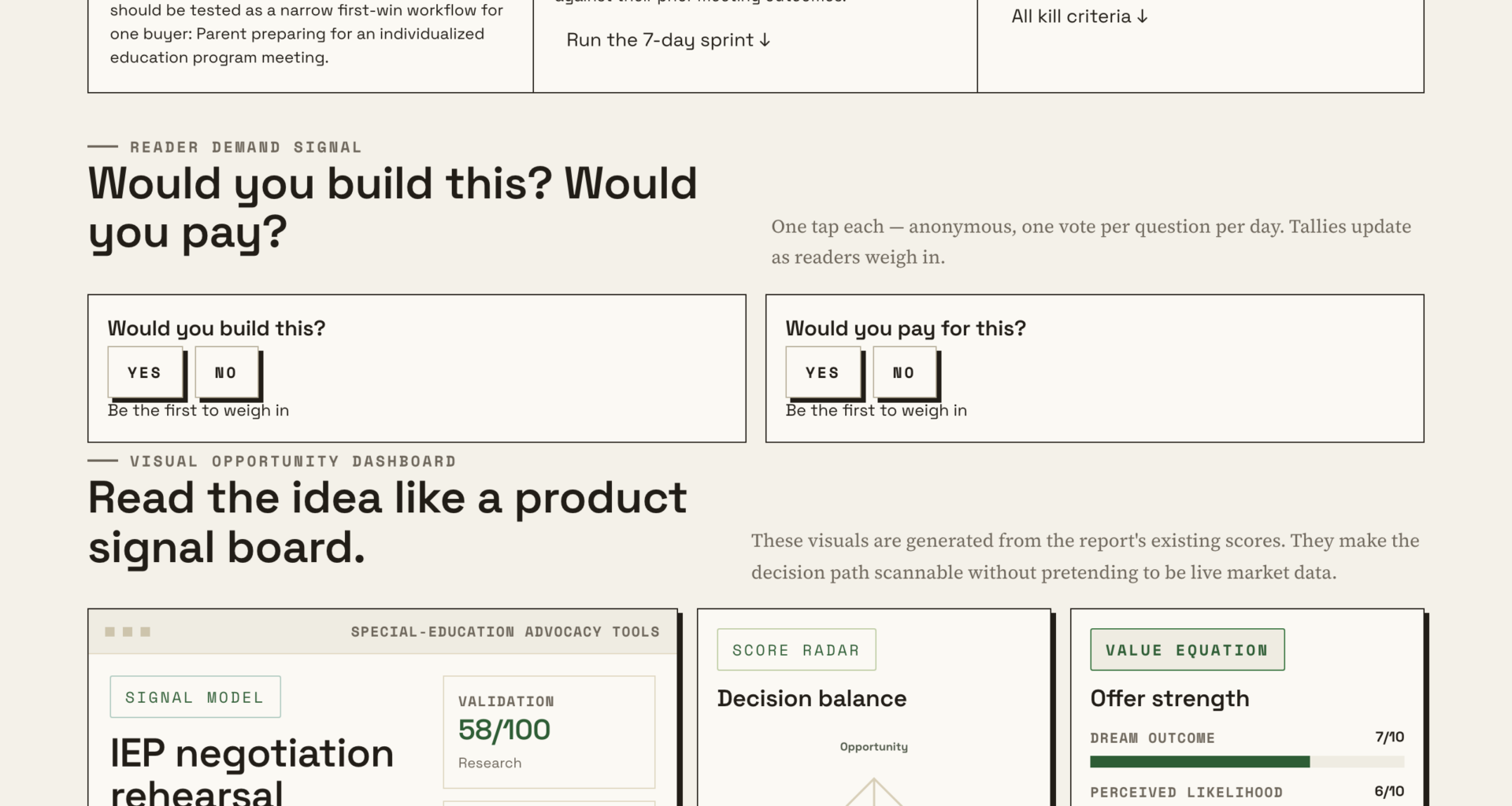

📊 Full opportunity report: What Makes An IEP Negotiation Simulator Useful For Parents? on IdeaNavigator AI — validation score, market gap, and execution plan.

Get the latest gadgets delivered free — and shop member deals
- Fast, free delivery on millions of items
- Access to Prime Big Deal Days deals on October 6–7
- Prime Video, Amazon Music and more included
TL;DR
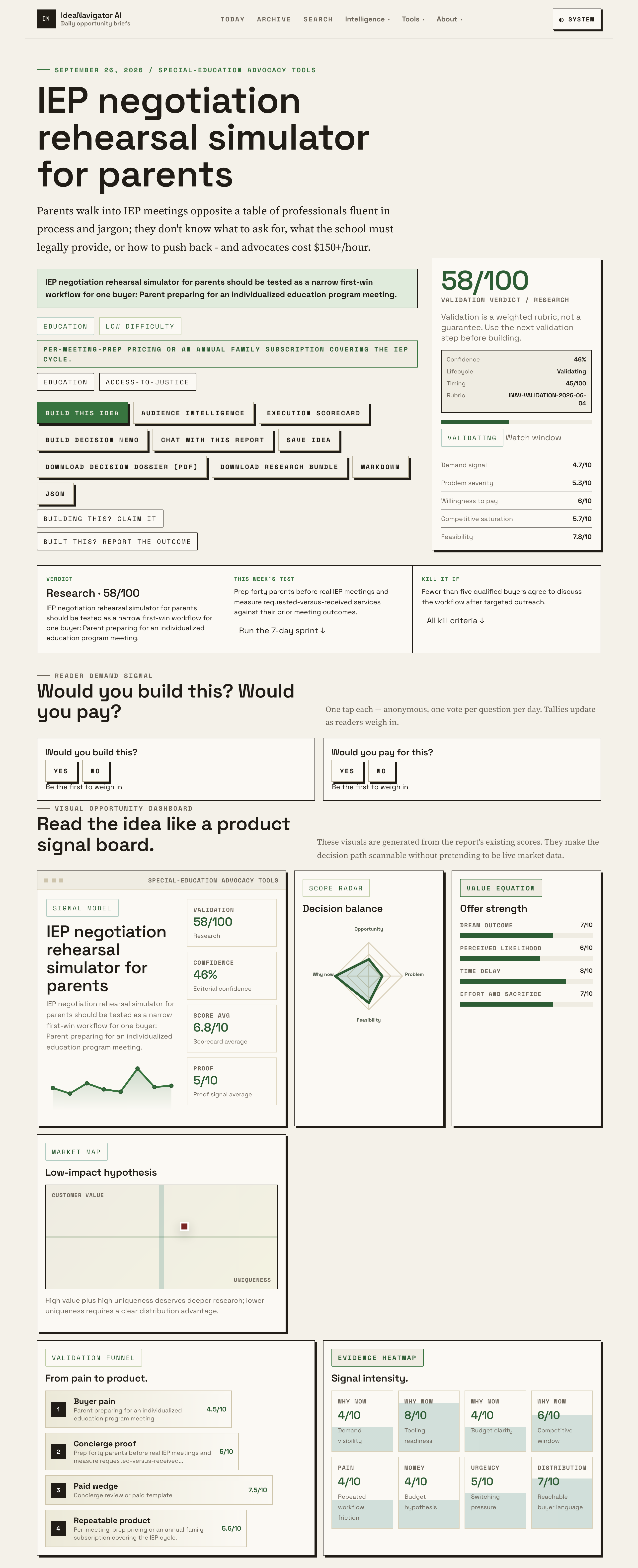
IdeaNavigator AI has proposed an early-stage IEP negotiation simulator to help parents review special education documents, prepare service requests and practice responding to school officials. The concept has not been shown to improve meeting outcomes; its proposed first test would involve 40 parents preparing for real IEP meetings.
IdeaNavigator AI has proposed an IEP negotiation rehearsal simulator for parents preparing for special education meetings, combining document review, plain-language explanations and role-play of likely school responses. The proposal describes a product concept and a plan to test it with 40 parents; it does not report that the tool has been built or that it improves services families receive.
The proposed tool would let a parent upload a child’s current individualized education program (IEP) and evaluation reports. It would then explain potential entitlements in plain language and generate a list of requests with legal grounding, according to the IdeaNavigator AI proposal. Parents could practice presenting those requests in a simulated meeting that includes realistic pushback.
The proposal frames the product around a specific user: a parent preparing for an IEP meeting. Its stated problem is that families may face school teams familiar with procedures and specialized terminology while being uncertain about what to ask for or how to challenge a response. It also cites advocacy services costing $150 or more per hour, but gives no geographic scope, pricing survey or other basis for that figure.
Possible payment models include a charge for each meeting preparation session or an annual family subscription covering an IEP cycle. To test the idea, the proposal suggests preparing 40 parents before actual meetings and comparing the services they request with what they receive, alongside their outcomes from previous meetings. No pilot results, product release, or independent evaluation are provided.
A Practice Tool for IEP Meetings
If developed, the simulator would be intended to help parents prepare for discussions about a child’s educational needs with a school team. Its proposed workflow includes reviewing documents, organizing questions and rehearsing responses. The proposal does not provide evidence that these activities improve communication or meeting outcomes.
The concept would use AI to interpret education records and explain legal rights. The proposal does not identify who would review that guidance or how its accuracy would be assessed. It also does not describe how the tool would account for differences in state and local rules. These questions would be relevant to evaluating the proposed system.
How the Proposed Workflow Works
An IEP is a plan for the special education and related services a student may need. Parents and school personnel discuss the student’s needs and proposed supports in a meeting. The simulator concept focuses on preparation for that conversation rather than replacing the school team or an advocate.
The proposal says recent progress in large language model role-play could make realistic meeting practice possible. It also points to rising special education identification rates and tighter district resources as reasons to explore the product. It supplies no figures, dates or independent evidence for those broader trends, so they remain part of the proposal’s rationale rather than verified findings in this account.
Accuracy and Outcomes Remain Untested
The proposal does not say whether a working simulator exists, who would build or review its legal guidance, or how it would account for differences in special education rules across jurisdictions. It also does not describe privacy protections for uploaded evaluations and IEPs, which can contain sensitive information about children.
There is no evidence yet that rehearsing with an AI system changes what services schools provide or improves a family’s experience. The suggested comparison with parents’ prior meetings could be affected by differences between students, schools and individual cases. The proposal does not specify how those differences would be accounted for.
A Forty-Parent Pilot Is Proposed
The next step described is a test with 40 parents preparing for real IEP meetings. The proposal does not provide a timetable, recruitment plan, measurement method or confirmation that the pilot will take place. If it proceeds, useful reporting would include how the tool checks legal explanations, protects uploaded records and compares requested services with outcomes across meetings.
Key Questions
Has the IEP simulator launched?
No launch is reported. IdeaNavigator AI describes a product proposal and a possible validation test, without confirming that the simulator is available.
What would the simulator do?
The proposed tool would review an uploaded IEP and evaluation reports, explain possible entitlements in plain language, help prepare service requests and let parents rehearse a meeting with simulated pushback.
Would it replace a special education advocate?
The proposal presents the simulator as a meeting-preparation tool. It does not establish that AI guidance could replace individualized advice from an advocate or qualified professional.
How would the idea be tested?
The proposed test would prepare 40 parents for real IEP meetings and compare requested and received services with their prior meeting outcomes. No results or detailed study methods are available.
Source: IdeaNavigator AI
Fall Picks
fall essentials
As an affiliate, we earn on qualifying purchases.