
📊 Full opportunity report: A Wealthtech-Informed Report Card For New Heirs on IdeaNavigator AI — validation score, market gap, and execution plan.

Get the latest gadgets delivered free — and shop member deals
- Fast, free delivery on millions of items
- Access to Prime Big Deal Days deals on October 6–7
- Prime Video, Amazon Music and more included
TL;DR
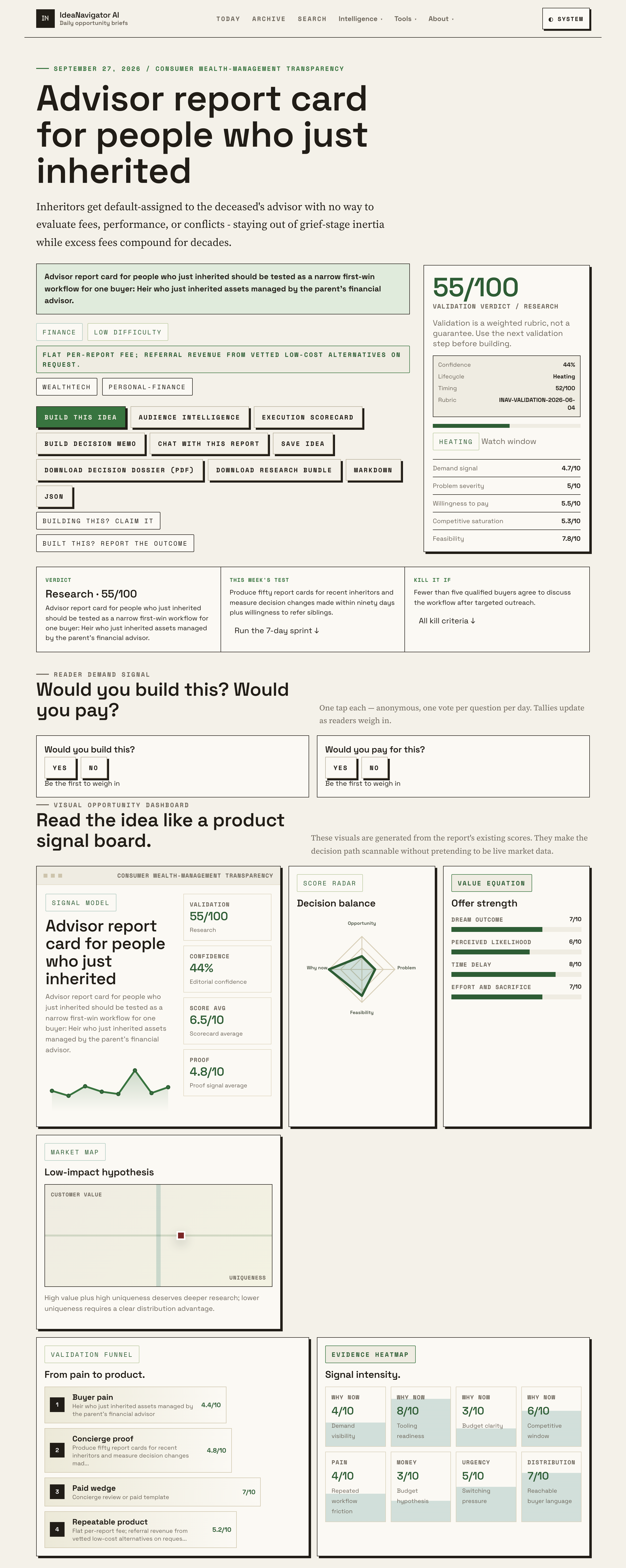
IdeaNavigator AI has outlined a proposed service that would help people who inherit assets review the financial adviser managing them. The concept would analyze statements and regulatory disclosures, but it has not been presented as a launched product or tested service.
IdeaNavigator AI’s proposal describes an adviser report card for people who inherit assets managed by a parent’s financial adviser. The proposed service would help users assess fees, performance and disclosed conflicts before deciding whether to stay. The outline presents a potential product and validation plan; it does not report a launch or tested recommendations.
In its published proposal, IdeaNavigator AI identifies the intended user as an heir who has recently inherited assets overseen by the deceased parent’s adviser. The company says inheritors may remain with that adviser by default, without a practical way to assess the relationship while managing bereavement and estate matters. It describes this as a risk of inertia that could leave people paying excess fees over time. The proposal provides no data measuring how often this occurs or how much heirs lose.
IdeaNavigator AI’s suggested minimum product would ask users to enter an adviser’s name and upload account statements. The proposal says the service would combine regulatory history and disclosed conflicts with fee information decoded from the statements, compare the adviser with alternatives, and offer stay, negotiate or switch guidance. It also mentions scripts for conversations with the adviser. The outline does not specify performance measures, how comparisons would account for differences in services or investments, or how incomplete documents would be handled.
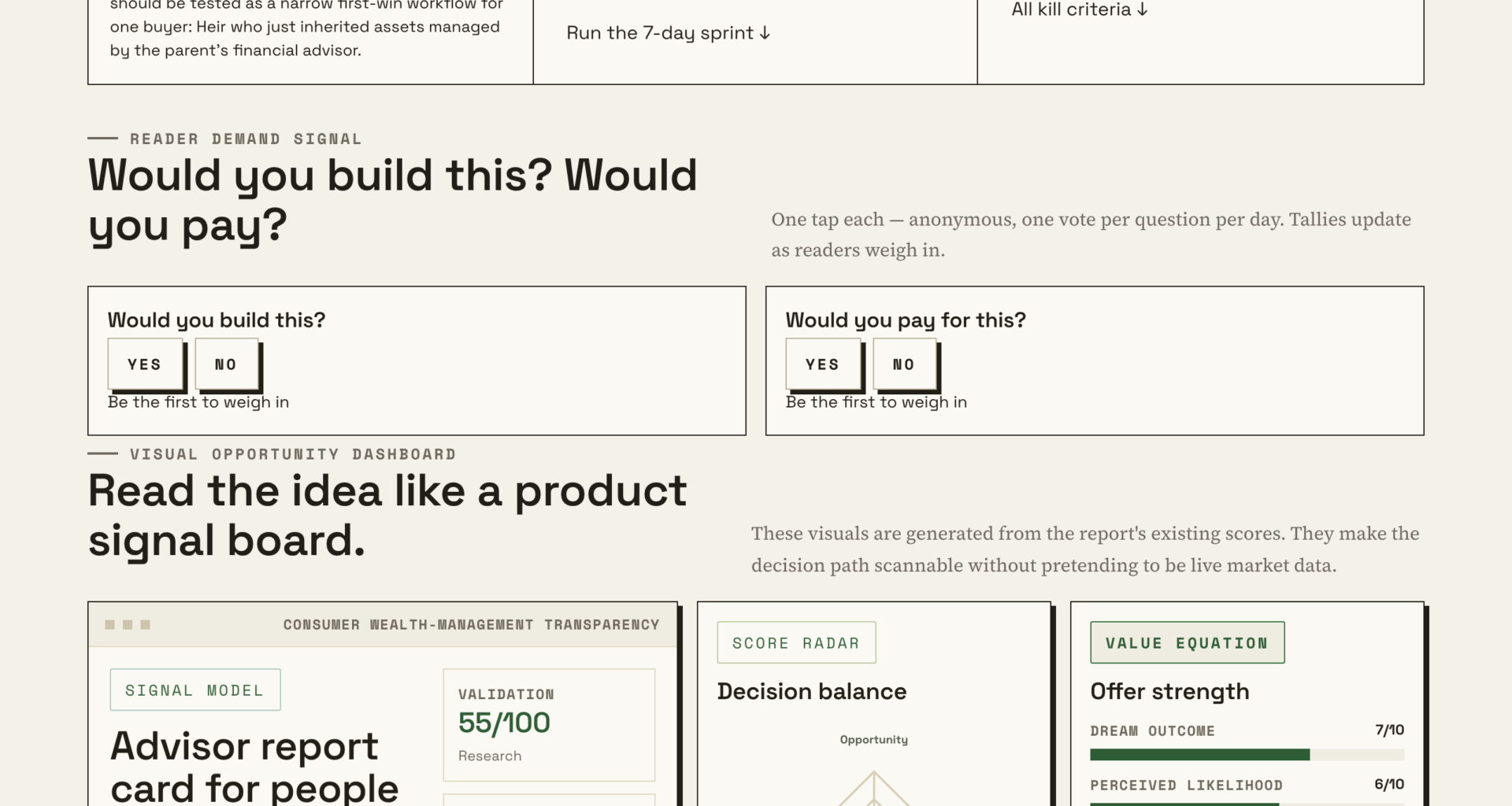
The proposal describes a business model combining a flat fee per report with referral revenue if users request introductions to vetted, lower-cost alternatives. IdeaNavigator AI suggests testing the concept by preparing 50 reports for recent inheritors, then tracking decision changes within 90 days and whether participants would refer siblings. The published outline reports no completed trial, participant findings, pricing, or referral partners.
A Check Before Heirs Stay
If built and validated, the proposed service could give new heirs a structured way to examine a financial relationship they may have inherited along with the assets. As IdeaNavigator AI’s outline suggests, an estimate of all-in fees could help a client ask focused questions or compare proposals, while a review of disclosed conflicts could identify issues to discuss. The proposal does not establish that automated analysis would catch every relevant fee or conflict.
IdeaNavigator AI’s proposal argues that substantial wealth is moving to heirs and that public filings, fee disclosures and language-model document parsing could make reviews easier to automate. These are the proposal’s rationale, not findings demonstrated in the published outline. The practical stakes for readers would depend on whether a report is accurate, understandable and useful enough to inform decisions without steering users toward a particular provider.
The referral element described in the proposal could create a financial incentive around recommendations. A service earning money when a user selects an alternative would need to make that relationship clear and explain how it chooses providers. IdeaNavigator AI says referrals would be optional and limited to vetted, lower-cost alternatives, but the outline gives no definition of vetting or details about how referral payments would affect rankings.
How the Proposed Review Works
IdeaNavigator AI’s concept addresses a specific point in a family’s finances: an heir receives assets managed by a parent’s adviser and must decide what to do with that existing arrangement. The proposal does not cover inheritance planning generally, tax advice, estate administration or a full financial plan. It describes an adviser review based on the adviser’s name and documents supplied by the user.
The proposal points to Form ADV and fee disclosures as sources of information about advisers and their practices, and suggests using language-model tools to parse statements. Such documents can show account charges and other costs, but the outline does not explain how the service would distinguish advisory fees from fund expenses, transaction costs or other charges, or verify extracted figures with the user.
IdeaNavigator AI’s proposed test focuses on recent inheritors rather than a broad consumer audience. Tracking decisions over 90 days could show whether participants acted after receiving a report, while sibling referrals could offer an initial signal of interest. Neither measure alone would establish that the guidance was correct or that a resulting change improved a household’s finances.
Product and Evidence Still Open
In the published outline, IdeaNavigator AI does not say whether development has begun, who would operate the service, or when a product might become available. It reports no results from the proposed 50-person validation exercise. The proposal also gives no information on the report’s price, data security arrangements for uploaded statements, or process for correcting errors.
Key methodological details remain open, including how alternatives would be selected, how performance would be benchmarked, and whether the analysis would account for an adviser’s service level and the heir’s circumstances. The outline does not describe oversight by a qualified human reviewer. Until these points and trial results are available, the proposed guidance should be understood as a product concept rather than a demonstrated way to reduce costs or improve outcomes.
A 50-Report Test Is Proposed
IdeaNavigator AI’s proposal sets out a next step: produce 50 report cards for recent inheritors, then measure whether participants change decisions within 90 days and whether they would recommend the service to siblings. The company has not reported that this test has started or set a timetable for it. Results could show whether users act on the reports; further evidence would be needed to assess accuracy, consumer outcomes and the effect of referral revenue.
Source: IdeaNavigator AI proposal
Key Questions
Has the adviser report card launched?
No launch is reported. IdeaNavigator AI has outlined a proposed service and a way to test it.
Who would use the proposed service?
IdeaNavigator AI describes it as intended for someone who has recently inherited assets managed by a parent’s financial adviser and wants to review that relationship.
What would a report include?
According to the proposal, a report would review regulatory history and disclosed conflicts, estimate fees from uploaded statements, compare alternatives and offer stay, negotiate or switch guidance.
How would the idea be tested?
IdeaNavigator AI’s proposal calls for 50 reports for recent inheritors, with decision changes tracked over 90 days and sibling referrals used as a signal of interest. The outline reports no trial results.
Source: IdeaNavigator AI
Fall Picks
fall essentials
As an affiliate, we earn on qualifying purchases.