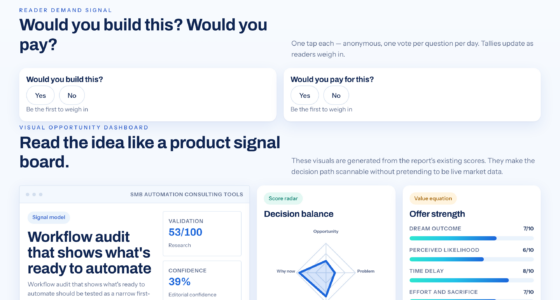
📊 Full opportunity report: A Tool To Help Consultants Identify Work Outside Project Scope on IdeaNavigator AI — validation score, market gap, and execution plan.

Get the latest gadgets delivered free with Prime
- Fast, free delivery on millions of items
- Prime Video, Amazon Music and more included
- Member-only deals all year
TL;DR

IdeaNavigator AI has outlined a proposed scope-creep detector for consultants who sell fixed-price packages. The tool would compare incoming client requests with contracted work, track accumulated out-of-scope effort and draft responses offering paid add-ons. Its proposed validation is a three-month test with 30 consultants; no test results or evidence of a launched product are provided.
IdeaNavigator AI has proposed a scope-creep detector for consultants who sell fixed-price packages, a tool intended to flag client requests that fall outside a project’s contracted work. The proposed software would compare incoming requests with the agreement, track extra effort and draft responses that offer paid add-ons; the proposal is not evidence that a product has launched or been tested.
The concept targets one buyer: a consultant delivering fixed-price packages. Its premise is that extra work can arrive in small, seemingly reasonable requests, such as another revision or a short call. In the proposal, those additions can accumulate without an obvious moment when the project has exceeded its agreed limits.
The suggested minimum viable product would connect to a consultant’s email and project-management tools. It would compare new requests with the contracted scope, estimate accumulated out-of-scope effort in real time and draft a tactful boundary-setting response. Those drafts could offer a paid addendum—an additional agreement for work not included in the original fee.
The proposed business model is a monthly subscription per consultant. To test whether the idea works, IdeaNavigator AI suggests running it for three months with 30 consultants, measuring revenue recovered through signed addenda and changes in effective hourly rates against each consultant’s baseline engagements. No pricing, integration partners, test participants or results are specified.
IDEANAVIGATOR AI · CONCEPT PROPOSAL
A Tool To Help Consultants Identify Work Outside Project Scope
A proposed scope-creep detector for consultants with fixed-price packages. It would compare client requests with contracted work, track extra effort and draft replies that offer paid add-ons.
From request to paid add-on
The proposed minimum viable product focuses on one recurring problem: small requests can accumulate while the fixed project fee stays the same.
Read the agreement
Connect to email and project-management tools, then use the contracted scope as the reference point.
Compare each request
Flag requests that may sit outside the agreed deliverables, such as another revision or a quick call.
Draft a tactful option
Estimate accumulated extra effort and prepare a response offering a paid addendum for additional work.
Small asks can shrink the effective rate
With a fixed fee, extra time does not automatically bring extra payment. The proposal argues that a series of modest requests can reduce a project’s effective hourly rate. It provides no measured data on how often this happens or how much income is lost.
Illustrative fee-to-time relationship
Concept illustration only. No measured values or loss estimates were supplied.
Make the boundary easier to discuss
The tool’s potential value depends on recognizing contract terms in varied documents and understanding informal client messages accurately.
Connect
Bring in project messages and agreement details.
Compare
Check a new request against contracted work.
Estimate
Track the added effort across the engagement.
Offer
Draft a response with a paid addendum option.
Measure recovery and rate changes
IdeaNavigator AI proposes a three-month evaluation. The proposal does not identify participants, a start date, a reporting schedule or completed results.
Track whether clients agree to pay for work identified as outside the original scope.
Compare rates on test engagements with each consultant’s baseline engagements.
Commercial value remains unverified
No product launch, working prototype or completed pilot is reported. Key details still need to be established before the concept’s day-to-day usefulness can be assessed.
How will it interpret varied contracts, vague requests and messages with unclear project context?
Will consultants review decisions before replies, and how will sensitive client information be handled?
Which integrations will it support? Subscription pricing, demand and pilot methods are unspecified.
The Cost of Untracked Extra Work
For a consultant paid a fixed fee, additional work can reduce the return on a project even when the client’s requests appear modest. The proposal describes the core commercial risk as a decline in the project’s effective hourly rate: the fee remains fixed while the time spent grows. It does not provide measured data establishing how often this happens or how much income consultants lose.
A tool that identifies extra requests early could give consultants a more consistent basis for discussing boundaries before a project becomes strained. Drafting a response with a paid option may make it easier to separate included work from additional work while keeping the client relationship professional. That benefit is a product hypothesis, not a demonstrated outcome.
The idea also matters because it proposes more than a reminder to track time. It depends on matching the request to the specific terms of an agreement and estimating the work’s accumulated impact. Whether software can interpret varied contracts and informal client messages accurately will shape whether it is useful in day-to-day consulting.
Products Worth Considering

Apple iPad Air 11-inch (M2), 512GB, Wi-Fi, Space Gray

Apple iPad Air (2025) 13‑inch Wi‑Fi 256 GB – Space Gray (M3 chip)

Logitech MX Mechanical Wireless Illuminated Keyboard, Tactile Quiet, Graphite
As an affiliate, we earn on qualifying purchases.
Fixed Fees Create Scope Risk
The proposal frames the opportunity around consultants who have moved from hourly billing to productized, fixed-price services. Under this model, a consultant sells a defined package for an agreed fee. That can make costs and deliverables clearer at the outset, but the fee also means extra work does not automatically generate extra payment.
The proposed problem is not a single major change request, but a series of smaller asks—such as another revision or a quick call—that can be difficult to distinguish from ordinary project communication. The concept argues that email and task-management integrations could make comparing requests with the contract more practical. That is the rationale offered for building the tool now; no market-size figures, adoption data or evidence of technical performance are supplied.
IdeaNavigator AI recommends starting with a narrow workflow for one buyer rather than building a broad consultant business platform. Its suggested test would examine two outcomes: whether clients sign paid addenda for out-of-scope work and whether consultants’ effective rates improve relative to their own baseline engagements. The proposal does not describe how baseline projects would be selected or how results would be independently checked.
Pilot, Accuracy and Pricing Unknowns
No product launch, working prototype or completed pilot is reported in the proposal. It is not clear whether development is underway, who would build or operate the tool, or when the suggested three-month test might begin.
The concept also leaves open how the detector would interpret different contract formats, vague requests and messages whose relationship to a project is not obvious. It does not state whether a consultant would review every scope decision before the tool responds, how it would handle sensitive client information, or which email and project tools it would support.
The proposed success measures—signed addenda and effective-rate changes—are not accompanied by a method for separating the software’s effect from other factors, such as project type or consultant experience. Subscription pricing and customer demand are also unspecified. Until those details and test results are available, the commercial value remains unverified.
A 30-Consultant Test Proposed
The next stated step is a three-month evaluation involving 30 consultants. The proposed test would track addenda signed for additional work and compare effective hourly rates with baseline engagements. No start date, recruitment plan or reporting schedule is given.
If the test proceeds, the results would help show whether the detector can identify out-of-scope requests accurately and whether its suggested paid options lead to recovered revenue without damaging client relationships. For now, the next milestone is not a confirmed launch but evidence that the workflow works in real consulting engagements.
Source: IdeaNavigator AI
Key Questions
What is the proposed scope-creep detector?
It is a proposed tool for fixed-price consultants that would compare incoming client requests with contracted project scope, track extra effort and draft responses offering paid add-ons.
Is the tool available now?
The proposal does not confirm a launch or a working product. It describes a possible minimum viable product and a suggested validation test.
How would the tool make money?
The proposed model is a monthly subscription per consultant. No subscription price or payment terms are provided.
How would the idea be tested?
IdeaNavigator AI proposes a three-month test with 30 consultants, measuring signed addenda and changes in effective rates against baseline engagements. No results or test start date are reported.
Source: IdeaNavigator AI