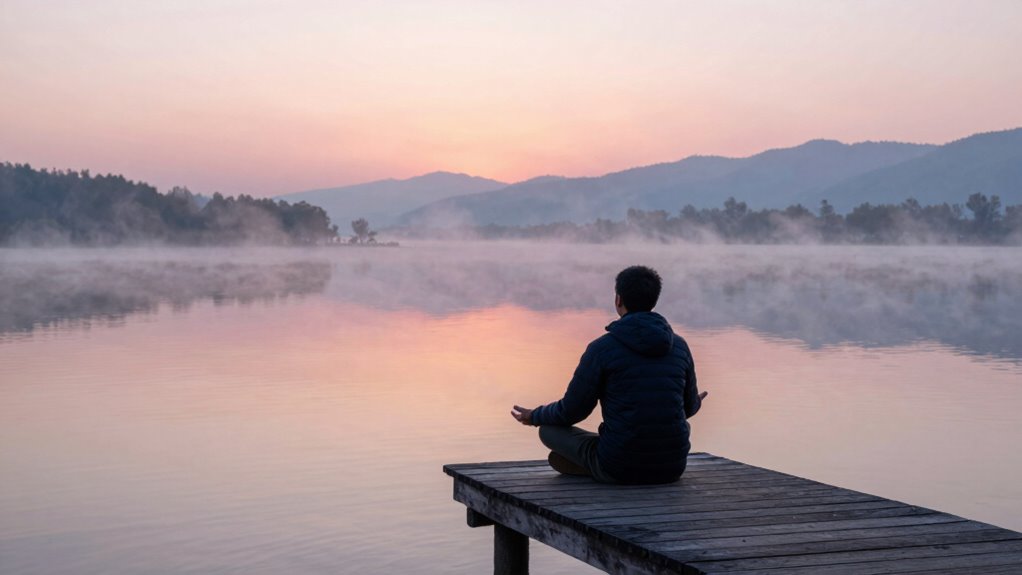

To sit with uncertainty without creating worst-case stories, focus on what’s within your control and assess real risks honestly. Practice staying present by shifting your attention to your breath or surroundings, which helps reduce anxiety. Use nature metaphors like water or trees to foster flexibility and acceptance. Remember, some risk is natural, and trusting your resilience helps you handle the unknown. If you keep exploring these strategies, you’ll discover ways to stay calm amid life’s unpredictability.
Key Takeaways
- Focus on what’s within your control and assess realistic risks to prevent catastrophizing.
- Practice mindfulness to stay present and reduce the tendency to create worst-case scenarios.
- Accept discomfort as temporary and trust your resilience to handle uncertainty.
- Use natural metaphors like water or trees to foster flexibility and acceptance of change.
- Reframe uncertainty as a natural part of life, emphasizing growth and adaptability over fear.

Have you ever felt overwhelmed by the unknown, unsure of what the future holds? It’s a common experience, especially when uncertainty feels like a looming storm. Instead of letting your mind spiral into worst-case scenarios, it helps to approach uncertainty with a mindful risk assessment. This isn’t about predicting every possible outcome but about examining what’s within your control and recognizing what’s not. When you take a moment to evaluate the actual risks involved, you avoid blowing situations out of proportion. Ask yourself: What’s the worst that can realistically happen? What’s most likely? And what can I do to prepare or adapt? This practical approach anchors you in reality, reducing the tendency to catastrophize. Incorporating strategies from risk management can further strengthen your ability to handle uncertainty effectively.
Assess what’s within your control, evaluate real risks, and stay grounded to navigate uncertainty calmly.
Building emotional resilience is also key. When you face uncertainty, your natural reaction might be anxiety or fear, but cultivating resilience allows you to stay grounded. It’s not about eliminating these feelings but learning to sit with them without judgment. Instead of fighting your emotional responses, acknowledge them and gently remind yourself that discomfort is temporary. Emotional resilience grows when you accept uncertainty as a part of life, not as an obstacle or a threat. It’s about trusting your ability to handle whatever comes, even if the outcome isn’t what you hoped for. The more you practice this mindset, the less likely you are to create a worst-case story that spirals out of control. Recognizing the natural risk involved can help you maintain perspective and reduce unnecessary worry. Exploring natural pools and other outdoor elements can also serve as metaphors for navigating uncertainty, reminding you of the importance of blending harmony with adaptability. Additionally, understanding the contrast ratio in your environment can influence how you perceive and cope with the emotional contrasts of uncertainty.
Another helpful step is to stay present. When you focus on what’s happening right now, you prevent your mind from racing ahead into imagined futures. Instead of worrying about things that might never happen, bring your attention back to your breath, your surroundings, or your current task. This mental shift creates space for clarity and calmness. It also reinforces your capacity for resilience, reminding you that you can manage your reactions and adapt as needed.
Ultimately, sitting with uncertainty without creating a worst-case story comes down to perspective. Recognize that some level of risk is natural, and your ability to assess risks effectively can empower you rather than paralyze you. Trust in your resilience, stay grounded in the present, and remind yourself that uncertainty isn’t an enemy but a part of life’s unfolding journey. With practice, you’ll find yourself more comfortable sitting with the unknown, facing it with curiosity instead of fear.

Retrospec Sedona Meditation Cushion, Buckwheat Pillow, Meditation Pillow
- Natural Buckwheat Filling: Supports spine and hips during meditation
- Customizable Firmness: Unzip to add or remove hulls
- Eco-Friendly Cotton Cover: Machine washable and microplastic-free
As an affiliate, we earn on qualifying purchases.
As an affiliate, we earn on qualifying purchases.
Frequently Asked Questions
How Long Does It Take to Become Comfortable With Uncertainty?
It varies, but with consistent acceptance strategies and mindfulness practices, you can start feeling more comfortable with uncertainty in a few weeks. As you practice observing your thoughts without judgment and accepting what you can’t control, your anxiety diminishes. Over time, these techniques help you build resilience, making uncertainty feel less threatening. Keep practicing daily, and you’ll notice a gradual shift toward greater ease and acceptance in uncertain situations.
Can I Completely Eliminate Negative Thoughts About Uncertain Situations?
You can’t completely eliminate negative thought patterns about uncertainty, but with consistent mindfulness practices, you can tame them like a wild beast. Think of your mind as a garden—negative thoughts are weeds, and mindfulness is your gentle gardener, pulling them out and making space for peace. While perfection isn’t possible, each practice helps you handle negative thoughts better, turning chaos into calm with steady, deliberate effort.
What Are Quick Techniques to Calm Anxiety During Uncertain Times?
When anxiety strikes during uncertain times, try deep breathing exercises—inhale slowly for four seconds, hold, then exhale. Pair this with mindfulness meditation by focusing on your breath or sensations, anchoring you in the present. These quick techniques help calm your nervous system, reduce racing thoughts, and bring clarity. Practice regularly, so they become automatic tools to manage anxiety whenever uncertainty arises.
How Does Uncertainty Affect Long-Term Decision-Making?
Imagine a maze with shifting walls—that’s how uncertainty influences your long-term decisions. You tend to overanalyze, risking poor choices. Using risk assessment helps you weigh options objectively, while emotional regulation keeps anxiety in check. When you stay calm and evaluate each move carefully, you’re better equipped to navigate uncertainty. This balanced approach leads to more thoughtful, resilient decisions, even when the path ahead feels unpredictable.
Is It Possible to Develop a Resilient Mindset Towards All Uncertainties?
Yes, you can develop a resilient mindset towards uncertainties by embracing a mindset shift that focuses on adaptability and growth. Cultivating emotional resilience helps you manage stress and stay grounded when facing unpredictable situations. You learn to accept what you can’t control, which reduces anxiety and fear. With consistent practice, this resilient mindset becomes second nature, empowering you to navigate all uncertainties with confidence and calmness, rather than fear.

Let's Beat the Odds: A Guided Journal & Workbook for Overcoming Adversity and Building Resilience
As an affiliate, we earn on qualifying purchases.
As an affiliate, we earn on qualifying purchases.
Conclusion
Sitting with uncertainty can feel like waiting in a storm, anxious and unsure of the calm that awaits. But remember, just as storms pass, so do worries—leaving space for growth and unexpected beauty. Embrace the unknown like a blank canvas, not a looming shadow. When you stop fighting the uncertainty, it no longer controls you. Instead, you become the quiet observer, finding peace in the unpredictable, and discovering that sometimes, the best stories are written in the moments of not knowing.

As an affiliate, we earn on qualifying purchases.

Stress Relief Breathing Tool – vidaBALL® Handheld Guided Breathing Device for Calm, Anxiety Relief, Desk Stress & Sleep – No App Required
- Calms nervous system with guided rhythm: Handheld stress relief device with light and vibration
- Perfect for busy professionals and students: Quick, easy breathing reset anytime
- Portable for home, office, or travel: All-in-one breathing tool included
As an affiliate, we earn on qualifying purchases.
As an affiliate, we earn on qualifying purchases.