
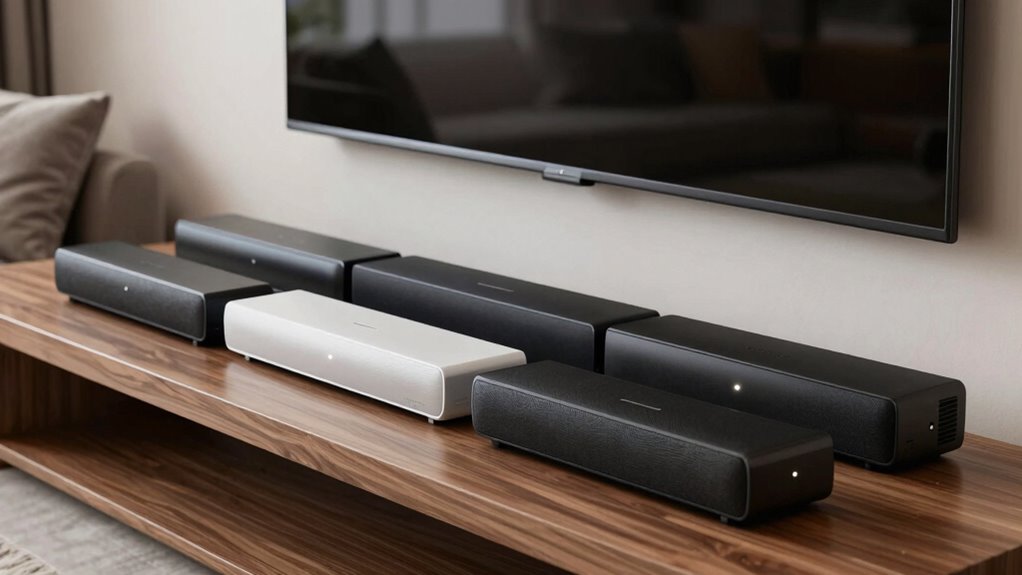

A soundbar worth a splurge should do more than make a TV louder: it should solve a real listening problem, whether that means surround effects, clearer dialogue, or fuller bass. I’d start with the Sonos Arc Ultra for a refined, single-bar spatial-audio setup, the JBL Bar 500MK2 for substantial bass and streaming flexibility, or the TCL S65K if a package with separate surround speakers matters most.

Get the latest gadgets delivered free with Prime
- Fast, free delivery on millions of items
- Prime Video, Amazon Music and more included
- Member-only deals all year
Those strengths come with different compromises. The Sonos keeps the main setup streamlined but leans on Wi-Fi for many features; JBL delivers a large wireless subwoofer but takes more floor space; TCL adds wireless rear speakers, which means more components to place and power. The ULTIMEA Poseidon M60 offers app-based sound shaping and voice enhancement, while the Bose TV Speaker is a compact clarity-first choice rather than a full home-theater system. I rank these by how convincingly each earns its place for a distinct kind of buyer—not by treating more channels as automatically better.
Complete the kit



Key Takeaways
- The Sonos Arc Ultra is the strongest fit when a single soundbar, spatial audio, and multi-room streaming matter more than separate rear speakers.
- The JBL Bar 500MK2 pairs a 10-inch wireless subwoofer with a wide soundstage, making it the bass-led choice for movies, games, and music.
- The TCL S65K includes wireless surround speakers and room calibration, but its extra components demand more setup space than the Sonos.
- The ULTIMEA Poseidon M60 stands out for VoiceMX dialogue enhancement and extensive app equalization, though its subwoofer is wired.
- The Bose TV Speaker prioritizes compact size and clearer speech; it is not a substitute for the four 5.1-channel systems when surround sound is the goal.
| Sonos Arc Ultra Soundbar with Dolby Atmos – Black |  | Best Overall for Spatial Audio and a Streamlined Setup | Channels: 9.1.4 | Audio format: Dolby Atmos | Connectivity: HDMI, Wi-Fi, Bluetooth | VIEW ON AMAZON | See Our Full Breakdown |
| JBL Bar 500MK2 5.1 Channel Soundbar System with Dolby Atmos, MultiBeam 3.0 and PureVoice 2.0 |  | Best for Big Bass and a Wide Soundstage | Channels: 5.1 | Maximum output: 750 watts | Subwoofer: 10-inch wireless | VIEW ON AMAZON | See Our Full Breakdown |
| TCL S65K S Series 5.1 Channel Soundbar System with Dolby Atmos, DTS:X, Wireless Subwoofer and Wireless Surround Speakers |  | Best Bundled Surround Package | Channels: 5.1 | Audio formats: Dolby Atmos and DTS:X | Maximum output: 630 watts | VIEW ON AMAZON | See Our Full Breakdown |
| ULTIMEA 5.1CH Surround Sound Bar System with Dolby Atmos, Poseidon M60 |  | Best for Dialogue Tuning and App Equalization | Channels: 5.1 | Maximum output: 300 watts | Audio format: Dolby Atmos | VIEW ON AMAZON | See Our Full Breakdown |
| Bose TV Speaker – Compact Soundbar with Bluetooth and HDMI-ARC |  | Best Compact Pick for Clear TV Dialogue | Audio output: Stereo | Dimensions: 2.21 × 23.38 × 4.02 inches | Weight: Listed as 0.07 lb; confirm current product details | VIEW ON AMAZON | See Our Full Breakdown |
| soundbars worth the splurge | Channels | Audio format | Maximum output | Subwoofer |
|---|---|---|---|---|
| Sonos Arc Ultra Soundbar with | 9.1.4 | Dolby Atmos | — | — |
| JBL Bar 500MK2 5.1 Channel Sou | 5.1 | Dolby Atmos | 750 watts | 10-inch wireless |
| TCL S65K S Series 5.1 Channel | 5.1 | — | 630 watts | Wireless, 6.5-inch |
| ULTIMEA 5.1CH Surround Sound B | 5.1 | Dolby Atmos | 300 watts | Wired wooden enclosure, 18 mm high-excursion driver |
| Bose TV Speaker | — | — | — | — |
More Details on Our Top Picks
Sonos Arc Ultra Soundbar with Dolby Atmos – Black
The Sonos Arc Ultra takes the top spot for buyers who want a premium, room-filling presentation without building a system from several separate speakers. Its stated 9.1.4 spatial-audio layout and Dolby Atmos support put it ahead of the Bose on immersion, while the single HDMI eARC connection keeps the TV hookup simpler than the component-heavy TCL package. Built-in microphones, app control, voice options, and multi-room audio also make this the most connected standalone bar in the group.
Its clearest advantage is integration: I’d choose it when the soundbar needs to be both a home-theater centerpiece and part of a broader music setup. Dialogue enhancement is a useful counterpoint to cinematic effects, since action-heavy sound should not come at the cost of understanding speech. Compared with JBL, the Arc Ultra does not arrive with a separate 10-inch subwoofer; buyers who want a visibly dedicated bass component may prefer the Bar 500MK2. The supplied details also do not list included rear speakers, so its channel figure should not be mistaken for a conventional package with rear units around the room.
The tradeoff is a feature set that makes more sense for people already comfortable with app-based and Wi-Fi-connected audio. The full experience depends on a compatible TV and Wi-Fi, and buyers who only want a simple dialogue lift may be paying attention to capabilities they will not use. It is a polished all-in-one premium pick, not the most flexible choice for someone who specifically wants separate rear speakers or a bundled subwoofer.
Pros:- Stated 9.1.4 spatial audio with Dolby Atmos
- Single HDMI eARC connection simplifies TV hookup
- Dialogue enhancement and built-in voice-control options
- Supports multi-room audio and Wi-Fi streaming
Cons:- Full set of features depends on compatible TV and Wi-Fi
- No separate subwoofer or rear speakers are listed in the supplied package details
- May be excessive for buyers focused only on clearer TV speech
Best for: People seeking one premium soundbar for Dolby Atmos, clear dialogue, multi-room audio, and voice or app control.
Not ideal for: Buyers who want included separate rear speakers or a dedicated subwoofer, or who prefer a setup that does not rely on Wi-Fi features.
- Channels:9.1.4
- Audio format:Dolby Atmos
- Connectivity:HDMI, Wi-Fi, Bluetooth
- Control:App and voice
- Audio features:Sound Motion technology and speech enhancement
- Multi-room audio:Supported
- Color:Black
Our verdict“I’d choose the Arc Ultra for the broadest premium soundbar experience, provided its connected features matter more than a bundled subwoofer or separate rear speakers.”
JBL Bar 500MK2 5.1 Channel Soundbar System with Dolby Atmos, MultiBeam 3.0 and PureVoice 2.0
The JBL Bar 500MK2 is the bass-first alternative to the Sonos Arc Ultra. Its included 10-inch wireless subwoofer gives buyers a dedicated route to weightier low-end sound, and the system lists 750 watts of maximum output. For action films, games, or music where impact matters, that package is more clearly focused on physical bass than the Arc Ultra’s standalone-bar approach. MultiBeam 3.0 is intended to spread sound across the room, while Dolby Atmos adds height-oriented effects.
JBL also makes a strong case for mixed use. PureVoice 2.0 adjusts dialogue against the surrounding soundtrack, and easy sound calibration is designed to account for room reflections. The JBL One app offers equalizer control, while AirPlay, Google Cast, Spotify Connect, Tidal Connect, and Roon Ready give it a broader stated streaming menu than the TCL or ULTIMEA descriptions. Compared with TCL, JBL has the larger subwoofer but does not list wireless rear surround speakers as part of this package; buyers should not choose it expecting the same separate-speaker arrangement.
The wireless subwoofer avoids a signal cable to the bar, but it still needs a suitable location and power. That can be awkward in a small room or a setup where bass needs to stay restrained. JBL’s feature list is also more involved than Bose’s simple optical-or-HDMI connection. I rank it just below Sonos because it makes a particularly strong case for bass and streaming, but its overall system fit depends more on room space and whether that subwoofer-led sound is what the buyer wants.
Pros:- Wireless 10-inch subwoofer is included
- Dolby Atmos and MultiBeam 3.0 aim for an enveloping presentation
- PureVoice 2.0 adjusts dialogue audibility
- App EQ, sound calibration, and several music-streaming options
Cons:- Large subwoofer needs space and a power outlet
- Separate rear surround speakers are not listed in the package details
- More setup and feature controls than a compact, clarity-focused bar
Best for: Movie and game watchers who want a substantial wireless subwoofer, room calibration, streaming choices, and dialogue adjustment.
Not ideal for: People short on floor space, seeking separate wireless rear speakers, or wanting the simplest possible stereo TV upgrade.
- Channels:5.1
- Maximum output:750 watts
- Subwoofer:10-inch wireless
- Audio format:Dolby Atmos
- Sound technologies:MultiBeam 3.0 and PureVoice 2.0
- TV connection:HDMI eARC
- Streaming:AirPlay, Google Cast, Spotify Connect, Tidal Connect, Roon Ready
- Room tuning:Easy sound calibration
Our verdict“I’d pick the JBL over the Sonos when a bundled large subwoofer and broad music-streaming support matter more than a streamlined standalone-bar setup.”
TCL S65K S Series 5.1 Channel Soundbar System with Dolby Atmos, DTS:X, Wireless Subwoofer and Wireless Surround Speakers
The TCL S65K earns its place by making separate surround speakers part of the package. Its 5.1-channel system includes a wireless subwoofer and wireless surround speakers, so it is the clearest choice here for someone who wants speakers positioned behind or beside the listening area rather than relying on sound beams alone. Dolby Atmos and DTS:X support broaden format compatibility, and AI Sonic Auto Room Calibration is intended to tune the presentation for the room.
That configuration makes it a more literal surround-system choice than the Sonos Arc Ultra, whose supplied details describe an all-in-one bar rather than included rear units. It differs from the JBL as well: JBL has a larger 10-inch subwoofer and more listed streaming services, while TCL offers the more explicit rear-speaker package. The listed 630-watt maximum output is a system figure, not a guarantee of a particular listening result; buyers should focus more on the layout and included components than on comparing wattage alone.
Extra speakers bring extra placement and setup decisions. Even with wireless links, each component needs a sensible position and access to power, so this is not as tidy as a single bar. The supplied description also gives less detail about streaming and app controls than JBL or Sonos. I’d choose TCL for the included surround hardware and flexible placement, but skip it if a clean, minimalist TV stand is a higher priority than discrete surround speakers.
Pros:- Wireless surround speakers and subwoofer are included
- Supports Dolby Atmos and DTS:X
- AI Sonic Auto Room Calibration is designed to tune sound to the room
- HDMI eARC and Bluetooth connectivity
Cons:- Multiple components require placement and setup
- The supplied details provide limited information about app controls and music streaming
- More difficult to fit into a minimalist room than the Sonos or Bose
Best for: Buyers who want a complete 5.1-style arrangement with wireless surround speakers, a subwoofer, and room calibration.
Not ideal for: People who want one compact bar, have no practical place for surround speakers, or prioritize clearly specified app and streaming features.
- Channels:5.1
- Audio formats:Dolby Atmos and DTS:X
- Maximum output:630 watts
- Subwoofer:Wireless, 6.5-inch
- Surround speakers:Wireless
- Room tuning:AI Sonic Auto Room Calibration
- TV connection:HDMI eARC
- Other connectivity:Bluetooth, USB, Wi-Fi
Our verdict“I’d choose the TCL when included wireless surround speakers matter more than a compact footprint or a broad, clearly documented streaming ecosystem.”
ULTIMEA 5.1CH Surround Sound Bar System with Dolby Atmos, Poseidon M60
The ULTIMEA Poseidon M60 is the most adjustment-friendly pick in this group. It pairs a stated 5.1-channel Dolby Atmos system with VoiceMX voice clarity and app control that includes a 10-band equalizer and 121 presets. That is a distinct selling point for viewers who want to shape sound for different content or compensate for speech that gets lost in a busy soundtrack. Compared with the TCL, ULTIMEA offers much more specific information about app-based tuning; compared with Bose, it aims at a more immersive multichannel setup.
The listed system output is 300 watts, with a frequency response of 45 Hz–18 kHz, and the subwoofer uses a wired connection. Its HDMI eARC and Bluetooth 5.4 support cover common TV and wireless-audio needs. The product description calls setup quick, but I would not treat that as a reason to ignore placement: the wired wooden subwoofer still needs a practical position and a cable route. That makes JBL’s wireless subwoofer easier to place, while TCL’s included wireless surround speakers may appeal more to buyers focused on room-around-you effects.
One limitation is that the listing does not mention built-in streaming services, and the surround-speaker arrangement is not described as expansively as TCL’s package. Its strength is control rather than a clearly specified streaming ecosystem or especially simple component placement. I’d shortlist it when dialogue tuning and equalizer presets are likely to be used regularly, but choose JBL for the wireless bass module or Sonos for broader multi-room features.
Pros:- VoiceMX technology is designed to improve speech clarity
- App offers a 10-band EQ and 121 presets
- Dolby Atmos and 5.1-channel configuration
- HDMI eARC and Bluetooth 5.4 connectivity
Cons:- Subwoofer uses a wired connection
- Built-in streaming services are not listed
- Rear-speaker details are less explicit than on the TCL package
Best for: Viewers who want app-based sound shaping and dialogue enhancement in a multichannel Dolby Atmos system.
Not ideal for: People who need a wireless subwoofer, want named built-in streaming services, or prefer minimal adjustment and cables.
- Channels:5.1
- Maximum output:300 watts
- Audio format:Dolby Atmos
- Frequency response:45 Hz–18 kHz
- Voice technology:VoiceMX
- App controls:10-band EQ and 121 presets
- Subwoofer:Wired wooden enclosure, 18 mm high-excursion driver
- Connectivity:HDMI eARC and Bluetooth 5.4
Our verdict“I’d choose the Poseidon M60 for its specific dialogue and EQ controls, but not if wireless subwoofer placement or a defined streaming ecosystem is a priority.”
Bose TV Speaker – Compact Soundbar with Bluetooth and HDMI-ARC
The Bose TV Speaker is the outlier because its aim is not to recreate a full theater system. It is a compact, all-in-one stereo soundbar focused on clearer dialogue and natural-sounding TV audio. At 23.38 inches wide and 2.21 inches tall, it is easier to fit below many screens than the JBL’s separate subwoofer package or TCL’s collection of surround components. HDMI-ARC or optical connection keeps the TV hookup straightforward, and Bluetooth adds a simple way to play music or podcasts.
Its dialogue and bass boost modes offer direct adjustments from the included remote. That makes Bose a more approachable speech-focused option than the ULTIMEA, whose appeal rests on app EQ and presets, and much less involved than Sonos or JBL. The simplicity is the point: for a smaller room, a bedroom TV, or a setup where speech is the main frustration, a compact stereo bar can be a better match than buying into features that will not be used.
The tradeoff is substantial if immersion is the goal. Bose is listed as stereo, with no Dolby Atmos, DTS:X, or bundled subwoofer, while TCL, JBL, and ULTIMEA are multichannel systems. It also lacks Wi-Fi, so it does not offer the broader streaming and multi-room options of Sonos or JBL. I rank it fifth because it is the least capable home-theater package, not because every buyer needs one. Choose it for small-footprint clarity; skip it for rear-channel effects or deep standalone bass.
Pros:- Compact 23.38-inch-wide design
- Dialogue and bass boost modes on the remote
- Connects by HDMI-ARC or optical
- Bluetooth supports wireless music and podcast playback
Cons:- Stereo-only design without listed Dolby Atmos or DTS:X
- No included subwoofer; compatible subwoofer and wall bracket are separate
- No Wi-Fi streaming features and may feel limited in a large room
Best for: People with a smaller TV space who mainly want clearer speech, simple connections, Bluetooth playback, and a compact enclosure.
Not ideal for: Movie fans seeking Dolby Atmos, true multichannel surround, included subwoofer bass, or Wi-Fi streaming features.
- Audio output:Stereo
- Dimensions:2.21 × 23.38 × 4.02 inches
- Weight:Listed as 0.07 lb; confirm current product details
- TV connections:HDMI-ARC and optical
- Wireless audio:Bluetooth
- Sound controls:Dialogue and bass boost modes
- Control:Remote
- Enclosure:Plastic
Our verdict“I’d pick the Bose for compact dialogue improvement, but it is the wrong choice if the splurge is meant to deliver surround effects or substantial bass.”

How We Picked
I compared these five models by asking what a buyer is actually paying for beyond basic TV sound. Immersion, dialogue, bass, setup demands, and connectivity shaped the ranking. A costly or feature-rich soundbar is only a worthwhile splurge when its strengths match the room and the way someone watches.
That is why the list does not simply reward the highest channel count or stated power figure. I gave weight to meaningful differences: the Arc Ultra’s 9.1.4 spatial-audio design and multi-room ecosystem; JBL’s large wireless subwoofer, calibration, and streaming options; and the TCL’s included wireless surround speakers. I also considered whether control and setup features help users tailor sound without adding avoidable hassle.
The lower-ranked picks serve narrower needs rather than being poor options. ULTIMEA’s app EQ and voice enhancement can suit someone who wants more control, but the wired subwoofer limits placement flexibility. Bose is last because its compact stereo design does not deliver the surround package offered by the other four. That does not make it a bad purchase: it can be the smarter fit for a smaller room where speech clarity and easy setup matter more than cinematic effects.
I used the supplied product descriptions and specifications, not personal listening tests. Some listing details are incomplete, so I avoid making claims that depend on undocumented performance. My order reflects the breadth of each model’s stated strengths and the tradeoffs buyers should weigh before choosing.
Factors to Consider When Choosing Soundbars Worth The Splurge
I’d start with the problem the soundbar needs to solve, then choose the system layout and features that answer it. A larger specification sheet does not automatically make a better match.Choose between a single bar and separate speakers
A standalone bar such as the Sonos Arc Ultra keeps the room visually simple and connects to the TV with one HDMI eARC cable. Its stated spatial-audio format is ambitious, but it is not the same package as a soundbar bundled with separately placed rear speakers. The TCL S65K explicitly includes wireless surround speakers, which may better suit buyers who want sound sources around the seating area. In exchange, those pieces need space and power. JBL’s package centers on its wireless subwoofer, while the supplied details do not list separate rear speakers.
Match the soundbar to your listening priority
If you want a deeper bass foundation for explosions, games, and music, the JBL Bar 500MK2 is the clearest match because it includes a 10-inch wireless subwoofer. If dialogue gets buried, compare its PureVoice 2.0 with the ULTIMEA’s VoiceMX controls and Bose’s direct dialogue mode. For more involved sound shaping, ULTIMEA’s 10-band EQ and preset library offer a level of adjustment that the Bose does not. Pick Bose only when compact speech improvement matters more than surround sound and dedicated bass.
Check connections and streaming needs
HDMI eARC is the most useful connection to check when you want a modern TV-to-soundbar link, especially for formats such as Dolby Atmos. It appears in the supplied details for TCL, ULTIMEA, and JBL; Sonos uses a single HDMI eARC connection, while Bose offers HDMI-ARC or optical. For listening to music through online services, JBL lists a particularly broad set of streaming options, and Sonos supports Wi-Fi and multi-room audio. ULTIMEA and Bose list Bluetooth, but their descriptions do not specify the same built-in streaming breadth.
Treat room calibration and app control as useful tools, not requirements
Calibration features can help adapt a soundbar to a room where walls, furniture, and seating affect sound. TCL’s AI Sonic Auto Room Calibration and JBL’s easy sound calibration are relevant if your space is not a simple open layout. App control has different value depending on how much tuning you expect to do: ULTIMEA offers the clearest EQ detail, JBL adds app-based equalization and setup, and Sonos ties app use to its broader connected-audio system. Bose is the simpler option if remote buttons and a small set of sound modes suit you.
Measure the room and plan component placement
Measure the space below your TV and check where a subwoofer could sit before choosing a package. Bose is only 23.38 inches wide, while the Arc Ultra is listed at 46.18 inches. Separate surround units make the TCL package more demanding to place, and the JBL’s 10-inch wireless subwoofer still needs floor space and power. ULTIMEA’s wired subwoofer adds a cable-routing task. A wireless connection removes a signal cable, not every setup constraint.
Buy for the experience you will actually use
For a feature-rich premium centerpiece, I’d compare Sonos with JBL: Sonos leans toward spatial audio and multi-room use, while JBL puts more emphasis on a separate bass module and several music-streaming services. TCL is the better fit when bundled wireless surround speakers are the deciding factor. ULTIMEA is aimed at hands-on dialogue and EQ adjustments. If your main complaint is thin, hard-to-understand TV speech in a small space, the Bose TV Speaker’s simpler stereo approach may be more sensible than paying for an elaborate surround setup.
Frequently Asked Questions
Which soundbar in this roundup is best for a premium all-in-one setup?
I’d choose the Sonos Arc Ultra if the priority is a refined standalone bar with stated 9.1.4 spatial audio, Dolby Atmos, dialogue enhancement, and multi-room features. Its single HDMI eARC connection keeps the TV hookup straightforward. Buyers who specifically want included rear speakers or a separate subwoofer should compare the TCL or JBL package instead, since the supplied Arc Ultra details do not list those components.
Which pick is strongest for bass?
The JBL Bar 500MK2 is the clearest bass-focused option here because its system includes a 10-inch wireless subwoofer. That makes it a better starting point than the compact Bose or the standalone Sonos bar for buyers who want a dedicated bass component. The subwoofer needs floor space and power, though, so the package may not suit a small room or a setup where low-frequency sound should stay restrained.
Are wireless surround speakers included with every 5.1 model here?
No. The TCL S65K description specifically lists wireless surround speakers and a wireless subwoofer. JBL’s listed package centers on its wireless subwoofer, and ULTIMEA’s details identify a wired subwoofer without describing an equivalent rear-speaker bundle. Check the included components for the exact model before buying; a 5.1 label alone does not tell you how speakers are supplied or arranged.
Which soundbar is the easiest fit for a small room?
The Bose TV Speaker is the most compact option in this lineup, measuring 23.38 inches wide and focusing on stereo sound and dialogue clarity. It avoids the separate speaker placement required by TCL and the subwoofer footprint of JBL. That compact design also limits immersion: buyers seeking Dolby Atmos, rear surround effects, or a bundled subwoofer should accept a larger setup and look at the other models.
Should I choose ULTIMEA for its dialogue and EQ features?
Choose the ULTIMEA Poseidon M60 if you expect to adjust sound regularly and value its VoiceMX speech enhancement, 10-band EQ, and 121 presets. JBL and Sonos offer different strengths, including broader listed streaming options, while Bose offers simpler remote-based dialogue controls. ULTIMEA’s wired subwoofer and lack of stated built-in streaming services are reasons to pass if cable placement or music-service access is a higher priority.
Conclusion
My recommendation depends on what makes a soundbar worth the splurge for you. Choose the Sonos Arc Ultra for a premium standalone bar with spatial audio and multi-room features; choose the JBL Bar 500MK2 when a large wireless subwoofer and flexible music streaming come first. Pick the TCL S65K if included wireless surround speakers are the key requirement, or the ULTIMEA Poseidon M60 if dialogue enhancement and detailed EQ adjustment matter most. For a smaller room where clearer speech and uncomplicated setup beat cinematic effects, the Bose TV Speaker is the focused choice. I would not buy by channel count alone: decide which tradeoff—room footprint, component placement, connectivity, or limited immersion—you can live with, then match the system to that priority.
Halloween Picks
halloween
As an affiliate, we earn on qualifying purchases.