
📊 Full opportunity report: NVIDIA Cosmos-H-Dreams: Bringing Real-Time Generative Simulation To Surgical Robotics on ThorstenMeyerAI.com — validation score, market gap, and execution plan.

Get the latest gadgets delivered free with Prime
- Fast, free delivery on millions of items
- Prime Video, Amazon Music and more included
- Member-only deals all year
TL;DR
NVIDIA has launched Cosmos-H-Dreams, a real-time, action-conditioned surgical simulator that generates video from robot commands. While promising for faster testing, its clinical accuracy and performance metrics are still unverified.
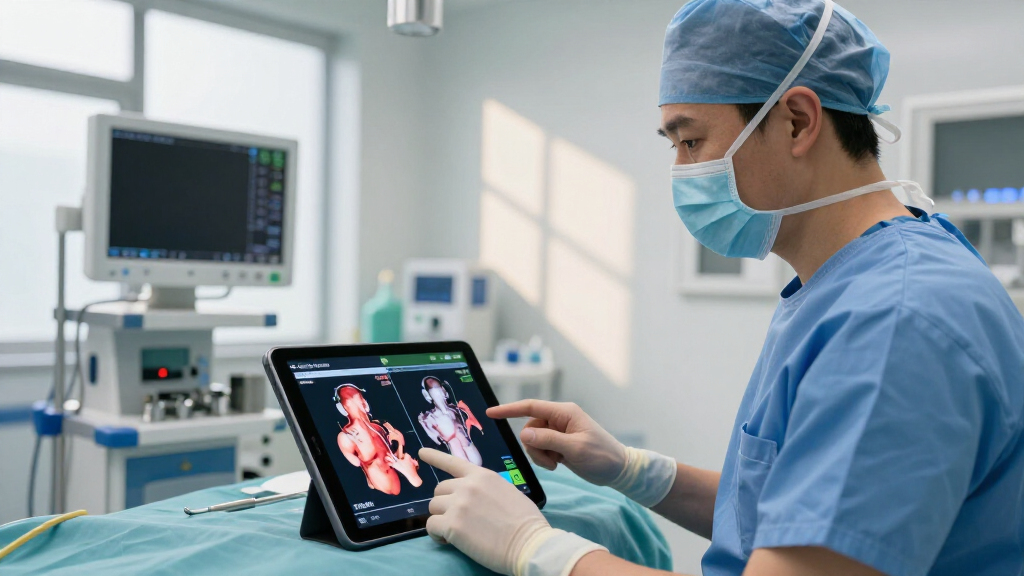
NVIDIA has introduced Cosmos-H-Dreams, a real-time, action-conditioned surgical simulation system designed to generate surgical videos from live robot commands. The system is said to run on a single RTX PRO 6000 GPU, enabling closed-loop control without physical hardware. This development aims to improve testing efficiency for surgical robots, but independent validation and clinical relevance remain unconfirmed.
The Cosmos-H-Dreams simulator is a distilled version of NVIDIA’s earlier Cosmos-H-Surgical-Simulator, based on Cosmos-Predict2.5-2B. It processes sequential robot actions to generate subsequent video frames, supporting real-time operation. NVIDIA claims it can run on a single RTX PRO 6000 GPU, with applications demonstrated on the Versius surgical platform, although specific performance metrics such as latency or accuracy are not provided. The system was trained with diverse data, including unsuccessful procedures, to better model real-world surgical variability, as detailed in the original analysis. The company emphasizes its potential to streamline surgical robot development by enabling faster, more cost-effective testing in virtual environments, reducing dependence on physical experiments that are costly and risk-prone. However, validation of the system’s physical fidelity and clinical reliability has not been disclosed, and its ability to accurately simulate tissue deformation or safety-critical events remains unverified, as discussed in the original analysis.Potential Impact on Surgical Robotics Development
The introduction of Cosmos-H-Dreams could significantly influence the future of surgical robotics by enabling faster, more flexible testing and policy evaluation through real-time simulation. If validated, it might reduce costs and risks associated with physical testing, accelerate innovation, and facilitate closed-loop control research. However, without independent validation or clinical trials, its effectiveness for real-world surgical applications remains uncertain, raising questions about safety and reliability.
As an affiliate, we earn on qualifying purchases.
Background on NVIDIA’s Surgical Simulation Efforts
NVIDIA has previously developed Cosmos-H-Surgical-Simulator, a system that generated future surgical videos offline from planned trajectories. The new Cosmos-H-Dreams moves this approach into a streaming, real-time framework, integrating with surgical platforms like Versius. The system is part of broader efforts to advance AI-driven surgical tools, aiming to create more dynamic, responsive virtual environments for development and training. Despite these advances, the field still faces challenges in validating simulation accuracy and ensuring transferability to clinical practice, especially for complex tissue interactions and safety-critical tasks.
“Cosmos-H-Dreams provides real-time, action-conditioned visual dynamics for surgical robotics, enabling faster iteration and testing.”
— NVIDIA spokesperson
real-time surgical training software
As an affiliate, we earn on qualifying purchases.
As an affiliate, we earn on qualifying purchases.
Unverified Aspects of Performance and Validation
Key performance metrics such as frame rate, latency, and image quality are not disclosed. The durability of the simulation’s coherence over extended sequences, its physical accuracy, and transferability to actual surgical procedures remain unconfirmed. Independent testing and peer-reviewed validation are still pending, leaving its readiness for clinical deployment uncertain.
As an affiliate, we earn on qualifying purchases.
Next Steps in Validation and Deployment
Future developments will likely focus on conducting independent validation studies, measuring the system’s accuracy, stability, and safety in simulated and real surgical environments. NVIDIA may also expand hardware compatibility and clarify access terms. The next milestone involves testing the system’s policies on physical surgical robots to evaluate transferability and robustness, with potential for broader clinical trials if results prove promising.
medical training simulation software
As an affiliate, we earn on qualifying purchases.
As an affiliate, we earn on qualifying purchases.
Key Questions
What exactly is NVIDIA Cosmos-H-Dreams?
It is a real-time, action-conditioned generative simulator that produces surgical videos based on live robot commands and initial camera images, aiming to support surgical robot development and testing.
Can Cosmos-H-Dreams control actual surgical robots?
The system generates visual simulations in response to robot commands, and NVIDIA demonstrated integration with the Versius platform. However, it is not yet described as capable of autonomous clinical operation.
What hardware is needed to run Cosmos-H-Dreams?
According to NVIDIA, it runs in real time on a single RTX PRO 6000 GPU. Performance on other hardware or lower-cost systems has not been disclosed.
Is this system ready for clinical use?
No, the system is currently a research tool. Its physical and clinical accuracy has not been validated, and it is not approved for actual surgical procedures.
How does this improve surgical robot development?
It could enable faster, safer testing and policy evaluation in virtual environments, reducing costs and risks associated with physical experiments, pending validation.
Source: ThorstenMeyerAI.com
Halloween Picks
halloween
As an affiliate, we earn on qualifying purchases.