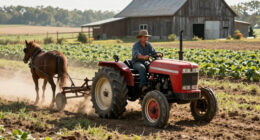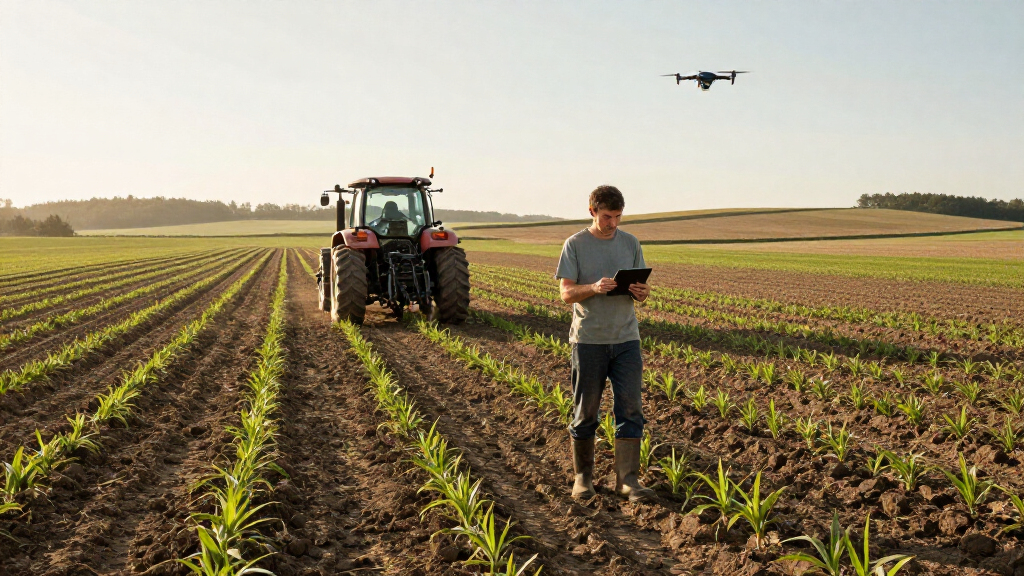

🔍 Read the full analysis: AI And Agriculture: Two Turning Points In Work on ThorstenMeyerAI.com

Get the latest gadgets delivered free with Prime
- Fast, free delivery on millions of items
- Prime Video, Amazon Music and more included
- Member-only deals all year
TL;DR
A November 3, 2026, article by Thorsten Meyer uses agriculture’s long decline as a share of employment to consider how technology reshapes work. It reports that about 928 million people still work in agriculture worldwide and presents AI-driven automation of a large share of work as the author’s thesis, not a confirmed forecast.
In a November 3, 2026, article, writer Thorsten Meyer argues that agriculture’s two-century decline as a source of employment offers a useful comparison for understanding how AI could reshape work. The account documents a major historical shift—from about 73.7% of the U.S. workforce in agriculture around 1800 to roughly 1.5% today—but frames the possibility that AI could automate up to 90% of a sector as Meyer’s thesis, not an established forecast.
Meyer’s article, the second episode of a series called “Work After Work,” traces agricultural productivity gains to successive changes in tools, chemistry and crop breeding. It cites Stanley Lebergott’s historical estimate, published by the U.S. Census Bureau, that 1.4 million of the 1.9 million people in the U.S. labour force in 1800 worked in agriculture. The underlying figures are estimates, particularly for years before 1840, and include enslaved people; the article says the estimate for 1810 was higher still. The broad conclusion is that roughly three in four workers farmed at the time.
The account describes these changes as a chain rather than a single technological break. It points to John Deere’s steel plough in 1837, the industrial production of ammonia fertilizer after Fritz Haber’s 1908 patent, and short-straw wheat associated with the Green Revolution in the 1960s. Citing Indian official statistics, Meyer says wheat production rose from 12.3 million tonnes in 1964-65 to 26.4 million tonnes in 1971-72. The figures illustrate increased output, though they do not by themselves isolate the contribution of any one technology.
The article also distinguishes workforce share from worker numbers: agricultural employment can become a smaller proportion of a growing workforce even while the number of farm workers remains steady or rises. Meyer cites a U.S. farm-worker count that peaked at 11.8 million around 1910 and a German series in which the agricultural share fell from 43% to 25% between 1882 and 1939 while the number of farm workers remained between 8 million and 10 million. These examples caution against treating a falling employment share as an immediate disappearance of jobs.
Agriculture Offers a Long-Run Test
Agriculture matters to the AI debate because it shows that a sector can produce far more while relying on a much smaller share of the workforce. Meyer cites an estimate from the International Labour Organization that about 928 million people worked in agriculture worldwide in 2025, roughly one in four workers. The contrast between that global figure and employment shares of around 1.5% in the United States and 1% in Germany shows that the transformation has been uneven and is far from complete.
The article’s historical lesson is not that every job removed by technology disappears without consequence, or that AI will follow farming’s path on the same schedule. Instead, it highlights two separate questions for workers and businesses: how quickly technology raises productivity, and where people find work as the economy changes. Agriculture’s gradual shift took generations in the United States, while many countries still employ large numbers of people on farms.
Meyer also challenges the idea that fewer farmers necessarily mean less food. He reports that global cereal harvests grew 4.2-fold between 1961 and the period discussed, while the world population grew 2.7-fold. That comparison gives context to productivity gains, but it does not establish that the same outcomes, distribution of benefits or social costs will follow from AI in other industries.
Products Worth Considering

DJI Osmo Mobile 8 Smartphone Gimbal with Mic Mini Transmitter, Infinity Black

Amazon Kindle Paperwhite (2024), 16 GB, 7-inch Display, Black

EcoFlow Delta 3 Portable Power Station – 1024 Wh, 1800 W
As an affiliate, we earn on qualifying purchases.
From Farm Tools to Modern AI
The article sits within a series that divides work into three broad areas: field, factory and office. Its focus is agriculture, which Meyer calls a test case for the series’ wider question about automation. The central historical pattern predates AI by centuries: tools and scientific advances allowed fewer workers to produce more food, while employment shifted toward other parts of the economy.
Meyer’s examples span countries and periods, but the measures are not all directly comparable. The U.S. figure for 1800 is a historical reconstruction; Japan’s 1872 estimate covers the broader primary sector, including forestry and fishing; India’s 1951 figure counts cultivators and agricultural labourers; and China’s figure begins in 1952. The article reports these estimates as evidence of agriculture’s former scale, rather than as a single standardized international dataset.
It also gives a more recent measure of agricultural output in the United States: 2023 farm output was nearly three times its 1948 level, according to the source article, with only a small rise in total inputs. The source does not provide a detailed breakdown of the input measure in the supplied material. The comparisons support a productivity argument, but they do not establish a direct forecast for AI’s effects on jobs.
““My thesis, not a fact: automation could become a sector of up to 90% within a decade or a few decades.””
— Thorsten Meyer, author of the November 3 article
AI’s Pace and Job Effects Remain Unknown
The article provides no new measurement of AI adoption, job losses or productivity gains in agriculture or other industries. Its suggestion that automation could reach up to 90% of a sector is explicitly presented as Meyer’s thesis. The source does not define precisely what “a sector of up to 90%” means, identify which sector it would apply to, or supply a method for measuring that possibility.
It is also unclear how closely AI-driven change will resemble agricultural mechanisation. Farming’s historical shift involved technologies introduced over a long period, varying conditions across countries, and movement of workers into other occupations. The article does not establish where displaced workers would go in an AI-driven economy or how quickly new jobs could emerge.
Some figures have limits the article itself acknowledges: early U.S. labour statistics are estimates, and the Japan, China and India measures cover different categories and years. The global figure of 928 million is an ILO estimate for 2025, but the supplied material does not provide its underlying calculation. These caveats do not erase the broad pattern, but they matter when comparing places or projecting future change.
The Series Turns to Factory Work
The article identifies itself as Episode 2 of “Work After Work,” with a later episode expected to examine mechanisation in agriculture, including reapers, threshers and tractors. Meyer’s larger series framework compares work in fields, factories and offices, so the next instalments may add evidence about how different sectors responded to technology.
For readers following the AI question, the next useful evidence will be direct data on adoption, output, worker numbers and job transitions—not historical analogy alone. The article supplies no timetable for AI-driven changes or specific forecast beyond Meyer’s stated thesis. Whether AI produces a similarly long transition, a faster shift, or a different pattern remains open.
Key Questions
What is the main development in the article?
Thorsten Meyer’s November 3, 2026, article uses agriculture’s long-term decline as a share of employment to discuss possible AI effects on work. It is a historical comparison and argument, not a report that a new AI system has displaced a specific group of workers.
How many people work in agriculture worldwide?
The article cites an ILO estimate of 928 million people in 2025, about one in four workers globally. The source material does not include the estimate’s detailed methodology.
Does the article predict that AI will automate 90% of jobs?
No. Meyer says automation could become a sector of up to 90% within a decade or a few decades, but labels this his thesis, not a fact. The supplied material gives no sector-specific model or supporting forecast for that figure.
Did agricultural employment fall as soon as farm technology improved?
Not necessarily. Meyer says the number of U.S. farm workers continued to rise until about 1910 even as agriculture’s share of the workforce declined over time. A falling share and a falling headcount are different measures.
What remains unknown about AI’s effect on work?
The article does not quantify AI adoption or job effects, say which occupations may be affected first, or establish how quickly workers could move into other jobs. Its agricultural history is a comparison, not proof that AI will produce the same outcome.
Source: ThorstenMeyerAI.com