
📊 Full opportunity report: How Automated Benefit Checks Are Changing Safety-Net Program Access on IdeaNavigator AI — validation score, market gap, and execution plan.

Get the latest gadgets delivered free — and shop member deals
- Fast, free delivery on millions of items
- Access to Prime Big Deal Days deals on October 6–7
- Prime Video, Amazon Music and more included
TL;DR
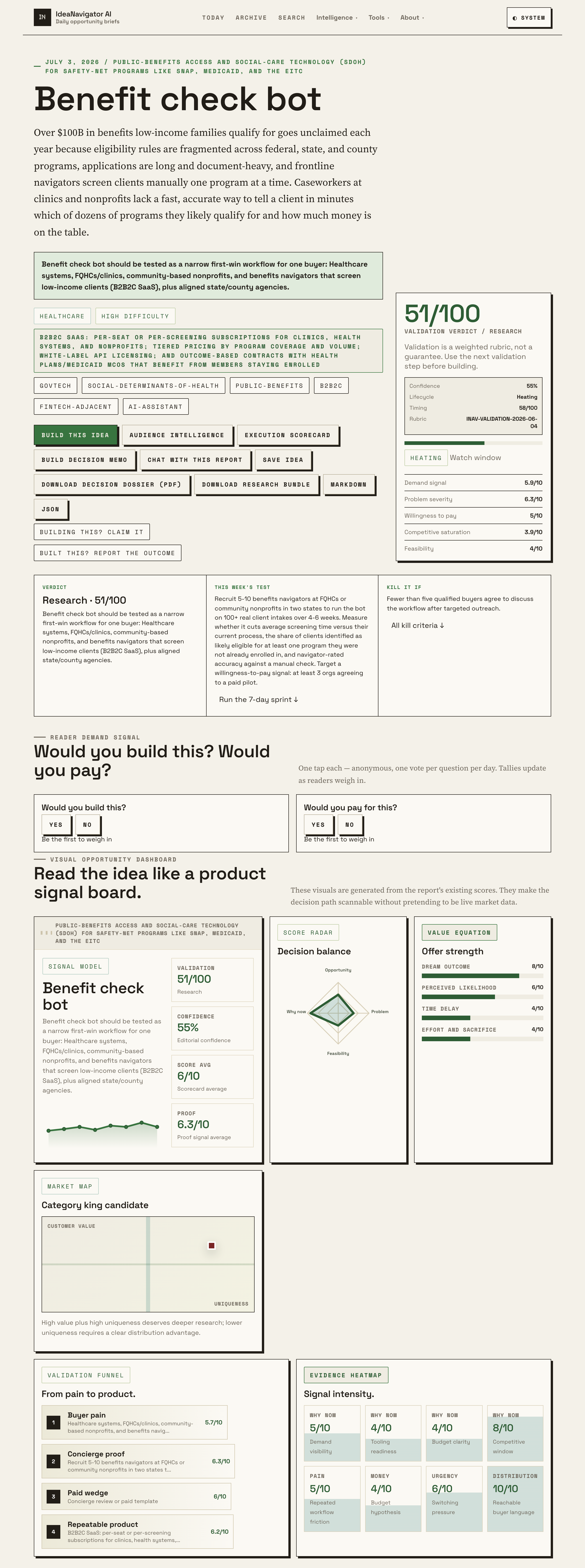
A new conversational AI benefit check tool is being tested to improve access to safety-net programs. It aims to reduce screening time, increase eligibility identification, and address gaps caused by nonprofit shutdowns and Medicaid redeterminations.
A new AI-driven benefit check bot is being tested to help clinics, nonprofits, and government agencies quickly identify low-income clients’ eligibility for multiple safety-net programs. This technology aims to address longstanding gaps in benefit access, especially after the recent shutdown of a major nonprofit and the surge in Medicaid redeterminations post-pandemic.
The benefit check bot is a conversational, multilingual tool that can be embedded on websites or accessed via SMS, designed to screen clients for programs like SNAP, Medicaid, WIC, and LIHEAP. It asks a brief series of yes/no and multiple-choice questions, then provides an estimated benefit amount and next steps for application, all within minutes. The system is currently being piloted in two states with 5-10 benefits navigators, who will test its effectiveness over the next 4-6 weeks.
Following the shutdown of Benefits Data Trust, a 20-year nonprofit that helped enroll millions across seven states, health systems and local agencies face increased challenges in connecting clients to benefits. The redetermination process for Medicaid, which resumed after pandemic pauses, has also created a surge in eligibility checks, straining existing manual screening processes.
By automating eligibility screening, the benefit check bot seeks to reduce the time navigators spend on each client, improve accuracy, and uncover benefits that clients may be unaware they qualify for. The system logs anonymized screening outcomes and can generate summaries for application assistance, potentially increasing enrollment rates and reducing unclaimed benefits, which experts estimate total over $100 billion annually.
Impact of Automated Benefit Screening on Access
This new technology could significantly improve access to safety-net programs by reducing the administrative burden on frontline staff and enabling faster, more accurate identification of benefits for low-income clients. It addresses a critical gap left by the closure of key nonprofit services and the increased complexity of benefit eligibility during Medicaid redeterminations. If successful, it could lead to higher enrollment, reduced benefit leakage, and more efficient use of public resources, ultimately supporting millions of vulnerable individuals and families.
benefit eligibility screening software
As an affiliate, we earn on qualifying purchases.
As an affiliate, we earn on qualifying purchases.
Background on Benefit Access Challenges and Recent Changes
Over the past decade, millions of low-income Americans have struggled to access benefits due to fragmented eligibility rules, lengthy application processes, and manual screening methods. The closure of Benefits Data Trust in 2024 removed a key capacity for benefits enrollment across multiple states, further complicating outreach efforts. Additionally, the post-pandemic ‘unwinding’ of Medicaid renewals has caused millions to undergo eligibility redeterminations, often leading to loss of coverage due to administrative hurdles.
Traditional screening relies heavily on caseworkers and call centers, which are often slow, costly, and prone to errors. The advent of conversational AI offers a promising alternative, capable of delivering multilingual, near-instant assessments at a fraction of the cost. Pilot programs are now exploring how these tools can be integrated into existing safety-net workflows to improve outcomes.
As an affiliate, we earn on qualifying purchases.
Uncertainties About Effectiveness and Adoption
While initial pilots are promising, it remains unclear how well the benefit check bot will perform at scale across diverse populations and regions. Questions remain about its accuracy compared to manual screening, its ability to handle complex eligibility rules beyond initial testing states, and the willingness of clinics and nonprofits to adopt new technology amidst resource constraints. Additionally, data privacy and integration with existing systems are ongoing concerns that need resolution before widespread deployment.
multilingual benefit eligibility chatbot
As an affiliate, we earn on qualifying purchases.
As an affiliate, we earn on qualifying purchases.
Next Steps for Pilot Expansion and Evaluation
Over the coming weeks, the pilot program will gather data on screening accuracy, time savings, and client outcomes. If results are favorable, developers plan to expand the tool to additional states and programs, with potential for broader commercialization. Stakeholders will also evaluate how to best integrate the system into existing workflows and address any technical or privacy issues. Success in these pilots could accelerate adoption across safety-net providers and government agencies.
Medicaid redetermination assistance software
As an affiliate, we earn on qualifying purchases.
As an affiliate, we earn on qualifying purchases.
Key Questions
How does the benefit check bot improve eligibility screening?
The bot automates the screening process by asking clients a brief set of questions and then estimating their benefits, reducing the time and effort required for manual review.
Will this technology replace human caseworkers?
Currently, the system is designed to assist and augment human navigators, not replace them. It aims to streamline initial screening and free up staff for complex cases.
What safety-net programs does the bot cover?
The pilot focuses on programs like SNAP, Medicaid, WIC, LIHEAP, and the EITC/CTC, with plans to expand coverage as the system matures.
What are the privacy considerations with this AI tool?
The system logs anonymized data for evaluation and must comply with existing privacy regulations. Details on data security protocols are still being finalized.
When will the system be available for widespread use?
If pilot results are positive, broader deployment could begin within the next year, with initial expansion to more states and programs.
Source: IdeaNavigator AI
Fall Picks
fall essentials
As an affiliate, we earn on qualifying purchases.