
📊 Full opportunity report: Parental Consent And Compliance Software: What Vendors Should Know on IdeaNavigator AI — validation score, market gap, and execution plan.
TL;DR
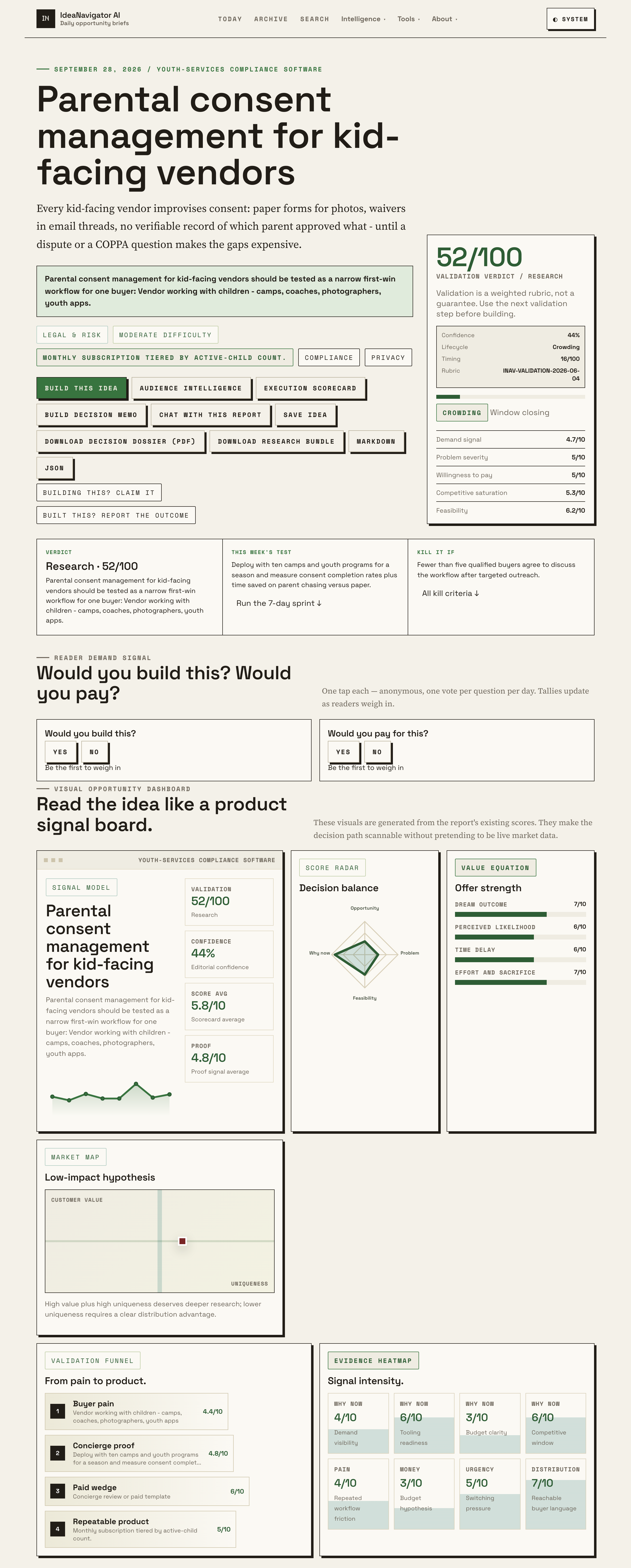
IdeaNavigator AI proposes testing parental consent software with camps and other vendors that work with children. The proposed pilot would track consent completion and time spent following up with parents; no pilot results or product deployment are reported.
IdeaNavigator AI has proposed a parental consent management product for camps, coaches, photographers and youth apps, with a seasonal pilot at ten camps and youth programs to test whether mobile forms improve completion and reduce time spent chasing parents. The proposal describes a product concept and validation plan; it does not report that the software has been built, deployed or evaluated.
The proposed service would let youth-facing vendors send parents branded consent flows to complete on a phone. The listed use cases include photo permissions, data collection, medical information and liability waivers. The proposal also calls for identity checks matched to the risk level, records organized by child, expiry tracking and an audit export vendors could use to review consent history.
The business model would be a monthly subscription tiered by active-child count. To validate demand and operations, IdeaNavigator AI recommends a season-long test with ten camps and youth programs. The proposed measures are consent completion rates and time saved on parent follow-up compared with paper forms. No pricing, completion targets or pilot partners are identified.
A Record for Each Child
For an organization working with children, a consent record needs to show which parent approved which use, and whether that approval is still current. The proposal addresses a practical record-keeping problem: permissions for photos, health information, data collection or liability may be handled through separate forms and messages. Bringing them into one ledger could make it easier for staff to find a record when a parent asks about a particular use.
The suggested audit export and expiry tracking could also help vendors respond to disputes or compliance questions. Those are proposed capabilities, not demonstrated outcomes. The value would depend on whether records are accurate, easy to retrieve and tied to an appropriate verification process. A subscription priced by active-child count would connect vendor costs to program size, though the proposal does not establish whether buyers would pay at the suggested model.
Top picks for "parental consent compliance"
As an affiliate, we earn on qualifying purchases.
Paper Forms and Privacy Rules
The proposal says many youth-facing vendors improvise consent with paper forms and email threads, leaving unclear records of which parent agreed to which use. It frames the risk around disputes over photos or data and questions about compliance. It does not provide survey results or other evidence quantifying how common those practices are.
It also points to updates to the U.S. Children’s Online Privacy Protection Rule, commonly known as COPPA, and state laws as reasons vendors may face more pressure to document consent. The idea spans different kinds of businesses, from camps and coaches to photographers and apps, whose services and data practices may differ. The proposal does not specify which legal requirements the product would address or how its workflows would vary by vendor type.
Pilot Results Are Not Available
No deployment or results are reported. It is unclear whether a product is in development, whether any camps have agreed to participate, or when a pilot might begin. The proposed evaluation does not specify a baseline, target improvement, measurement method or how results would be reported.
Other open questions include what identity checks would be used at each risk level, how long records would be retained, and what safeguards would protect children’s and families’ information. The proposal also does not explain how consent could be withdrawn, how vendors would handle multiple guardians, or which jurisdictions and legal obligations the product would support. Those details would affect both the product design and its usefulness to potential customers.
Ten Programs to Test Demand
The next step in the outlined plan is to run a season-long pilot with ten camps and youth programs. The test would compare consent completion and staff time spent following up with parents against paper-based processes. No start date or participating organizations have been named.
If the pilot proceeds, reporting those measures alongside implementation details could help establish whether vendors adopt the workflow and whether the records meet their operational needs. Until then, the proposal remains an early product concept with a suggested buyer group, feature set, subscription approach and validation plan.
Source: IdeaNavigator AI
Key Questions
What is the proposed product?
A service for youth-facing vendors to collect and track parental permissions through mobile forms, with child-level records, expiry tracking and audit exports.
Has the software launched?
No launch or deployment is reported. The proposal describes a product concept and recommends a pilot.
Who would use it?
The suggested customers are camps, coaches, photographers and youth apps that need parental consent for activities such as photo use or data collection.
How would the proposed pilot be evaluated?
IdeaNavigator AI recommends testing with ten camps and youth programs for a season, measuring consent completion rates and staff time spent following up with parents compared with paper processes.
Source: IdeaNavigator AI