
📊 Full opportunity report: Keep Social Media Content Work Moving With Shared Tasks on IdeaNavigator AI — validation score, market gap, and execution plan.

Get the latest gadgets delivered free with Prime
- Fast, free delivery on millions of items
- Prime Video, Amazon Music and more included
- Member-only deals all year
TL;DR
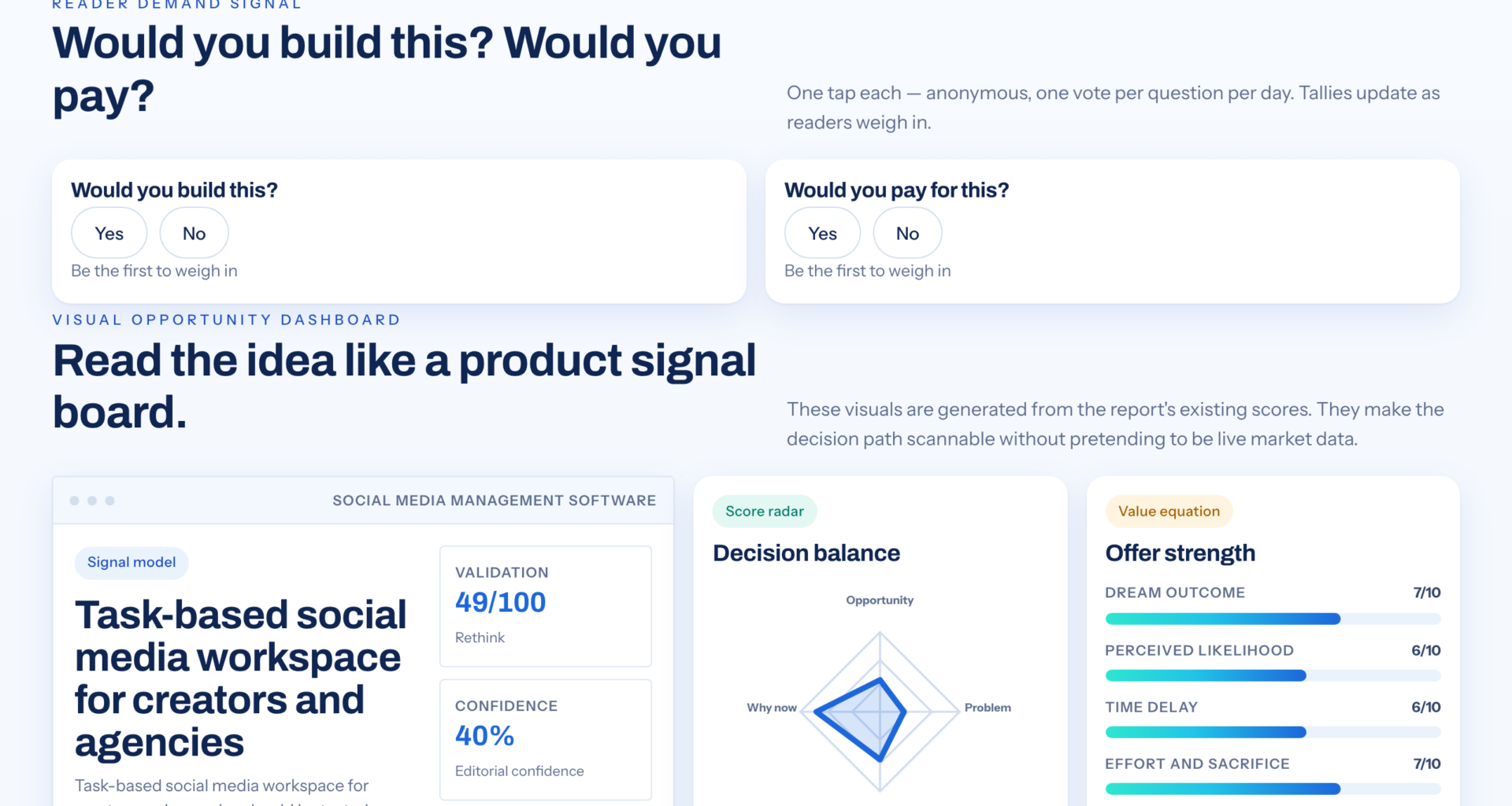
IdeaNavigator AI proposes testing a task-based social media workspace for creator teams and small agencies managing content across clients. The concept would combine post production, client approval and scheduling, but it is a product proposal, not a launched service or validated business.
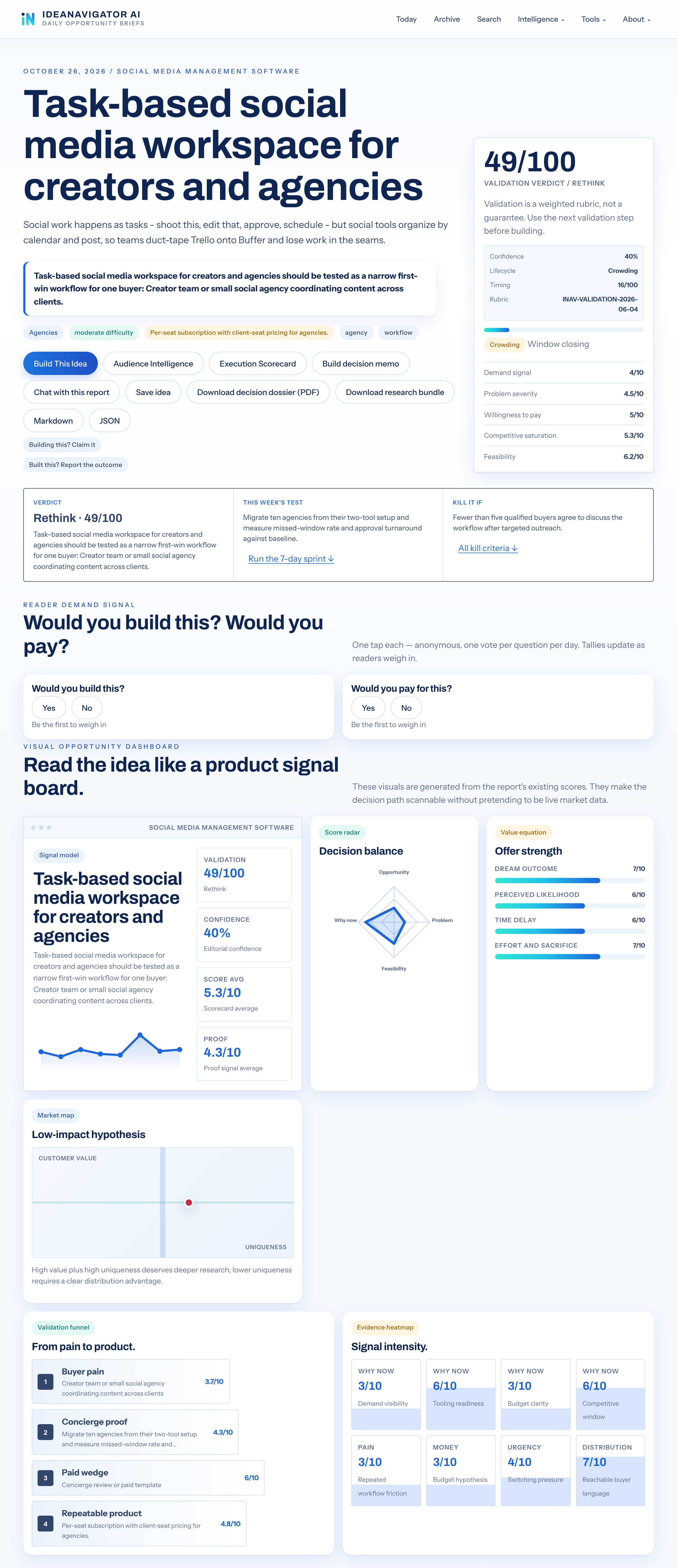
IdeaNavigator AI has proposed testing a task-based workspace for creator teams and small social agencies that manage posts across multiple clients. In its proposal, the company describes a concept that would bring briefs, assets, editing, approvals and scheduling into one workflow. The proposal does not establish that a product has launched or that agencies have tested it.
According to IdeaNavigator AI’s proposal, the suggested product treats each social post as a task moving through stages such as brief, asset creation, editing, approval and scheduling. The proposed features include client-facing approval links and asset versioning, followed by scheduling after approval. IdeaNavigator AI says the aim is to connect work that is often split between social media schedulers and general project-management tools.
IdeaNavigator AI identifies the initial customer as a creator team or small social agency coordinating content across clients. The proposal suggests a per-seat subscription, with separate client-seat pricing for agencies. These are elements of a product concept, not confirmed pricing, customer commitments or an operating business.
For validation, IdeaNavigator AI recommends moving ten agencies from their existing two-tool setup and comparing missed publishing windows and approval turnaround with each agency’s baseline. The proposal names no participating agencies and provides no baseline figures, test period or results. These measures are a plan for evaluation, not evidence that the workspace reduces delays.
Connecting Production to Publishing
IdeaNavigator AI’s proposal addresses a coordination problem that can arise when content production and publishing are managed in separate systems. A post may require a brief, files, revisions, client sign-off and a scheduled time; if those pieces are tracked in different places, teams may have to reconcile status manually. A shared post-level task could make ownership and progress easier to follow, if the workflow works as intended.
For small agencies, the potential value is not simply another calendar. The concept puts client review and production steps alongside scheduling, with the aim of reducing handoffs between tools. Whether that saves time or prevents missed posting windows remains an empirical question. The pilot IdeaNavigator AI proposes would focus on approval turnaround and missed-window rates, measuring operational outcomes rather than relying only on user preference.
The commercial case also depends on who pays and how often clients need access. IdeaNavigator AI proposes per-seat billing, including a client-seat model, but provides no evidence about agencies’ willingness to pay, the cost of onboarding clients or how many seats a typical account would require. Those factors could affect whether combining the workflow is more attractive than continuing to use separate products.
Products Worth Considering

Amazon Kindle Scribe Colorsoft 64GB (1st Generation)

Sony WH-1000XM4C Wireless Noise-Cancelling Headphones, Black

LG UltraGear 32GX850A-B 32-Inch 4K UHD Glossy OLED Gaming Monitor
As an affiliate, we earn on qualifying purchases.
The Proposed Workflow and Its Gap
IdeaNavigator AI’s proposal distinguishes between how social media tools commonly organize work and how teams carry it out. Scheduling products center on calendars and posts, while the production process includes assignments such as shooting, editing and obtaining approval. The company says teams may bridge that gap by combining a scheduler with a general-purpose task tool, which can leave work divided between systems.
The proposal frames increased content expectations as a reason this coordination issue may matter more to teams. It also argues that existing scheduling-tool providers have not filled the work-management role, leaving room for a product built around the full path from idea to publication. These are IdeaNavigator AI’s market assumptions; its proposal includes no market-size figures, competitor analysis or evidence of customer demand.
IdeaNavigator AI describes a deliberately limited first version: post stages, client approval links, asset versions and scheduling after approval. That scope could make a pilot easier to evaluate than a broad social media platform, but the proposal does not specify supported networks, integrations, permissions or technical requirements.
Demand and Results Remain Untested
IdeaNavigator AI’s proposal does not identify a product developer, launch date, working prototype or confirmed pilot participants. It also supplies no customer interviews, usage data or financial projections. The opportunity should therefore be understood as a suggested product direction, not a report of a company launch or a verified market trend.
Key details remain open: which social networks would be supported, how scheduling would connect to them, how client permissions and asset versions would work, and what the subscription would cost. The proposal also gives no definition of a missed-window baseline or method for separating the tool’s effects from changes in staffing, content volume or client response times. Until a pilot reports those details, claims about faster approvals or fewer missed posts would be unconfirmed.
A Ten-Agency Pilot Would Test It
IdeaNavigator AI proposes moving ten agencies from their current two-tool arrangements and comparing performance with a baseline. A useful account of such a test would identify its duration, participating teams, baseline period and definitions for missed publishing windows and approval turnaround. It would also report whether teams continued using the workspace after the test.
IdeaNavigator AI’s proposal gives no pilot schedule or results. Until those are announced, the concept’s practical and commercial prospects remain unsettled. The immediate question is whether agencies will adopt a unified post workflow and whether measured improvements justify replacing or connecting tools they already use.
Source: IdeaNavigator AI proposal
Key Questions
Has the task-based social media workspace launched?
No launch is reported. IdeaNavigator AI describes a proposed product and an MVP scope, but provides no release date or evidence of an available service.
Who is the proposed workspace for?
IdeaNavigator AI identifies creator teams and small social agencies coordinating content across multiple clients as the initial audience.
What would the product include?
IdeaNavigator AI’s concept covers post stages from brief through scheduling, along with client-facing approval links and asset versioning. Scheduling would follow approval.
How would the idea be tested?
IdeaNavigator AI recommends moving ten agencies from a two-tool setup and measuring missed-window rates and approval turnaround against a baseline. The proposal names no participating agencies and reports no test results.
Is the business model confirmed?
No. IdeaNavigator AI suggests a per-seat subscription with client-seat pricing, but provides no prices, paying customers or evidence of willingness to pay.
Source: IdeaNavigator AI