
🔍 Read the full analysis: 2.8 Trillion Tokens For Indic Pretraining: How The Data Pipeline Works on ThorstenMeyerAI.com

Get the latest gadgets delivered free with Prime
- Fast, free delivery on millions of items
- Prime Video, Amazon Music and more included
- Member-only deals all year
TL;DR
NVIDIA and AI4Bharat at IIT Madras say they plan to release Nemotron-pretraining-Indic-v1, a corpus with about 2.8 trillion retained tokens across 22 Indian languages, plus the GPU-accelerated pipeline used to generate it. The release date, licensing terms and detailed translation-quality results have not been specified.
NVIDIA and AI4Bharat at IIT Madras plan to release Nemotron-pretraining-Indic-v1, a corpus containing about 2.8 trillion retained tokens across 22 Indian languages, alongside the GPU-accelerated pipeline used to create it, as detailed in the original analysis. The resource is aimed at developers training language models in Indic languages, but the teams have not said when it will be available or provided full release and evaluation details.
The reported inventory comprises 2,601.0 billion native-script tokens and 224.6 billion romanized tokens, counted with the Gemma-4 tokenizer. Native-script material covers all 22 languages; romanized text, which represents Indic languages using Latin letters, covers 12. Together, the project describes 34 language-script configurations.
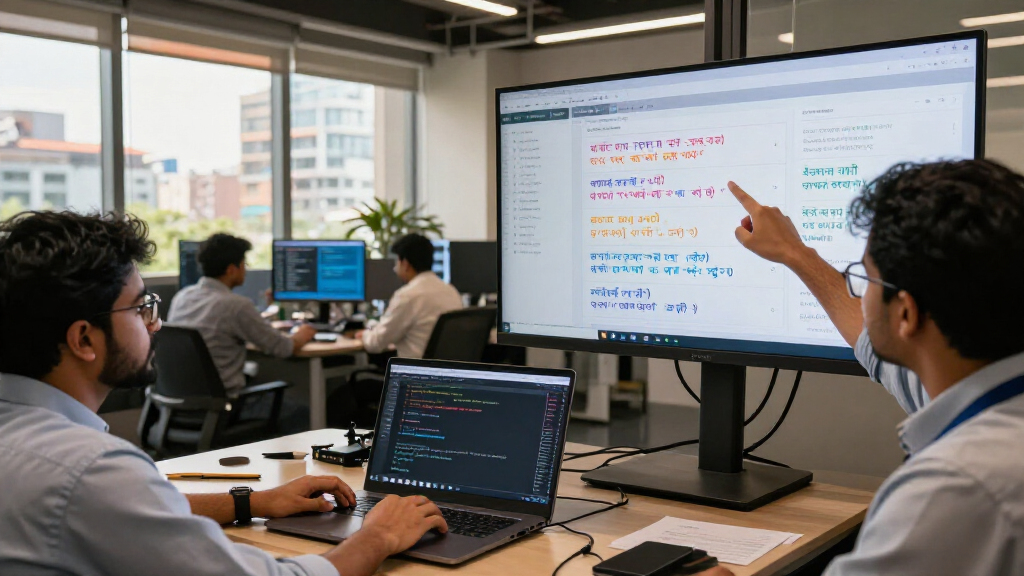
The workflow begins with English documents from 15 Nemotron-CC-v2 subsets, covering material such as web text, question-and-answer content, mathematics and code. Using NVIDIA’s NeMo Data Designer framework, it translates documents, assesses translation quality, repairs outputs that score poorly and converts some accepted translations into Latin script. The teams say records keep source identifiers and undergo input-output checks, including checks intended to preserve equations, tables and code.
The announcement says developers will be able to use the corpus directly or adapt its prompts, workflows and quality checks for other source material. The teams also report that continued pretraining for Nemotron 3.5 Super VL used 10 billion Indic tokens from a 12-language subset of this corpus alongside naturally authored Indic text. That reported training use is separate from the full corpus inventory; it does not mean the model was trained on all 2.8 trillion tokens.
A Larger Data Pool for Indic Models
A large corpus could give model developers more material for training across languages where the announcement says data availability remains a constraint. Its reported mix includes technical subjects and question-and-answer material, which could be useful for models meant to discuss mathematics, programming or general topics in Indic languages. That potential is not yet a demonstrated outcome: the announcement includes no independent evaluation showing whether, or by how much, the corpus improves model performance.
Releasing the generation workflow as well as the text could let researchers examine or adapt the process rather than relying on a finished dataset alone. Source identifiers and quality checks may support traceability, but their practical value will depend on the code, documentation, acceptance criteria and evaluation results made available with the release.
The corpus is described as translated material, not a substitute for naturally authored Indic writing. Translations based on English documents can broaden subject coverage, but may carry the source material’s framing and omit local knowledge or cultural context. Natural Indic-language data remains necessary, according to the project’s own account.
GPU-accelerated data processing pipeline
As an affiliate, we earn on qualifying purchases.
As an affiliate, we earn on qualifying purchases.
From Sangraha to Translated Data
AI4Bharat, an Indian-language research lab at IIT Madras, develops open datasets and models. The announcement cites Sangraha, its open pretraining corpus for 22 Indian languages, as part of the foundation for open Indic-language model research. Nemotron-pretraining-Indic-v1 adds a large translated-data collection and a described method for generating further material from selected English sources.
The project says the 22 languages are those listed in India’s Constitution and that they are the first languages of 97% of Indians, or nearly 1.2 billion people, citing the 2011 Census. That figure comes from the cited census and is not a current population estimate. The project’s reported token totals are counts made with the Gemma-4 tokenizer and include accepted rewrites and script variants; they are not counts of unique English source documents.
“We do not have enough data for Indian languages.”
— Mitesh Khapra, head of AI4Bharat
Indic language NLP training datasets
As an affiliate, we earn on qualifying purchases.
As an affiliate, we earn on qualifying purchases.
Release Terms and Quality Still Open
The announcement does not give a release date or hosting location, nor does it specify the precise terms for redistribution or adaptation. It also does not provide per-language token breakdowns, detailed quality scores, acceptance thresholds or independent assessments of translation fidelity.
The total is a tokenizer-based corpus count, not a measure of unique documents or a model’s training budget. The announcement does not report a performance comparison for models trained with this data, and it does not fully specify how synthetic translations and naturally authored Indic text will be balanced in future training mixtures. Those details remain unconfirmed until release materials or further evaluations are available.
large language model training corpus
As an affiliate, we earn on qualifying purchases.
As an affiliate, we earn on qualifying purchases.
Publication and Evaluation Ahead
The next milestone is the planned publication of the corpus and its generation pipeline. After release, developers and researchers will be able to inspect the data and workflow, check the documentation and licensing, and assess how the quality controls operate. The teams have not announced a timetable.
Evaluation by users and independent researchers could help establish how well translations preserve meaning across languages and whether the data benefits downstream models. Until the corpus, code and supporting results are published, its usability and measurable impact remain unknown.
As an affiliate, we earn on qualifying purchases.
Key Questions
What is Nemotron-pretraining-Indic-v1?
It is a planned corpus of about 2.8 trillion retained tokens across 22 Indian languages, which NVIDIA and AI4Bharat at IIT Madras say they will release with the pipeline used to generate it.
How many languages include romanized text?
The announcement reports native-script material for all 22 languages and Latin-script romanizations for 12. It counts those formats together as 34 language-script configurations.
How was the corpus produced?
The described workflow starts with English documents from 15 Nemotron-CC-v2 subsets, translates them, checks translation quality, repairs low-scoring outputs and romanizes some accepted translations. The teams say records retain source identifiers and are checked against their inputs.
When will the corpus be available?
No release date has been specified. The announcement describes publication of the corpus and pipeline as planned, not completed.
Does the corpus have proven benefits for language models?
The announcement reports use of 10 billion Indic tokens from a 12-language subset in continued pretraining for Nemotron 3.5 Super VL, alongside naturally authored text. It does not provide an independent performance comparison or establish the corpus’s overall effect on model quality.
Primary source: Hugging Face · via ThorstenMeyerAI.com
Halloween Picks
halloween
As an affiliate, we earn on qualifying purchases.