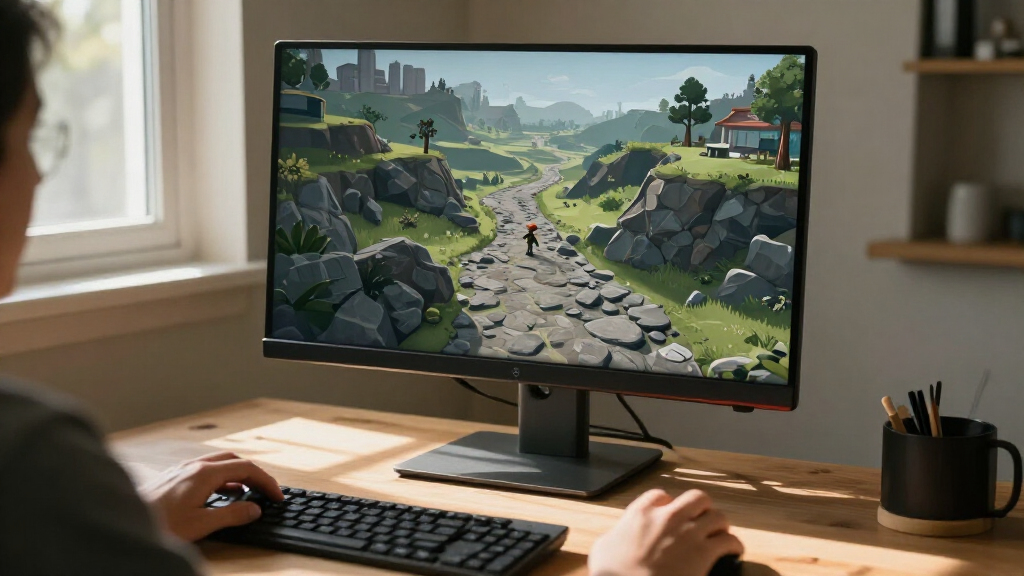

🔍 Read the full analysis: Genie 4 And The Limits Of What World-Building AI Can Understand on ThorstenMeyerAI.com

Get the latest gadgets delivered free with Prime
- Fast, free delivery on millions of items
- Prime Video, Amazon Music and more included
- Member-only deals all year
TL;DR
Google DeepMind frames Genie 4’s realistic, interactive environments as a step toward AGI and as a way to train agents. But the model has no published Physics-IQ result, and research on other video models finds that visual realism does not reliably track physical understanding.
Google DeepMind is presenting Genie 4, its interactive world-generation model, as part of a research path toward artificial general intelligence, but the evidence cited in a November 1 analysis does not establish that the model understands the physics behind the scenes it creates. The distinction matters because realistic simulated environments could help train AI agents and robots—if those environments reliably represent how the physical world behaves.
On its Genie 4 model page, Google DeepMind says that exploring “an unlimited range of realistic environments is a key stepping stone on the path to AGI.” The company also argues that training and testing agents in more realistic settings could bring them closer to successful deployment in the physical world. Those statements describe a research direction; the source analysis reports that DeepMind has not published a Genie 4 benchmark score or a measurement showing how much the system advances progress toward AGI.
The central issue is the difference between generating plausible images and modeling the rules that cause events. A video model might depict a ball speeding up as it rolls downhill without having a reliable internal representation of gravity, momentum or collisions. In the account provided, Genie 4 predicts video frames based on earlier frames and user input; it does not use an underlying game engine or stored three-dimensional map. Its scenes can look convincing, but appearance alone cannot establish that the model can predict physical outcomes accurately.
A 2025 Physics-IQ benchmark from Google researchers found that video models’ physical understanding was “severely limited, and unrelated to visual realism,” according to the source. On Physics-IQ Verified, where real videos score 100, the best image-to-video result cited reached 55.1 after eight attempts, while Gemini Omni 1.1 Flash scored 35.3. The analysis says Genie 4 itself has not been tested on the benchmark, so those results are evidence about related models, not a direct assessment of Genie 4.
THE AGI CLAIM, VERSION BY VERSION
Three Genies, one promise
Google DeepMind has tied every recent Genie to the path to AGI. Here is what each version could do, what was claimed, and who said it.
- 4 Dec 2024Genie 23D worlds from one image, consistent for up to about a minute.“…the breadth and generality required to progress towards AGI.”Company claim
- 5 Aug 2025Genie 3First real-time Genie: 720p, 24 frames per second, a few minutes of consistency.“World models are also a key stepping stone on the path to AGI…”Company claim
- 13 Nov 2025SIMA 2 in Genie 3 worldsDeepMind's game agent orients itself and self-improves in newly generated worlds.“…a major milestone toward training general agents across diverse, generated worlds.”Company report
- 6 Feb 2026Waymo World ModelWaymo says its driving simulator is built on Genie 3 and can generate rare events.“…from a tornado to a casual encounter with an elephant.”Company report
- 27 Oct 2026Genie 4Photorealism, native sound, live text steering, Gemini in the loop. Trusted testers only.“…a key stepping stone on the path to AGI.”Company claim
- 31 Oct 2026TechRadar pushes backColumnist Eric Hal Schwartz: realism is not understanding.“Faking plausibility is easier than grasping the underlying rules…”Opinion
The Genie 2 and Genie 3 capability notes are DeepMind’s own descriptions. No Genie post measures progress toward AGI; DeepMind published no benchmark numbers for Genie 4.
Sources: Google DeepMind, Genie 2 (4 Dec 2024), Genie 3 (5 Aug 2025), SIMA 2 (13 Nov 2025), Genie 4 model page (read 1 Nov 2026); Waymo (6 Feb 2026); TechRadar (31 Oct 2026, opinion).
Powered by Thorsten Meyer AI
Why Simulation Needs Reliable Physics
Generated environments could make it easier to train agents on situations that are expensive, dangerous or difficult to reproduce in real life. Robots can break, physical trials take time, and rare events—such as an unexpected hazard on a road—may be hard to stage repeatedly. A simulator that can create varied scenarios on demand could help developers test responses before putting a system into the world.
But a visually convincing simulation is not automatically a useful training environment. If an agent learns from scenes whose physics are inconsistent with reality, its apparent skill in simulation may not carry over to a robot, vehicle or other real-world task. For companies evaluating these tools, the distinction affects safety testing and investment decisions: demonstration footage shows what a system can render, not whether its simulated events follow dependable physical rules.
The practical implication is to treat world models as tools for exploration and stress-testing, rather than proof that a plan will work outside the simulation. Buyers and researchers need task-specific tests of physical prediction and transfer to real settings, alongside visual demonstrations.
Products Worth Considering

Amazon Kindle Paperwhite (12th Generation, 2024), 16 GB, 7-inch Display, Jade

Amazon Kindle Scribe Colorsoft 64GB (1st Generation)

Amazon Kindle Paperwhite Signature Edition (12th Generation, 2024), 32 GB, Metallic Black
As an affiliate, we earn on qualifying purchases.
Three Meanings of World Model
The term “world model” covers systems with different aims. One research ideal is an agent that learns a model of its surroundings, imagines what may happen and practices within that model. A 2018 project by David Ha and Jürgen Schmidhuber, cited in the source, trained an agent inside a learned model of a simple video game before transferring its skill back to the game.
Genie 4 is closer to a video-generating model: it produces scenes in response to preceding frames and user actions. Another category uses structured data and explicit rules. The source points to Dream, a construction start-up that TechCrunch reported on October 29 as training a model on more than 100 million square feet of building data from U.S. permit archives. These approaches may serve different purposes: generating a plausible scene is not the same as calculating whether a structure can bear a load.
Google has linked successive Genie models to the AGI goal. The source says DeepMind used similar “key stepping stone” language for Genie 3 in 2025 and described Genie 2 in 2024 as pointing toward the breadth and generality needed to progress toward AGI. The repeated phrasing signals a continuing company research thesis, not a benchmark finding that Genie models have reached general intelligence.
“The ability to explore an unlimited range of realistic environments is a key stepping stone on the path to AGI.”
— Google DeepMind, Genie 4 model page
Genie 4’s Physics Score Is Unknown
The main evidence gap is direct testing: the source says Genie 4 has no reported Physics-IQ result, and DeepMind has not published benchmark numbers establishing its physical understanding. Scores for other video models cannot answer how Genie 4 performs, nor do they establish whether the system can transfer simulated experience to physical robots or other real-world tasks.
It is also unclear how consistently the model’s environments obey physical rules across different scenes and user actions. The source describes a hybrid arrangement in which Gemini plans and checks scenes while Genie generates frames, but does not provide detailed evaluation results for that process. The extent to which the generated worlds improve agent performance, and under what conditions, remains unverified in the material provided.
Look for Tests Beyond Video
The next meaningful evidence would be published Genie 4 evaluations that test physical predictions, repeatability and performance on tasks not used to create the scenes. Comparisons with real-world outcomes would help show whether agents trained in its environments can transfer their skills beyond generated video. Until those results are available, Google’s AGI language is best read as a statement of research intent, not proof that Genie 4 understands the physical world.
Companies considering world models can ask vendors for physics-focused benchmarks and evidence of transfer to real tasks, rather than relying on demo clips alone. The source points to early applications—including DeepMind’s report that its SIMA 2 agent learned in Genie 3 worlds and Waymo’s use of Genie 3 in a driving simulator—but those examples do not settle the separate question of Genie 4’s capabilities.
Key Questions
Does Genie 4 prove that Google is close to AGI?
No. Google DeepMind describes realistic generated environments as a step toward AGI, but the source reports no Genie 4 benchmark or measurement showing that the model is close to general intelligence.
Does Genie 4 understand physics?
The material provided does not establish that it does. Genie 4 has not been tested on the cited Physics-IQ benchmark, according to the source analysis.
What did the Physics-IQ results show?
The 2025 benchmark found that physical understanding in the video models it evaluated was “severely limited, and unrelated to visual realism.” The cited Physics-IQ Verified scores—55.1 for the best image-to-video result after eight attempts and 35.3 for Gemini Omni 1.1 Flash—are not Genie 4 scores.
Why would companies use generated worlds?
They can provide varied practice and test scenarios that may be costly, dangerous or difficult to stage in reality. Their value depends on whether the environments model relevant rules reliably and whether skills learned there transfer to real-world tasks.
What evidence should readers look for next?
Look for direct Genie 4 tests of physical prediction, repeatability and transfer to real settings. Published results would help distinguish convincing scene generation from dependable modeling of how the world behaves.
Source: ThorstenMeyerAI.com