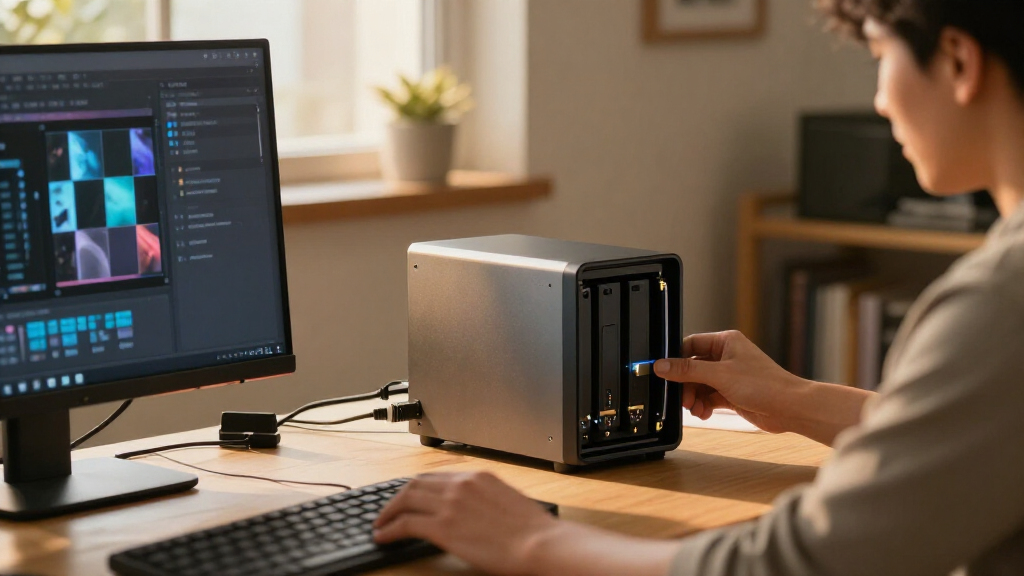

🔍 Read the full analysis: Is The UGREEN NAS DXP4800 Pro A Practical Pick For AI Projects? on ThorstenMeyerAI.com

Get the latest gadgets delivered free with Prime
- Fast, free delivery on millions of items
- Prime Video, Amazon Music and more included
- Member-only deals all year
TL;DR
The UGREEN NAS DXP4800 Pro combines a six-core Intel Core i3-1315U, expandable DDR5 memory, four drive bays and 10GbE networking in a home- and small-team-focused NAS. The product assessment and UGREEN’s listed specifications describe hardware that could suit some self-hosted AI and media workflows, but the assessment provides no performance results for specific AI tasks. Buyers must also supply storage and may need compatible networking.
The UGREEN NAS DXP4800 Pro pairs an Intel Core i3-1315U with expandable memory, four drive bays and 10GbE networking, according to UGREEN’s product specifications. A product assessment, the original analysis, presents it as a possible base for some self-hosted AI and home-server projects. But the assessment reports no tests of particular AI models or workloads, and buyers must plan for drives, software and compatible network equipment.
UGREEN lists 8GB of DDR5 memory, expandable to 96GB, and a six-core, eight-thread processor with a stated maximum frequency of 4.5GHz. The product assessment says that combination can provide room for file serving alongside AI storage, Docker services or virtual machines. For an AI project, those capabilities may support a self-hosted setup, but the assessment gives no benchmark results, tested models or measured inference performance.
UGREEN’s listed storage specifications include four 3.5-inch drive bays and two PCIe 4.0 M.2 slots, with capacity of up to 144TB across four hard drives and two M.2 SSDs. That is a possible configuration, not storage stated as included with the NAS; buyers have to select and purchase drives. The product information lists RAID options 0, 1, 5 and 10. RAID can help preserve access after some drive failures, but it is not a substitute for a separate backup.
UGREEN lists 10GbE and 2.5GbE networking and a maximum transfer speed of 1.25GB/s. That figure depends on a compatible network path and suitable clients, cabling, switches, storage and workload. The product assessment describes UGOS Pro as including media, photo and cloud-sync features, as well as on-device AI photo organization. It does not specify the photo feature’s model or capabilities, or explain how it relates to running other AI workloads.

UGREEN NAS DXP4800 Pro 4-Bay Network Attached Storage
- ✔ Processor: Intel Core i3-1315U, 6 cores, 8 threads, up to 4.5GHz
- ✔ Memory: 8GB DDR5, expandable to 96GB
- ✔ Graphics: 13th Gen Intel UHD Graphics
The 1 picks
- 1
 UGREEN NAS DXP4800 Pro 4-Bay Desktop NAS with Intel Core i3-1315U, 8GB DDR5,…View on Amazon →
Where Its AI Hardware Could Help
The product assessment does not present the DXP4800 Pro’s specifications as proof that it is an AI accelerator, and it provides no AI performance testing. Instead, its processor, memory expansion and storage options, as listed by UGREEN, could give technically inclined users a platform to host services alongside shared files. That may matter to home-lab users seeking to consolidate tasks, provided the software and workload fit the machine.
For teams moving large project files or creators working with video and image libraries, the 10GbE port and four bays could also be useful if the rest of their setup supports them. On a standard gigabit network, the faster port cannot deliver its stated potential. The assessment notes that buyers seeking only automated backups or shared folders may pay for hardware they will not use; a simpler two-bay NAS may be a more practical match.
Cost and setup are part of that decision. UGREEN’s listed maximum capacity should not be confused with ready-to-use storage, since the source material does not state that drives are included. Buyers need to budget for drives and decide how much capacity, redundancy and SSD use their projects require.
A Home NAS Above Basic Storage
The product assessment places the DXP4800 Pro above entry-level NAS devices because UGREEN’s specifications list a four-bay enclosure, an Intel Core i3-1315U, Docker and virtual-machine support, and faster network ports. The assessment contrasts that approach with two-bay models such as the Synology DS223 and DS223j, which may be enough for compact backup and file-sharing needs.
UGREEN’s product information describes tool-free drive trays and an aluminum chassis, and lists a two-year warranty. These product details are not evidence of long-term reliability or a guarantee about noise. A NAS intended to remain available for shared files also requires choices about placement, drives and ongoing backups.
The assessment’s practical verdict is conditional: the UGREEN may be worth considering for people who will use its speed and flexibility, while buyers with simpler storage needs may be better served by a less capable model. The assessment does not base that judgment on a published comparison of measured AI performance or total system cost.
AI Performance Still Unmeasured
The product assessment reports no AI benchmarks, model compatibility tests, inference speeds or memory use for specific tasks. It also does not explain which AI functions can run locally through UGOS Pro, beyond describing on-device AI photo organization. The DXP4800 Pro’s potential for AI projects should therefore be treated as a hardware-based possibility, not a demonstrated performance claim.
The complete purchase cost is also unclear because the source material specifies no drive bundle, and it does not detail the drive configuration behind the 144TB capacity figure. Real-world transfer rates will depend on the network and storage configuration. The assessment does not establish long-term reliability, noise levels or performance under sustained workloads.
Match the NAS to the Workload
Prospective buyers should identify the AI or server tasks they want to run, check that the required software supports their setup, and compare those needs with the NAS’s processor and memory. They should also price the drives, any memory upgrade and compatible networking before comparing it with a simpler NAS or a separate server.
For a stronger assessment of AI suitability, the next useful evidence would be workload-specific testing: named models, configuration details, performance measurements and sustained-use results. The product assessment provides no such data, so the DXP4800 Pro is best described as a flexible NAS that may support some self-hosted projects, not a proven solution for a particular AI workload.
Key Questions
Is the UGREEN DXP4800 Pro proven to run AI workloads well?
No AI benchmark or test of named models appears in the product assessment. UGREEN’s listed processor and expandable memory may support some self-hosted projects, but performance for a particular workload remains unverified.
Does it include hard drives?
The source material does not state that drives are included. UGREEN’s 144TB figure describes a possible configuration; buyers should check the listing and budget for the drives they need.
What network setup is needed to benefit from 10GbE?
UGREEN lists 10GbE networking, but the NAS, client computer, cabling, switches, storage and workload all need to support the transfer path. Without compatible equipment, the network can limit transfer speeds; the source material does not guarantee users will reach the stated maximum.
Is it a good choice for basic backups?
The product assessment says the NAS can provide storage for backups, but its extra hardware may be more than basic backup and file-sharing users need. A simpler two-bay NAS may be a more practical fit for those uses.
Source: ThorstenMeyerAI.com