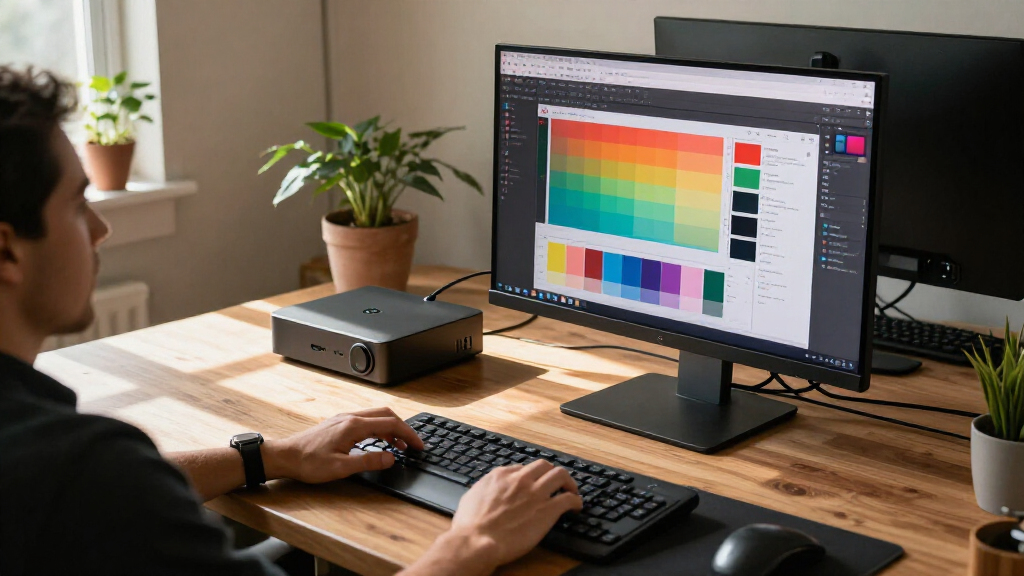

🔍 Read the full analysis: Palette: Teaching A Small Model To Build Decks In Your Design Language on ThorstenMeyerAI.com

Get the latest gadgets delivered free with Prime
- Fast, free delivery on millions of items
- Prime Video, Amazon Music and more included
- Member-only deals all year
TL;DR
Hugging Face says it fine-tuned Palette, an open-weight 20-billion-parameter model, to build slide decks in IBM Design Language using separate planning and coding roles. The company reports first-place rankings in two of three PresentBench domains it measured, but the available account gives no scores, domain names or comparison details.
Hugging Face says it fine-tuned Palette, an open-weight model with 20 billion parameters, to create slide decks in IBM Design Language, as detailed in the original analysis. The company reports that Palette ranked first in two of the three PresentBench domains it measured, while the available account does not provide domain names, scores or evaluation details needed to compare that result independently.
Palette uses one LoRA adapter for two distinct tasks: a designer role that turns a request into a structured JSON brief, and a coder role that writes JavaScript for pptxgenjs to implement each slide. The brief sets out deck content and visual choices, including palette, typography and layouts, and gives a rationale for those choices. The coding stage uses each slide’s specification to produce its layout.
Hugging Face says this division lets slide coding run in parallel and makes that stage about six to seven times faster than running it sequentially. The supplied account does not provide the measurements or test conditions behind the speed figure. It also says coder examples were about five times longer than designer examples, so the team oversampled designer examples fivefold during training to give that role more representation.
For training, Hugging Face says it used a larger open model to synthesize about 1,000 decks, or roughly 10,000 slides. The examples covered different genres, lengths, layouts and input styles. They included counterfactual explanations of why a design choice was made rather than an alternative. The team says it rendered generated decks, checked for overlaps and text overflow, repaired broken slides and added the revised reasoning to the training examples.
A Two-Stage Route to Branded Slides
Palette’s approach addresses two practical obstacles in automated presentation creation: a general-purpose model may not follow a company’s visual identity, and an organization may not want confidential material processed by an external service. Hugging Face presents an open-weight model that could run on an organization’s own infrastructure as one way to give teams more control over style and where inputs are handled.
Those are project motivations, not demonstrated deployment outcomes. The supplied account does not show Palette operating in a company’s environment or establish how private information is protected in practice. Still, the role split offers a concrete design for a demanding task: first decide what each slide should communicate, then translate those choices into slide geometry and code. A structured brief may also make it easier for a person or another agent to review the plan before the deck is rendered.
The benchmark report is a limited signal that a smaller model can do well on some measured deck-generation tasks. It does not establish that Palette is generally better than larger or frontier models, or that its slides are reliable across subjects and organizations. The absence of scores and evaluation conditions makes the result difficult to interpret beyond Hugging Face’s reported ranking.
Products Worth Considering

Bose SoundLink Flex Bluetooth Speaker (2nd Gen) – Portable Outdoor Speaker with Hi‑Fi Audio, Waterproof and Dustproof, USB‑C, Up to 12 Hours

LG UltraGear 27GX704A-B 27-inch QHD OLED Gaming Monitor

Bose QuietComfort Headphones (2nd Gen), Wireless Over-Ear Noise-Cancelling Headphones, Hazelnut Taupe
As an affiliate, we earn on qualifying purchases.
How Palette Separates Planning and Code
Presentation generation involves more than drafting concise text. A system has to decide what belongs on each slide, then determine positions, font sizes and visual elements. Hugging Face says models that write slide code without seeing a rendered result can produce overlapping elements, text overflow or hard-to-read titles. Palette’s planning brief is intended to make deck-wide editorial and visual decisions before the code for individual slides is written.
The project also describes a challenge in creating training data: according to Hugging Face, there is no public corpus that pairs finished decks with the plans, design decisions and code behind them. The team therefore synthesized examples with a larger open model and used rendered-slide checks to identify and repair some layout failures. The account says examples from reference decks helped guide the teacher model when specifications were incomplete, reducing a tendency to fill gaps with invented content more reliably than adding more prompt rules.
Hugging Face used LoRA fine-tuning, which it says made experiments less expensive while adding the deck-building format and skill to the base model. The material supplied for this report focuses on IBM Design Language. It describes the possibility of training in a user’s design language, but does not provide results for other systems.
“The designer handles the editorial judgment, and the coder handles the geometry.”
— Hugging Face, describing Palette’s approach
Benchmark and Release Details Missing
The supplied account does not name the three PresentBench domains, give Palette’s scores, identify the competitors or describe the evaluation conditions. It is not possible from the reported rankings alone to assess the size of the lead, compare results across systems or determine how the test maps to day-to-day presentation work.
Other details are also absent: the account does not identify Palette’s 20B base model, provide a release date, or say whether weights, code and evaluation results are publicly available. It does not include independent testing or results on design languages beyond IBM’s. Performance on complex data, long decks and presentations with strict factual requirements remains unreported. The team’s account of checks for overflow and overlap also does not establish how often those checks miss problems.
Hugging Face describes a risk that Palette may invent content when its brief lacks information, and says reference-deck examples helped address that behavior. The available material does not quantify how often unsupported facts occur after training. Nor does it specify operational safeguards for private deployments or establish that running the model locally, by itself, protects sensitive information.
Public Weights and Wider Testing
The supplied material does not announce a date for a Palette release or say when model weights, code or full PresentBench results might become available. Those details would allow developers to reproduce the workflow and test the reported rankings against other systems. Until then, the benchmark placement and speed improvement should be understood as claims reported by the project team, not independently verified comparisons.
Further evaluation could clarify how Palette performs across different design languages, longer decks and presentations involving complex data or strict factual constraints. Results on unsupported content, layout errors and the effectiveness of the rendering checks would also help readers judge whether the method is dependable beyond the examples described. Hugging Face has not provided a schedule for such testing in the supplied account.
Key Questions
What is Palette?
Palette is a 20B open-weight model that Hugging Face says it fine-tuned to create slide decks in IBM Design Language. It uses a planning role to produce a structured deck brief and a coding role to generate slide layouts.
What did Hugging Face report on PresentBench?
The company says Palette ranked first in two of three measured domains. The supplied account does not name those domains or provide scores, competitors or test conditions, so the result cannot be independently compared from the information available here.
How does Palette make slide decks?
A designer role creates a JSON brief with content and visual decisions. A coder role then writes pptxgenjs JavaScript for each slide. Hugging Face says slide coding can run in parallel and takes about six to seven times less time than sequential coding, though test details were not supplied.
Can organizations use Palette with private material?
Hugging Face presents running an open-weight model on an organization’s own infrastructure as a possible way to control where inputs are processed. The account does not report a deployment or explain its security safeguards, so it does not establish how well Palette protects sensitive material in practice.
Is Palette publicly available?
The supplied material does not say whether the model weights or code have been released, identify a license or give a release date. Public availability is therefore unclear.
Primary source: Hugging Face · via ThorstenMeyerAI.com