TL;DR

Get the latest gadgets delivered free with Prime
- Fast, free delivery on millions of items
- Prime Video, Amazon Music and more included
- Member-only deals all year
Neufangled Robotics is presenting Stringman, an open-source, cable-driven gripper robot priced at about $800 that moves through a room from four ceiling-mounted anchors. The company says it can carry up to 2.2 kilograms near the floor and averages 1.9 kilograms across a specified 7-by-7-by-3-meter workspace; independent performance testing and broader installation details are not provided in the source material.
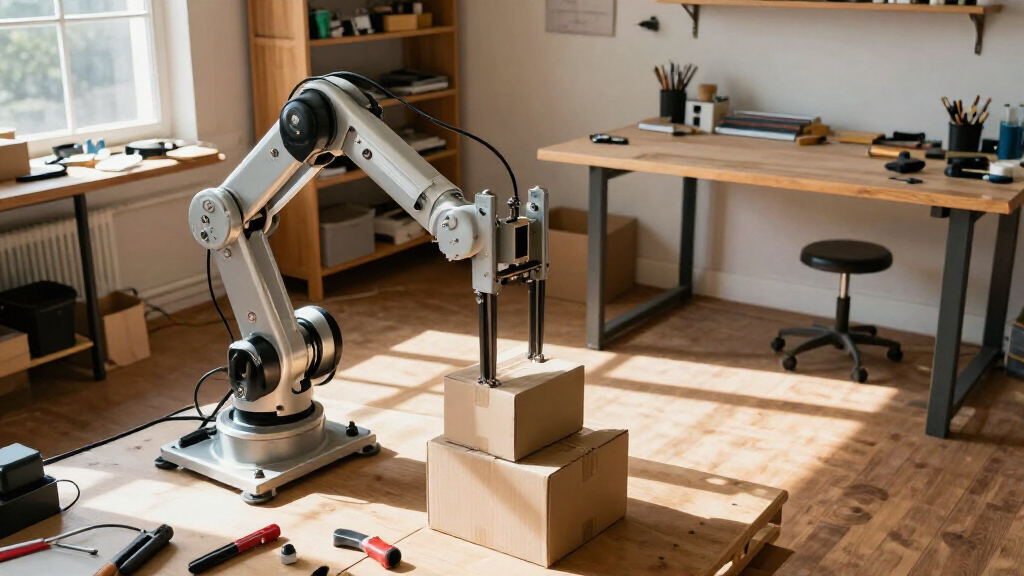
Neufangled Robotics is offering Stringman, an open-source, cable-driven robot that uses four motors and lines attached near a room’s ceiling to move a gripper across the space. The company lists the system at $795 and says it can carry up to 2.2 kilograms near the floor, positioning it as an alternative to desktop robot arms for moving objects between locations around a room.
Stringman’s four anchors mount near the ceiling, typically at the room’s corners, and control the gripper by changing the lengths and tensions of its lines. The company describes the arrangement as a way to reach a room-scale work area without a wheeled or legged base. Its published specifications cover room dimensions with an XY diagonal of 3 to 10 meters and heights of 2.3 to 4 meters; the payload and work-volume comparisons cited on the site use a 7-by-7-by-3-meter room.
For that example room, Neufangled reports an average payload of 1.9 kilograms across the work volume, with a maximum of 2.2 kilograms near the floor. The company says those payload figures are calculated at a 28-newton line-tension limit and subtract the 638-gram gripper and marker. It also lists a traverse speed of about 0.4 meters per second. These are manufacturer-provided figures; the supplied material does not include independent testing.
The system uses an external computer as its controller, with a Raspberry Pi Zero 2W on the gripper and Pi 3A+ units at the anchors. Neufangled says it connects over Wi-Fi and can run locally on a home network, with the interface served on that network and AI models running on the owner’s hardware. The company says the mechanical CAD, circuit-board designs and control software are published, and describes the project as open source and OSHWA certified.
A Robot That Uses the Ceiling
Stringman proposes a different trade-off from a conventional robot arm: rather than fitting a limited reach into a desktop footprint, it uses lines suspended above the work area to move a gripper through a much larger space. That could suit home laboratories and multi-workcell setups where small parts need to move between equipment and floor space is crowded. Neufangled presents it as a courier for other robots, with a Python API and MCP server intended to support automated workflows.
The company’s comparison gives Stringman a 147-cubic-meter work volume in a 7-by-7-by-3-meter room and compares it with a 0.75-meter research arm. It says the room-scale system offers roughly 500 times the work-area volume per dollar at a comparable payload. That comparison reflects the company’s chosen room size, arm and pricing assumptions; it is not a general measure of performance across all robot arms or installations.
The price and open hardware may make room-scale manipulation easier for researchers and hobbyists to investigate than a custom-built system. But the installation requires secure mounting near the ceiling, a compatible room and lines that remain present while the robot is set up. Those practical requirements, alongside payload, speed and reliability in everyday use, will shape whether the design is useful beyond demonstrations and home-lab work.
Products Worth Considering

Bose QuietComfort Wireless Noise-Cancelling Over-Ear Headphones, Black

Samsung Galaxy Tab A11+ 11-Inch Tablet, 6GB RAM, 128GB Storage, Expandable, Gray

Jackery Explorer 300 Portable Power Station, 292Wh
As an affiliate, we earn on qualifying purchases.
How the Cable System Works
In a cable-driven robot, motors move a tool by adjusting lines attached at separated points, rather than by extending a chain of rigid arm segments. Stringman’s four ceiling anchors define its working area, while cameras at the anchors and on the gripper provide visual information for control. According to Neufangled, setup includes mounting the anchors, connecting the lines and running an automated calibration that adapts the system to the room.
The design’s room-scale reach depends on a room where the anchors can be fastened to appropriate structure. The company lists wooden-stud-backed drywall, plaster-wall mounts and structural columns as mounting options. It says the lines sit near the ceiling when the robot is parked and can be detached from their mounts without tools, though the wall cleats remain. Neufangled reports that the system has accumulated about 1,000 hours of testing in real homes; the source does not describe the test protocol or publish results from those hours.
“Tension is all you need.”
— Neufangled Robotics
Installation and Testing Questions
The published figures do not establish how Stringman performs across different room layouts, object shapes or operating conditions. The source provides company-reported payload and speed specifications, but no independent evaluation, detailed test methodology or failure-rate data. It also does not specify how the $795 listed price changes with shipping, taxes, required computer hardware, mounting supplies or assembly effort.
Installation safety depends on securing the anchors to suitable structural points and arranging the lines around fixtures. Neufangled says the motors relax when line tension reaches 28 newtons, allowing lines to be pulled loose, and advises placing anchors at or below ceiling-fan blade height so lines cannot reach the fan. The source does not provide independent safety testing or a complete assessment of risks for people, pets and fragile objects in an operating room. Its local-network privacy description is also the company’s own account, rather than an external audit.
What Buyers Can Verify
Readers considering the system can check Neufangled’s published bill of materials, build guide, CAD files and code against their room and computing setup. The company says calibration takes about five minutes after installation, but the source does not describe a formal rollout schedule or independently verified installation times. Practical next steps for evaluating the announcement include confirming current pricing and availability, reviewing the mounting requirements, and testing performance in the intended room.
Further documentation or third-party testing could clarify real-world payload consistency, reliability, setup effort and operation around people and household fixtures. Until that evidence is available, Stringman’s room coverage, payload, speed and testing-hour figures should be treated as manufacturer-reported specifications, not independently established results.
Key Questions
What is Stringman?
Stringman is a cable-driven gripper robot from Neufangled Robotics. Four ceiling-mounted anchors control lines that move its gripper around a room.
How much does it cost and what can it carry?
Neufangled lists a price of $795. The company reports a maximum payload of 2.2 kilograms near the floor and an average of 1.9 kilograms in a specified 7-by-7-by-3-meter room, net of the gripper and marker.
Does Stringman need cloud access?
Neufangled says Stringman can run on a local Wi-Fi network, with its interface served locally and AI models running on the owner’s hardware. The company also describes optional remote access through an account-linked service.
What does installation require?
The anchors need to be secured near the ceiling to suitable supports, such as wall studs or structural columns. The system also requires a computer to run the controller, a drill and a ladder, according to the company’s installation information.
Have its performance claims been independently verified?
The provided source presents specifications and testing-hour figures from Neufangled Robotics. It does not include independent performance or safety testing, so those claims should be understood as company-reported.
Source: neufangled.com