
TL;DR

Get the latest gadgets delivered free with Prime
- Fast, free delivery on millions of items
- Prime Video, Amazon Music and more included
- Member-only deals all year
Pixelatron has published a longer, previously unpublished version of a 2001 interview with Super Mario 64 programmer Giles Goddard. The material describes the game’s early development on SGI systems, a team Goddard estimated at about 15 people, and Shigeru Miyamoto’s role in experiments that included the interactive Mario face.
Pixelatron has published an unpublished, unedited version of a 2001 interview with Giles Goddard, a programmer who worked on Nintendo’s Super Mario 64. The account adds detail to the game’s development, including early work on SGI computers, the small core team and Goddard’s contribution to the interactive Mario face that greeted players.
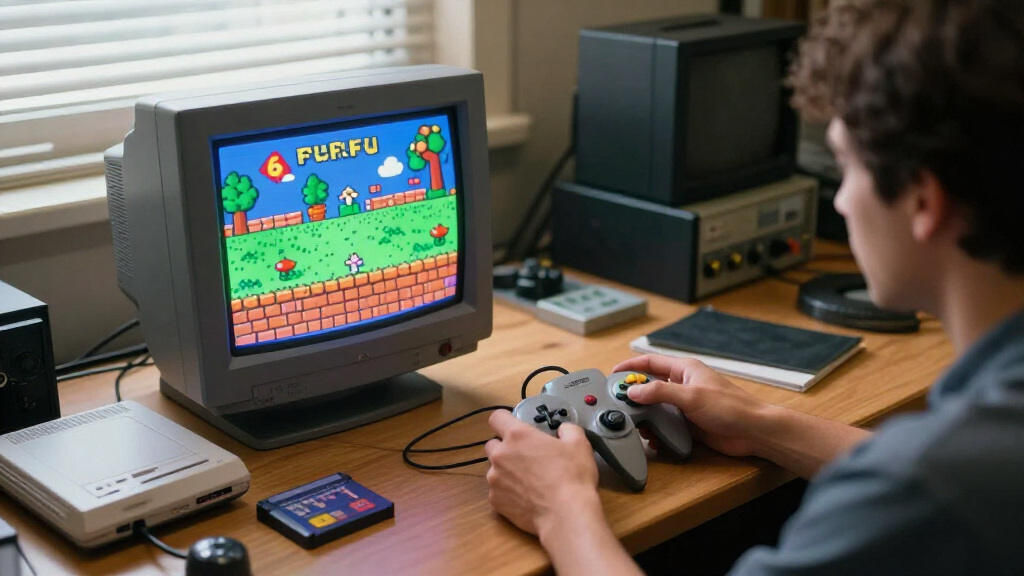
Goddard recalled that the project began before Nintendo had final N64 hardware. The team used SGI Onyx systems and later Indy workstations, running an emulator that recreated the system’s programming interface rather than the console’s hardware. He described early tests in which a Mario character moved around a simple grid, with animation and basic interactions taking shape before the larger game was built.
Asked about the team’s size, Goddard estimated there were about 15 people on Super Mario 64 by the end, while noting that other staff contributed behind the scenes. He characterized it as a smaller group than the team on The Legend of Zelda: Ocarina of Time. The interview also describes Nintendo’s open-plan office, where artists and programmers were organized in groups and project teams could draw on nearby staff.
Goddard said he worked on the Mario face, initially experimenting with real-time changes to individual points on a model. He recalled that Shigeru Miyamoto asked him to make a Mario face using the technique. Goddard said Miyamoto was closely involved with the project and spent time trying development demos. He also described months of experimentation with camera perspectives as the team worked out how to make Mario feel natural in three dimensions.
How Early Experiments Shaped Mario 64
The interview offers a developer’s recollection of choices behind a game that helped establish how a major platform series could work in three-dimensional space. Its account connects the familiar face interaction and character animation to technical experiments that began before the game’s environments and full play structure were in place.
It also gives readers a view of production at Nintendo during the N64’s early development: a relatively small core group, tools running on SGI computers and close involvement from Miyamoto. These details are useful historical testimony, but they come from a participant recalling events years later, not from contemporaneous production records presented alongside the interview.
As an affiliate, we earn on qualifying purchases.
From SGI Prototypes to the N64
According to Pixelatron’s introduction, parts of the 2001 interview appeared in NGC magazine, while the newly posted version is longer and includes material omitted from that article. The publisher says it was released as part of a retrospective marking Mario’s 25th birthday; it does not provide a precise date for the original conversation in the supplied account.
Goddard’s descriptions trace the project from early emulation to experiments in movement, animation and camera control. He recalled that the first tests involved Mario moving across a simple grid, while the team explored different ways of viewing the game world. One early approach used a more fixed, isometric-like perspective, before the team continued testing camera views intended to carry the feel of 2D Mario into a three-dimensional game.
“Probably about 15 people in the end.”
— Giles Goddard, in the 2001 interview
Super Mario 64 Nintendo 64 cartridge
As an affiliate, we earn on qualifying purchases.
As an affiliate, we earn on qualifying purchases.
Limits of the Recovered Interview
Pixelatron cautions that its notes are rough and that the interview’s questions are guesses: the interviewer says they did not keep a record of the exact questions asked. The supplied material therefore does not establish a verbatim transcript of the original exchange, even though the publisher describes the version as unedited.
Goddard also framed several details as estimates or recollections, including the team size and his job title. The account does not provide production documents to verify those memories, nor does the material supplied here include the complete interview: it ends during a discussion of camera development. The full scope of the posted version and any additional details beyond the excerpt cannot be confirmed from the source text provided.
As an affiliate, we earn on qualifying purchases.
What Readers Can Verify Next
Pixelatron’s post is the next point of reference for readers seeking the expanded interview, while the earlier NGC article provides a comparison for material that was previously published. No further publication, correction or follow-up is announced in the supplied source. The precise original interview date and a full record of the questions remain unavailable in the account.
video game development history book
As an affiliate, we earn on qualifying purchases.
As an affiliate, we earn on qualifying purchases.
Key Questions
What is the new development?
Pixelatron published a longer version of a 2001 interview with Giles Goddard about making Super Mario 64. The site says parts had previously appeared in NGC magazine.
What did Goddard do on Super Mario 64?
Goddard recalled working on the interactive Mario face and experimenting with real-time changes to points on a character model. He said he could not remember his exact official job title.
How large was the development team?
Goddard estimated the team had about 15 people by the end. He qualified that estimate by saying other people also contributed behind the scenes.
How reliable is the interview as a transcript?
Pixelatron describes it as an unpublished, unedited version, but says the notes are rough and the questions are reconstructed guesses because the interviewer did not keep a record. Some development details are also Goddard’s recollections rather than independently documented facts in the post.
Source: hn
Columbus Day / Indigenous Peoples' Day Picks
long weekend sales
As an affiliate, we earn on qualifying purchases.