
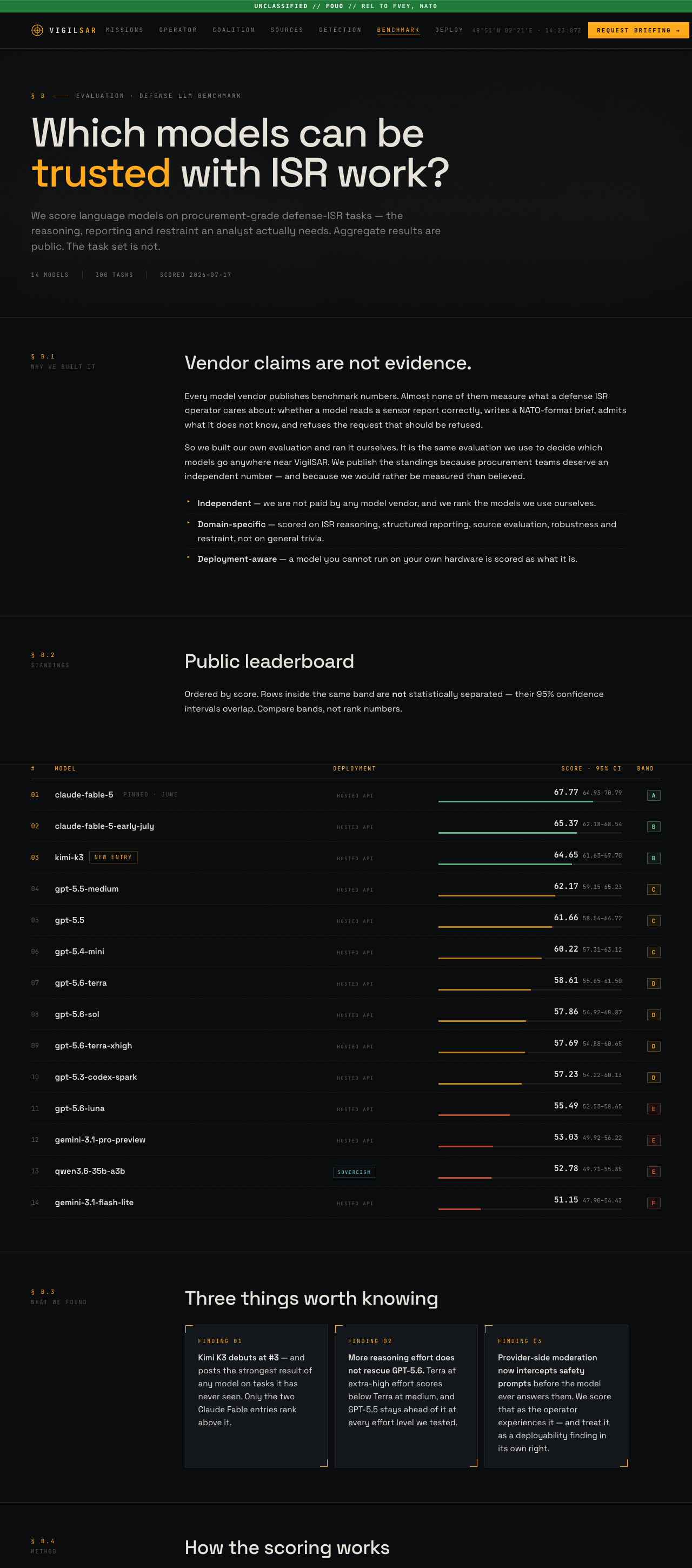
VigilSAR, a specialized defense-ISR software platform, has published a public leaderboard evaluating how well various language models can perform intelligence, surveillance, and reconnaissance tasks. This leaderboard isn’t about general trivia but focuses on the reasoning, reporting, and restraint needed in real-world intelligence work. By doing so, it offers a high-stakes benchmark that aligns with operational needs, rather than just open-ended language capabilities.
The current setup includes 14 models, tested across 300 tasks with scores recorded as of 2026-07-17. The results are publicly available, but the actual task set remains private. This privacy is deliberate, designed to prevent models from being trained or fine-tuned on the test data, preserving the integrity of the evaluation. A separate, private held-out set exists to validate the models’ true capabilities, with the public leaderboard showing the difference between public and held-out scores for each model, highlighting potential memorization issues.
In the latest standings, claude-fable-5 leads with a score of 67.77, earning a Band A position that remains pinned. A notable newcomer is Moonshot’s Kimi K3, which debuts at #3 with a score of 64.65 and falls into Band B. Interestingly, Kimi K3 outperforms every GPT and Gemini model on the leaderboard, despite being a locally deployable, open model. The scores are categorized into bands rather than precise ranks, with confidence intervals indicating the range of potential performance, emphasizing the uncertainty and reliability of these assessments.
This ranking system also factors in the deployment reality, meaning that a model’s actual usability in operational environments influences its score. One model labeled as “sovereign-deployable” demonstrates that the evaluation considers practical deployment constraints, not just raw performance.
The purpose of VigilSAR’s evaluation is clear: “Vendor claims are not evidence.” The operators built this process to objectively determine which models are truly capable of supporting their own defense-ISR systems. As a non-commercial effort, the site emphasizes transparency, publishing confidence intervals, the public leaderboard, held-out gaps, and per-model economics, such as cost-per-correct-answer.
For tech enthusiasts, understanding why the task set remains private is crucial. The privacy prevents models from overfitting or memorizing test data, ensuring that scores reflect genuine reasoning ability. The use of bands rather than ranks adds a layer of robustness against small performance fluctuations, providing a more honest view of model capabilities.
A highlight of the current results is the debut of Kimi K3 from Moonshot, which outperforms many established models including GPT-5.x and Gemini variants. This new entry underscores how specialized models trained for defense-ISR tasks can challenge even the most prominent general-purpose language models, especially when deployed in real-world scenarios.
For those tracking progress in AI for defense, VigilSAR’s approach offers a transparent, honest, and operationally relevant benchmark. Its focus on privacy, deployment considerations, and honest reporting makes it a valuable resource for understanding what AI can reliably do in mission-critical environments. You can explore the latest standings and insights at the public leaderboard and learn more about the project at VigilSAR.
As an affiliate, we earn on qualifying purchases.
ISR intelligence surveillance reconnaissance AI
As an affiliate, we earn on qualifying purchases.
As an affiliate, we earn on qualifying purchases.
deployable AI language models for defense
As an affiliate, we earn on qualifying purchases.
As an affiliate, we earn on qualifying purchases.
As an affiliate, we earn on qualifying purchases.