
📊 Full opportunity report: Outcome-First Decisions: Keep, Change, or Kill on ThorstenMeyerAI.com — validation score, market gap, and execution plan.
TL;DR
Outcome-First is a decision framework that guides organizations to evaluate ongoing initiatives by their current outcomes, enabling more effective pruning of projects. It emphasizes stopping efforts that no longer produce value, fostering better resource allocation.
A new decision-making framework called Outcome-First is emerging as a tool for organizations to evaluate their ongoing projects and commitments based solely on current outcomes and costs, rather than past efforts or sunk costs. Developed as an open-source project, it aims to address the common problem of portfolio bloat by encouraging deliberate stopping of initiatives that no longer justify their expenses.
Outcome-First is built around a core question: given the current state of an initiative, is the outcome it produces worth its ongoing cost? This simple but powerful question replaces traditional backward-looking assessments that focus on past investments or effort, which often lead to keeping unproductive projects alive. The framework introduces the ‘Worth Filter,’ a mechanism that forces decision-makers to evaluate forward-looking outcomes rather than emotional or sunk-cost biases.
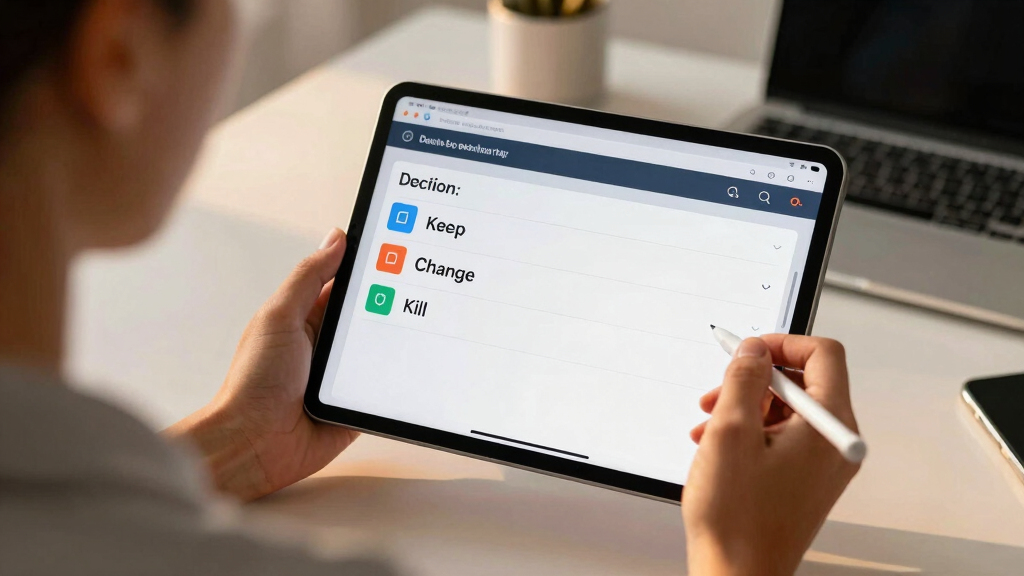
Decisions are categorized into three verdicts: ‘keep’ (continue because outcomes justify costs), ‘change’ (modify to improve outcomes), or ‘kill’ (terminate because outcomes no longer justify costs). The framework is designed to be provider-agnostic, local-first, and licensed under AGPL-3.0, ensuring openness and adaptability. It aims to be the final step in a portfolio management cycle, closing the loop after ideation and planning phases, and enabling routine pruning to prevent portfolio silt-up.
Outcome-First Decisions — keep, change, or kill
The hardest decision isn’t what to start — it’s what to stop. Judge every initiative by the outcome it produces now, not the effort already spent.
Independent commentary, produced with AI assistance under human editorial oversight. The views are the author’s own and may change. Outcome-First Decisions is open source under AGPL-3.0, provided “as is” without warranty; see the repository LICENSE. The framework’s verdicts are reasoning aids based on the inputs given and may be wrong — decision support, not decisions; verify independently before acting. Product and company names are trademarks of their respective owners; mention does not imply endorsement.
Why Outcome-First Matters for Organizational Efficiency
This framework addresses a longstanding challenge in portfolio management: the tendency to continue supporting initiatives due to emotional attachment, sunk costs, or effort justification. By focusing solely on current outcomes, organizations can free up resources, reduce waste, and improve overall productivity. It emphasizes that the cost of maintaining inactive or unproductive projects often exceeds their perceived value, yet these projects drain attention and capital. Implementing Outcome-First can lead to more disciplined decision-making and a leaner, more effective portfolio.

Manage Your Project Portfolio: Increase Your Capacity and Finish More Projects
As an affiliate, we earn on qualifying purchases.
As an affiliate, we earn on qualifying purchases.
The Need for Better Portfolio Pruning Methods
Many organizations struggle with long tail of ongoing projects that neither succeed nor are terminated. This phenomenon, often called ‘portfolio silting,’ results from emotional biases and reluctance to stop initiatives, despite evidence they no longer deliver value. Traditional evaluation methods tend to focus on past effort or investment, which can reinforce continuation biases. The Outcome-First framework responds to this by shifting the focus to current outcomes, encouraging routine pruning and better resource allocation.
“Outcome-First is a decision discipline that institutionalizes the hardest part of portfolio management: stopping. It helps organizations cut their losses and reclaim capacity.”
— Thorsten Meyer
decision-making framework tools
As an affiliate, we earn on qualifying purchases.
As an affiliate, we earn on qualifying purchases.
Uncertainties in Outcome Measurement and Application
While the framework promotes outcome-based decisions, it relies heavily on accurate measurement of current outcomes. There is a risk of mismeasuring or gaming metrics, which could lead to premature or unjustified kills. Additionally, it is unclear how well the framework handles slow-start initiatives that may appear unproductive initially but could yield value over time. The emotional and cultural factors influencing decision-makers remain a challenge, as the framework cannot override human reluctance to stop.
outcome-based project evaluation software
As an affiliate, we earn on qualifying purchases.
As an affiliate, we earn on qualifying purchases.
Next Steps for Adoption and Refinement
Organizations interested in Outcome-First are encouraged to test the framework within their portfolios, adapting metrics and decision thresholds as needed. Developers are expected to further refine the tool, especially around outcome measurement and slow-start initiatives. Broader adoption will depend on case studies demonstrating its effectiveness in reducing portfolio bloat and improving resource allocation. Continued community engagement and feedback are expected to shape future iterations.
resource allocation tools for organizations
As an affiliate, we earn on qualifying purchases.
As an affiliate, we earn on qualifying purchases.
Key Questions
How does Outcome-First differ from traditional portfolio management?
Outcome-First focuses on current outcomes and costs to decide whether to keep, change, or kill initiatives, rather than relying on past investments or effort. It aims to make stopping a deliberate, routine decision.
Can Outcome-First be applied to all types of projects?
While designed to be provider-agnostic and flexible, its effectiveness depends on the ability to measure relevant outcomes accurately. Slow-start projects may require careful metric selection to avoid premature termination.
Is Outcome-First open source?
Yes, the framework is released under the AGPL-3.0 license and is available on GitHub for anyone to adopt and adapt.
What are the main risks of using Outcome-First?
The primary risks include mismeasuring outcomes, gaming metrics, and making premature kills of projects that could yield long-term value. It also does not eliminate emotional resistance to stopping initiatives.
How often should organizations review their portfolios using Outcome-First?
Frequent reviews are recommended, especially since the framework runs on local compute and can be integrated into routine decision cycles to prevent portfolio silting.
Source: ThorstenMeyerAI.com