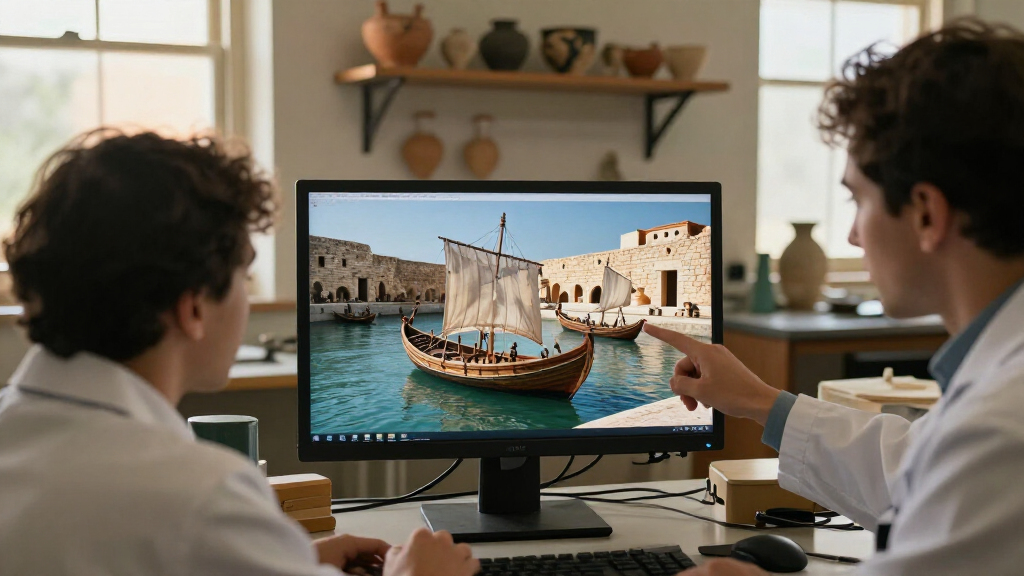
🔍 Read the full analysis: Is Grok’s AI-Generated The Odyssey Historically Accurate? Grok Says No on ThorstenMeyerAI.com

Get the latest gadgets delivered free with Prime
- Fast, free delivery on millions of items
- Prime Video, Amazon Music and more included
- Member-only deals all year
TL;DR
WIRED’s headline reports that Grok described an AI-generated version of Homer’s The Odyssey as “not historically accurate.” The available source does not include the article body, generated work, or full exchange, so the reasons for the caveat and the output’s intended purpose cannot be confirmed.
WIRED’s headline, as summarized in the original analysis, reports that Grok, the chatbot associated with xAI, described an AI-generated version of Homer’s The Odyssey as “not historically accurate.” The article body was unavailable in the source material, leaving the generated work, Grok’s full wording and the basis for its caveat unconfirmed.
The available report establishes a narrow point: WIRED’s headline attributes the accuracy caveat to Grok and identifies the work as an AI-generated version of The Odyssey. It does not provide the chatbot’s complete answer or show the output it was discussing. The quoted wording is therefore evidence of a reported qualification, not an independent assessment of the work’s accuracy.
There is no confirmed information in the material about the prompt, the format of the output, or when the exchange occurred. It is also not clear whether Grok volunteered the caveat or gave it in response to a question. Without that surrounding exchange, readers cannot determine what the phrase referred to or whether Grok identified particular historical claims as inaccurate.
The source does not establish that the generated work was presented as a scholarly reconstruction, that a reader was misled, or that any specific historical detail was disputed. Nor does it include a response from a historian, the creator of the output, or another independent reviewer. Those limits mean the report supports only the attributed caveat—not a broader conclusion about the quality or reliability of the generated version.
Why the Accuracy Caveat Matters
A label such as “not historically accurate” can help readers distinguish creative retelling from a history-focused account. That distinction matters because an AI-generated version of a classical poem might be made for entertainment, education, or an attempted reconstruction, and each purpose invites different expectations. The available material does not say which purpose applied here.
The report also illustrates a limit of relying on a chatbot to characterize its own output. A model’s warning may signal that the material should not be treated as a reliable historical account, but the warning alone does not show which details are wrong, why they are wrong, or what evidence supports the judgment. Specific claims and comparison with relevant sources would be needed to evaluate the output.
That is a practical implication, not proof that this particular version contains errors that have been independently identified. The headline does not show that the work claimed scholarly authority or that anyone relied on it as fact. Until the output and exchange are available, the caveat is best understood as a reported qualification whose scope remains unknown.
Products Worth Considering

Samsung 27-inch Odyssey OLED G6 QD-OLED QHD Gaming Monitor

Amazon Kindle Paperwhite Signature Edition (12th Generation, 2024), 32 GB, Metallic Black

Samsung Galaxy Tab S10 FE 128GB Wi-Fi Android Tablet, Blue
As an affiliate, we earn on qualifying purchases.
The Epic Behind the AI Version
The Odyssey is an ancient Greek epic traditionally attributed to Homer. It recounts Odysseus’s journey home after the Trojan War, combining mythic episodes with a literary story of travel, conflict and return. The poem’s subject and setting do not, by themselves, make every modern adaptation a historical reconstruction.
A retelling can adapt the epic’s characters and plot while taking creative liberties. A work that makes claims about ancient Greek life or historical conditions would raise different questions from one framed as imaginative fiction. The available WIRED headline calls the version AI-generated but does not say whether it retold the plot, depicted a particular period, or made claims about ancient history. No timeline or earlier statement can be established from the material provided.
““Not historically accurate.””
— Grok, as quoted in WIRED’s headline
What the Report Does Not Show
The source material does not include the AI-generated version or the full conversation in which Grok reportedly made its comment. It therefore cannot establish what prompt produced the work, whether it was text or another format, or whether the caveat followed a user’s question. The date of the exchange is also unavailable.
It remains unclear what standard of historical accuracy Grok was applying and whether it named any specific inaccuracies. The material includes no independent review, supporting evidence, or response from a historian or user. It also does not establish whether WIRED’s full article supplies additional details beyond the headline available here. Without those points, readers cannot assess how much the caveat says about the output or whether it accurately describes its contents.
Details Needed to Assess the Output
The most useful next information would be WIRED’s full account, including the generated work and the conversation around Grok’s caveat. That could clarify what the system was asked to produce, how the result was framed, and whether Grok pointed to concrete historical claims.
Until those details are available, the reported wording should be treated as a caveat, not a verdict on specific historical assertions. A fuller assessment would require examining the output and comparing any historical claims it makes with relevant evidence. The available material does not identify a further statement, review, or publication date to watch for.
Key Questions
What did Grok reportedly say about the AI-generated version of The Odyssey?
WIRED’s headline quotes Grok describing it as “not historically accurate.” The full response is not available in the supplied source material.
What was the AI-generated version like?
The available report does not show the work or describe its format, prompt, contents, or intended audience. It is not clear whether it was a creative retelling or a history-focused reconstruction.
Did Grok identify specific historical errors?
The material provided does not list any errors or explain the basis for the caveat. It also contains no independent assessment of the output.
Does the caveat prove the generated work was misleading?
No. The reported phrase signals a qualification, but the available information does not establish that the work was presented as factual, that a reader was misled, or that particular claims were wrong.
Primary source: xAI · via ThorstenMeyerAI.com