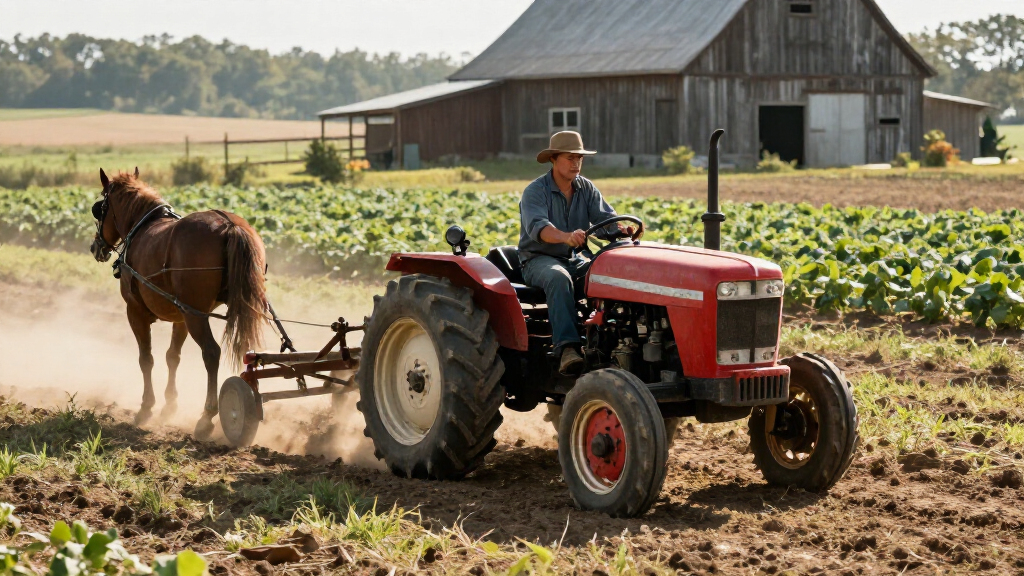
🔍 Read the full analysis: What Happened When Farms Switched From Horses To Tractors? on ThorstenMeyerAI.com

Get the latest gadgets delivered free with Prime
- Fast, free delivery on millions of items
- Prime Video, Amazon Music and more included
- Member-only deals all year
TL;DR
U.S. farms shifted from horses and mules to tractors over several decades: tractors numbered about 1,000 in 1910 and 4.7 million in 1960, while farm horses and mules fell from a 1918 peak of 26.7 million to 3.1 million. The change released land previously used to grow animal feed and reduced farm employment, while many workers moved into other sectors. The horse-to-tractor comparison is a historical analogy, not proof of what automation will do to workers today.
U.S. farms replaced most working horses and mules with tractors between the early and mid-20th century, a shift that reduced the land needed to grow animal feed and helped transform agricultural employment. Farm horses and mules reached 26.7 million in 1918; by 1960, the count had fallen to 3.1 million, while tractors on farms had climbed to about 4.7 million, according to historical figures cited by ThorstenMeyerAI.com.
The change unfolded over decades rather than in a single leap. About 1,000 tractors were on U.S. farms in 1910, rising to 246,000 in 1920 and 920,000 in 1930. The count reached 1.57 million in 1940 and 3.39 million in 1950. Around 1955, tractors outnumbered horses and mules for the first time, with approximately 4.35 million tractors against 4.31 million animals. By 1960, the tractor count stood at 4.69 million.
The animals required substantial acreage for feed. The source, drawing on historical U.S. Department of Agriculture statistics, says about 93 million acres of harvested cropland grew feed for horses and mules in 1915, out of 340 million harvested acres overall. Feed acreage fell to about 5 million acres by 1960. Tractors needed fuel when operating rather than feed every day, allowing former feed-growing land to be used for other crops.
Tractors were part of a broader mechanization of farm work. Combine harvesters, which cut, threshed and cleaned grain in one pass, grew from about 4,000 on U.S. farms in 1920 to more than 1 million in 1960. Farm employment fell from a peak of 13.6 million in 1916 to 4.5 million in 1970, even as the overall U.S. labor force doubled, according to the figures presented in the source. It also reports that one farm worker supplied 7.1 people in 1910 and 47.1 in 1970; the latter estimate includes people abroad supplied by exports.
How Mechanization Reshaped Farm Work
The tractor shift changed more than the source of farm power. It reduced the acreage devoted to feeding working animals and increased the capacity of each farm worker to produce agricultural goods. The figures point to a major productivity change: the number of people supplied by each farm worker rose from 7.1 in 1910 to 47.1 in 1970, although that measure reflects a mix of machinery, improved seed, fertilizer and other changes, not tractors alone.
The employment consequences were substantial. As fewer people were needed for farm labor, workers and their families had to find livelihoods elsewhere, often in cities, according to the account. The aggregate figures do not say how individual workers experienced the change or how many moved directly into particular jobs. They do show that agricultural employment fell while the wider labor force grew, a reminder that productivity gains can reshape where work happens and which skills employers need.
The history also matters in current debates about automation. The source links the tractor story to concerns that machines could replace human workers, while warning that the comparison has limits. Farm animals were not workers with political rights or livelihoods; people are. The past can show how a technology altered production and employment, but it cannot by itself predict how present-day automation will affect wages, job creation or the pace of change.
Products Worth Considering

Amazon Kindle Paperwhite (2024), 16 GB, 7-inch Display, Black

EcoFlow Delta 3 Portable Power Station – 1024 Wh, 1800 W

Samsung Odyssey G4 25-inch FHD Gaming Monitor
As an affiliate, we earn on qualifying purchases.
From Fordson to Farm Machinery
Gasoline tractors predated the First World War, but early models were heavy and expensive, making them more suited to large farms. The Henry Ford museum describes the Fordson, launched by Henry Ford in 1917, as the first mass-produced, inexpensive lightweight tractor designed for small farmers. The museum says it rapidly became the most popular tractor in America. The 100,000th Fordson left the assembly line on February 21, 1920.
Other machinery added to the shift. The source lists combines, corn pickers, balers and milking machines, alongside fertilizer and better seed, as parts of the wider change in farm productivity. Historical counts need some care: tractor totals for the listed decades come from census figures with differing reference dates, and the Department of Agriculture counted horses and mules together from 1951. The 1918 peak refers to the combined total of horses and mules; horses alone peaked earlier, in 1915, at 21.4 million.
The account also frames the story internationally, mentioning China, Germany and Japan, and refers to modern autonomous farm equipment. Those subjects are not detailed in the figures supplied for the U.S. history. The documented U.S. timeline is the clearest basis for understanding how the transition happened: tractors spread, animal numbers declined, and other farm technologies expanded alongside them.
“The first mass-produced and inexpensive lightweight tractor”
— The Henry Ford museum, describing the Fordson
Limits of the Historical Comparison
The historical figures establish the scale and direction of the U.S. shift, but they do not trace the paths of individual farm workers. The figures provided do not show how many displaced workers moved to cities, what jobs they took, or how the benefits and costs were distributed among farms and communities. Nor do they isolate the tractor’s contribution from other changes, including combines, improved seed and fertilizer.
The source raises comparisons with mechanization in China, Germany and Japan and with today’s driverless tractors, but the material provided does not include enough detail to assess those cases fully. It mentions a John Deere 16-camera autonomy kit, announced in February 2025, for tillage on selected large tractors, and reports that China said about 74% of ploughing, sowing and harvesting was mechanized in 2023. The definitions, methods and independent verification behind those current figures are not supplied here. The horse analogy also cannot settle how artificial intelligence or robotics will affect human employment today.
What Modern Farm Automation Can Do
The next question is how far current farm automation can move beyond specific tasks. The account describes the cited John Deere system as limited to tillage on select large tractors, rather than as a technology that can run every kind of farm work without people. It also cites China’s reported 2023 mechanization rate for ploughing, sowing and harvesting, but offers no further data to show how that figure is defined or how it has changed over time.
For readers comparing past and present, the useful next evidence would include independently checked measures of which tasks autonomous equipment performs, how widely farms adopt it, and what happens to labor needs and operating costs. The historical record shows that tractors spread over several decades, alongside other innovations, and that farm employment declined as the wider economy expanded. It does not establish the pace or employment effects of today’s machines. Those outcomes remain open questions as farm technologies and their use develop.
Key Questions
When did tractors outnumber horses and mules on U.S. farms?
They crossed around 1955, when the figures cited in the source show about 4.35 million tractors and 4.31 million horses and mules.
How many horses and mules worked on U.S. farms at the peak?
The combined farm total peaked at 26.7 million on January 1, 1918, according to historical estimates cited by ThorstenMeyerAI.com. Horses alone peaked earlier, in 1915.
What happened to the working horses?
The account says farmers stopped breeding replacements, and the working population declined as animals aged. It does not describe a single mass event that removed them from farms.
Did farm employment fall as tractors spread?
Yes. The figures cited put U.S. farm employment at 13.6 million in 1916 and 4.5 million in 1970. The account connects the decline with mechanization and other productivity changes, but does not attribute it to tractors alone.
Does the horse-to-tractor shift predict what automation will do to workers?
No. It offers a historical comparison, not a reliable forecast. The transition shows how technology can change production and employment, but modern work, labor protections and technologies differ from the farm-animal economy.
Source: ThorstenMeyerAI.com