
📊 Full opportunity report: Mac vs GPU Tower for Local LLMs: The Heat-and-Noise Tradeoff on ThorstenMeyerAI.com — validation score, market gap, and execution plan.

Get the latest gadgets delivered free — and shop member deals
- Fast, free delivery on millions of items
- Access to Prime Big Deal Days deals on October 6–7
- Prime Video, Amazon Music and more included
TL;DR
This article compares Mac Studio and GPU towers for running local large language models, focusing on heat, noise, capacity, and performance tradeoffs. The choice depends on model size, throughput needs, and noise tolerance.
Apple Silicon-based Macs, like the Mac Studio with M3 Ultra, offer near-silent operation and low power consumption for local large language model inference, contrasting sharply with high-performance GPU towers that generate significant heat and noise.
The core difference lies in architecture: GPU towers optimize memory bandwidth, with RTX 5090 cards delivering around 1,792 GB/s, enabling faster inference on models fitting within VRAM (24–32GB). In contrast, Macs leverage unified memory architecture, supporting up to 512GB, allowing them to run larger models (70B+ quantized) that cannot fit in GPU VRAM, albeit at slower speeds.
Heat and noise are significant factors: GPU towers consume 575W to over 800W, producing heat that requires extensive cooling and noise management. Conversely, Macs operate quietly and produce minimal heat, making them suitable for continuous, unobtrusive use. These differences influence user choices based on workload type, model size, and environmental preferences.
Mac vs GPU tower
for local LLMs.
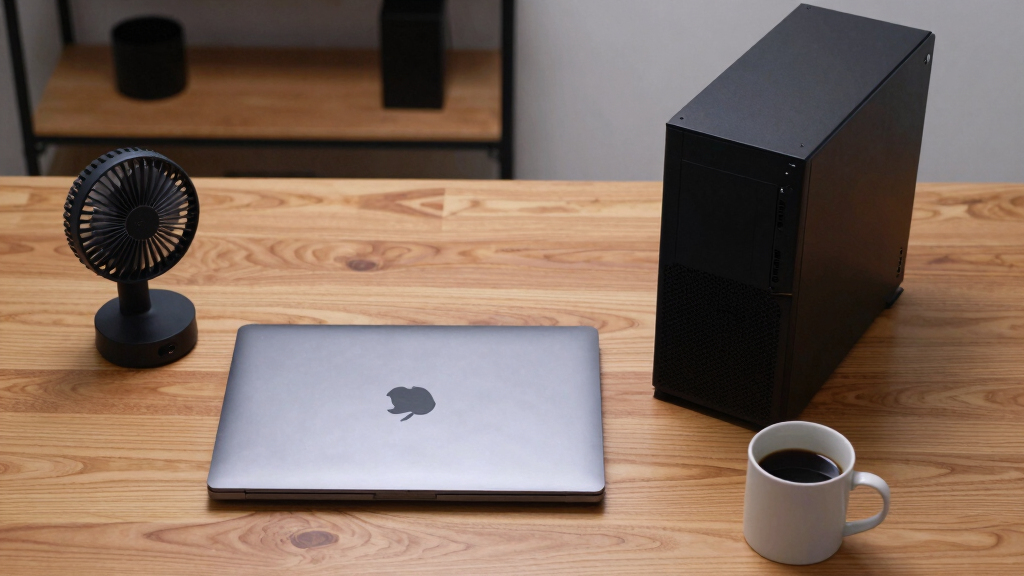
What if you sidestep the heat entirely with a different kind of machine? A tower is a high-bandwidth furnace you spend five levers quieting. Apple Silicon is near-silent by design — but asks for different tradeoffs. Match your priority in Part 2.
Put the loud, hot machine where its noise doesn’t matter, and the quiet one where you do. SSH into the tower when you need raw power; let the Mac handle everything else, silently.
Implications for AI Workstation Design
The comparison highlights a fundamental tradeoff: high throughput and upgradeability versus silent operation and capacity for large models. For users needing maximum speed on models within VRAM limits, GPU towers are superior. For those working with larger models that fit in unified memory, Macs offer a quiet, power-efficient alternative. This impacts how individuals and organizations choose hardware based on workflow priorities and environmental considerations.
Mac Studio M3 Ultra desktop computer
As an affiliate, we earn on qualifying purchases.
As an affiliate, we earn on qualifying purchases.
Evolution of Local AI Hardware Choices
Traditionally, GPU towers have dominated local AI inference and training due to their high bandwidth and native CUDA ecosystem support. Recent advances in Apple Silicon, with increased unified memory and optimized inference engines, challenge this dominance by enabling large models to run locally without the noise and heat of GPU rigs. The ongoing development of MLX and other AI frameworks continues to shape this landscape, but the fundamental architecture differences remain central to hardware selection.
"Our Macs are designed for silent, power-efficient operation, making them ideal for long-term, always-on AI inference."
— Apple spokesperson (hypothetical)
As an affiliate, we earn on qualifying purchases.
Unclear Aspects of Performance and Ecosystem
It remains uncertain how well upcoming Mac Silicon models will scale in inference speed for models that fit within VRAM, or how improvements in MLX and other frameworks will impact performance. Additionally, the extent of multi-GPU scaling and upgradeability for high-end GPU rigs continues to evolve, influencing long-term hardware planning.
As an affiliate, we earn on qualifying purchases.
Future Developments in Hardware and Software Ecosystems
Next steps include testing upcoming Mac Silicon models for inference performance on large models, and observing developments in GPU ecosystem support, multi-GPU scaling, and cooling solutions. Industry trends suggest ongoing improvements in both architectures, but the fundamental tradeoffs in heat, noise, and capacity will remain central to hardware decisions for local AI.
large memory capacity external SSD
As an affiliate, we earn on qualifying purchases.
As an affiliate, we earn on qualifying purchases.
Key Questions
Can a Mac Studio run large language models as effectively as a GPU tower?
Mac Studio can run models larger than VRAM capacity, such as 70B+ quantized models, but at slower inference speeds compared to GPU towers optimized for bandwidth. The choice depends on whether capacity or speed is the priority.
Why is heat and noise such a concern for GPU towers?
GPU towers draw hundreds of watts, producing significant heat that requires extensive cooling and generates noise from fans. Managing this heat and noise is a major part of maintaining high-performance GPU setups.
Will future Mac Silicon chips improve inference speed for large models?
Potential improvements are expected as Apple enhances unified memory and inference engines, but whether they will match GPU bandwidth remains uncertain. The architectural differences suggest capacity will continue to be a key advantage for Macs.
Is upgradeability a significant factor in choosing hardware for AI?
Yes. GPU towers typically allow adding or swapping GPUs, extending their lifespan and performance. Macs are fixed at purchase, which may limit long-term scalability.
Source: ThorstenMeyerAI.com
Halloween Picks
halloween
As an affiliate, we earn on qualifying purchases.