

📊 Full opportunity report: AI Changelog Digest For Open-source Maintainers on IdeaNavigator AI — validation score, market gap, and execution plan.

Get the latest gadgets delivered free with Prime
- Fast, free delivery on millions of items
- Prime Video, Amazon Music and more included
- Member-only deals all year
TL;DR
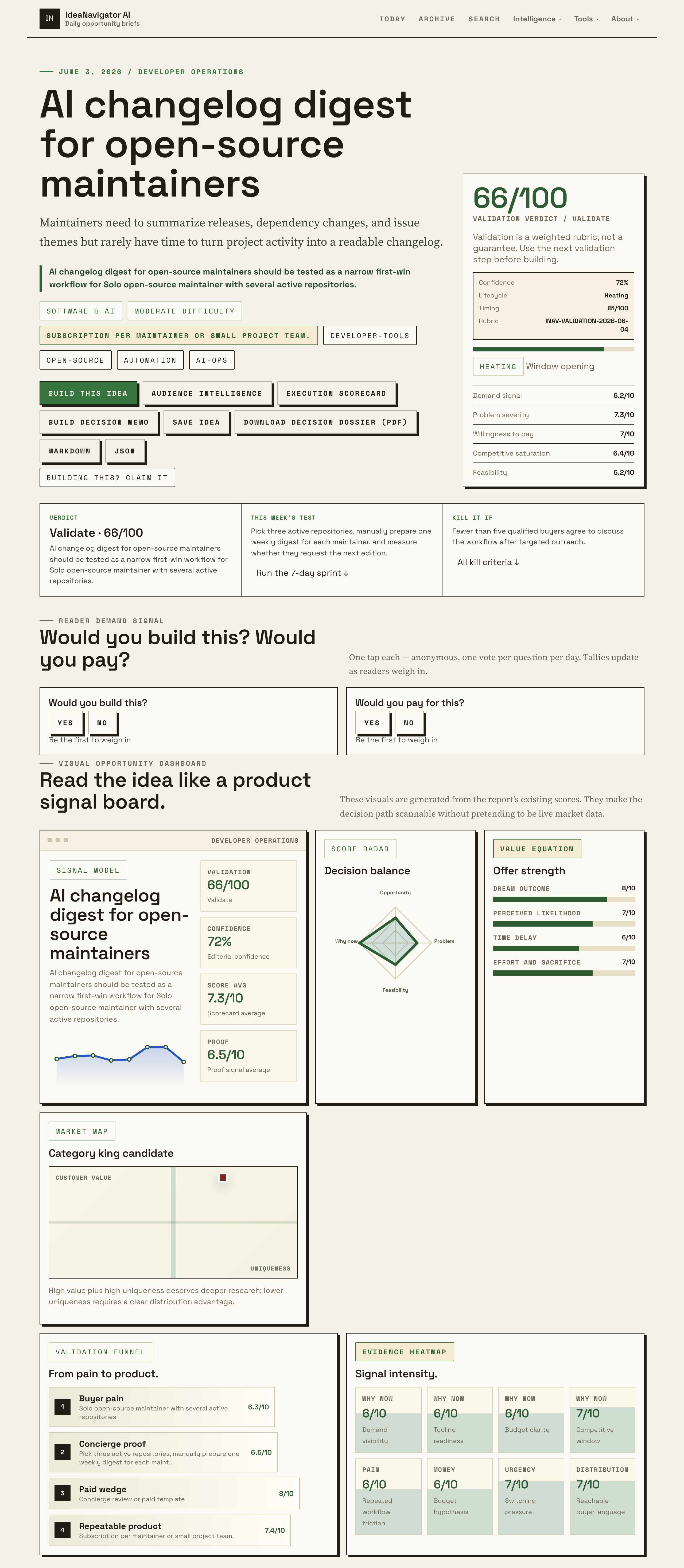
An emerging AI-driven digest system aims to help solo open-source maintainers summarize releases, dependencies, and issues efficiently. The project is in early testing with potential for subscription-based adoption.
AI-powered weekly changelog digest tools are being tested for solo open-source maintainers, offering a new way to automate release summaries and dependency updates across multiple repositories. This development aims to address a common challenge for maintainers with limited resources, and its success could reshape project management workflows.
The initiative is focused on creating a minimal viable product (MVP) that automatically reads repository data, including releases, merged pull requests, and top issues, to generate a concise, maintainable digest. This digest can be reviewed and approved by the maintainer before distribution.
According to sources involved in the project, the system leverages recent advances in AI summarization and repository metadata extraction, making it feasible to produce weekly updates without a dedicated developer-relations team. The approach is designed specifically for solo maintainers managing several active repositories, streamlining their workflow.
Initial testing involves selecting three active repositories, with the goal of measuring whether maintainers request subsequent editions after reviewing the generated digests. The model aims to provide a cost-effective subscription service tailored to individual developers or small teams.
Potential Impact on Solo Maintainers’ Workflow
This development could significantly reduce the time and effort required for solo open-source maintainers to keep their projects well-documented and transparent. Automating changelog creation ensures timely updates, improves project visibility, and may encourage more consistent communication with users and contributors. If successful, this tool could become a standard part of project management, especially for maintainers with limited resources.
Products Worth Considering

Jackery Explorer 300 Portable Power Station, 292Wh

Jackery Explorer 1000 v2 Portable Power Station, 1024Wh LiFePO4 Battery

Jackery HomePower 3000 Portable Power Station, 3072Wh, 3600W
As an affiliate, we earn on qualifying purchases.
Growing Need for Automated Release Summaries
Maintainers often struggle to keep up with the demands of summarizing releases, dependency changes, and issue themes, especially when managing multiple repositories. Currently, many rely on manual updates or ad hoc summaries, which can be inconsistent or delayed. Recent advances in AI and increased repository activity have prompted efforts to automate this process, with several projects exploring AI-driven summaries as a solution. The concept has gained traction as a way to improve transparency and reduce administrative overhead in open-source projects.
“Leveraging AI to automate changelog summaries could transform how solo maintainers manage their projects.”
— an anonymous researcher
Unanswered Questions About Implementation and Adoption
It is not yet clear how accurately the AI system will generate useful summaries across diverse repositories or how maintainers will respond to automated drafts. The effectiveness of the tool depends on the quality of AI summarization and integration with existing workflows. Additionally, adoption may be limited initially to early testers, and broader market acceptance remains uncertain.
Next Steps for Testing and Market Validation
The project plans to continue testing with the selected repositories, collecting feedback from maintainers on digest quality and usability. If initial results are positive, developers aim to refine the AI models, expand the feature set, and launch a subscription service. Further validation will involve measuring whether maintainers request subsequent editions and how the tool impacts their workload.
Key Questions
How will the AI generate changelogs for different types of projects?
The system will analyze repository data, including release notes, pull requests, and issues, using AI models trained on open-source documentation to produce relevant summaries tailored to each project.
Is this tool intended for large organizations or solo maintainers?
The initial focus is on solo maintainers managing multiple repositories, aiming to provide a lightweight, cost-effective solution tailored to their needs.
When will the AI changelog digest be generally available?
It is currently in testing, with a broader release likely after successful validation and refinement, which could take several months.
Will the tool support multiple programming languages or ecosystems?
Support will depend on the AI models’ training data, but the initial version aims to be adaptable across common open-source ecosystems.
What are the costs associated with using this AI digest system?
The project plans to offer a subscription model per maintainer or small team, with pricing to be determined based on feature scope and usage.
Source: IdeaNavigator AI