
📊 Full opportunity report: Enhance Kitchen Safety Protocols With Vision-Model Inspection Software on IdeaNavigator AI — validation score, market gap, and execution plan.

Get the latest gadgets delivered free with Prime
- Fast, free delivery on millions of items
- Prime Video, Amazon Music and more included
- Member-only deals all year
TL;DR
A new software leverages vision models to verify kitchen safety inspections via phone photos. It aims to replace traditional checklists with verifiable, timestamped data, enhancing food safety compliance.
A new vision-model inspection software is being tested to verify kitchen safety checks through phone photos, offering a more reliable alternative to traditional handwritten checklists. This development is relevant for restaurant operations and food safety compliance, aiming to improve accuracy and accountability in daily inspections.
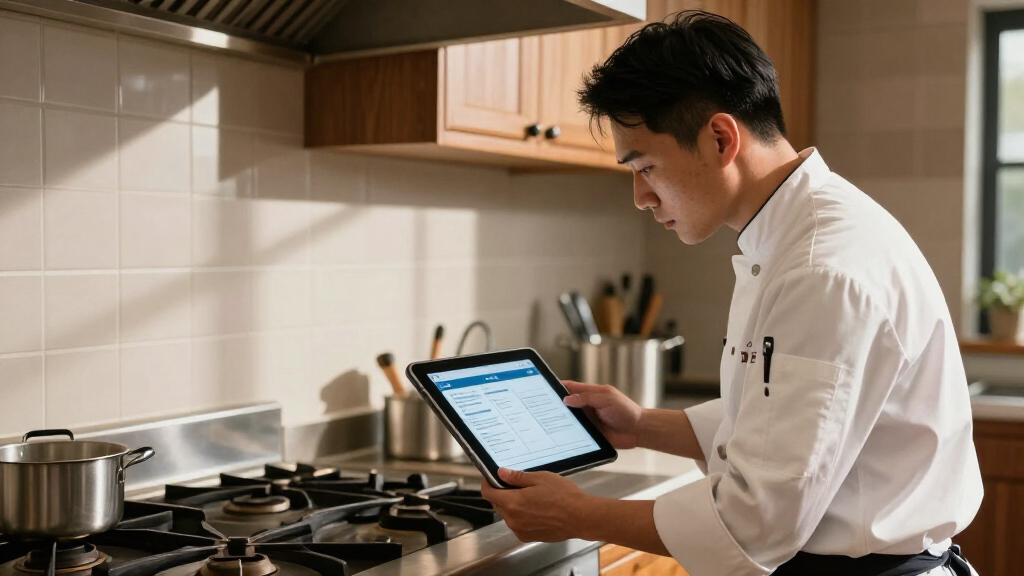
The software enables managers to photograph key areas during morning walk-throughs, including prep stations, storage, and sinks. A built-in vision model then analyzes these images to identify violations such as uncovered containers, propped cooler doors, or missing date labels. It generates timestamped reports and flags violations with severity ratings, providing a verifiable record of safety checks.
This approach addresses common issues with manual checklists, which often record that inspections occurred without capturing actual conditions. According to an anonymous researcher involved in the project, the system can reliably flag violations using ordinary phone photos, eliminating the need for new hardware. The initial testing involves comparing the model’s flagged violations against findings from a hired health-inspection consultant at five restaurant locations over two weeks.
Enhance Kitchen Safety Protocols With Vision-Model Inspection Software
Ordinary phone photos could turn routine kitchen walk-throughs into objective, timestamped safety records—replacing “box checked” with visual evidence managers can verify.
“The system can reliably flag violations using ordinary phone photos, eliminating the need for new hardware.”
Anonymous project researcherFrom walk-through to evidence
Managers photograph prep stations, cold storage, sinks, and labeling areas. A vision model reviews each image, identifies potential violations, assigns severity, and produces a timestamped report.
Use the phone already in hand
No dedicated scanners or fixed cameras are required. Standard photos document the real condition of key kitchen zones during routine rounds.
Detect visible safety failures
The model looks for uncovered containers, propped cooler doors, missing date labels, improper storage, and other image-visible risks.
Create an accountable record
Findings become timestamped reports with severity ratings, giving managers evidence to review, escalate, and track over time.
Checklist versus visual proof
The central shift is not merely automation. It is the move from a staff member’s assertion that a check occurred to an inspectable record of what conditions looked like at that moment.
| Capability | Handwritten checklist | Vision-model report |
|---|---|---|
| Objective condition evidence | ✗ Limited | ✓ Photo-backed |
| Automatic timestamp | ~ Manual entry | ✓ Built in |
| Consistent severity rating | ✗ Subjective | ✓ Standardized |
| Multi-location oversight | ~ Slow review | ✓ Dashboard-ready |
| Professional judgment | ~ Staff-dependent | ~ Still required |
Where the system could raise the bar
The strongest near-term value lies in repeatability: making daily checks easier to prove, review, and compare across sites. The pilot must establish whether that promise survives real kitchen variability.
Expected operational impact
Directional opportunity based on the proposed workflow—not measured pilot results.
The pilot test
Model findings will be compared with observations from a hired health-inspection consultant.
Accuracy across different lighting, layouts, menus, storage practices, and local regulatory standards remains unconfirmed.
Validation before scale
A successful two-week test would be an opening signal, not final proof. Broader deployment depends on accuracy, workflow integration, privacy controls, and regulatory acceptance.
Run the pilot
Collect phone photos and compare model detections with professional inspection findings.
Refine the model
Study false positives, missed violations, image quality, and differences between kitchens.
Expand testing
Add locations, longer time periods, varied restaurant formats, and regional requirements.
Launch at scale
Offer subscription dashboards for group-wide monitoring, trends, alerts, and audit history.
A stronger record, with humans still in the loop
Vision-model inspection software could make routine kitchen checks more objective and accountable. Its practical role today is as a verification layer that helps staff find, document, and correct risks faster.
Does it require new hardware?
No dedicated hardware is proposed; the system is designed around ordinary phone photos.
What can it identify?
Visible issues such as uncovered food, open cooler doors, missing labels, and improper storage.
Will it replace inspectors?
Not currently. It is intended to supplement human judgment with verifiable visual records.
What could slow adoption?
Variable accuracy, system integration, privacy practices, staff workflows, and local regulations.
When might it become available?
If validation succeeds, commercial deployment could begin within a year and scale gradually.
Why Verifiable Kitchen Safety Inspections Matter
Implementing vision-model inspection software could significantly improve food safety compliance by providing objective, timestamped evidence of safety conditions. This reduces reliance on subjective checklists and manual recordkeeping, which can be prone to oversight or misreporting. For restaurant groups managing multiple locations, the technology offers a scalable way to monitor safety standards consistently, potentially lowering the risk of violations and health violations.
Adopting such software may also streamline operations, freeing staff from manual documentation and enabling quicker response to safety issues. As food safety regulations tighten worldwide, verifiable inspection data could become a crucial component of compliance and liability management.
kitchen safety inspection software
As an affiliate, we earn on qualifying purchases.
As an affiliate, we earn on qualifying purchases.
Background on Kitchen Safety Monitoring Technologies
Traditional kitchen safety checks rely on manual checklists completed by staff or inspectors, which are often subject to human error and lack verifiability. Recent advances in AI and computer vision have enabled automated inspection tools in other industries, such as manufacturing and healthcare. The restaurant industry has begun exploring these technologies to improve compliance and operational efficiency. The current development builds on prior research demonstrating that vision models can reliably detect food safety violations in standard phone photographs, making it feasible for everyday restaurant use without additional hardware.
“The system can reliably flag violations using ordinary phone photos, eliminating the need for new hardware.”
— an anonymous researcher
As an affiliate, we earn on qualifying purchases.
Uncertainties in Pilot Outcomes and Scalability
It is not yet confirmed how accurately the vision model will perform across diverse kitchen environments or over longer periods. The two-week pilot will provide initial data, but questions remain about scalability, integration with existing systems, and compliance with local regulations. Further testing and validation are needed to determine if the software can replace or supplement manual inspections reliably at scale.
As an affiliate, we earn on qualifying purchases.
Next Steps in Validation and Deployment
The pilot testing at five restaurant locations will run over the next two weeks, with results comparing the model’s flagged violations against professional health inspections. Pending successful validation, the software provider plans to refine the system based on feedback and expand testing to additional sites. If proven effective, the software could be offered as a subscription service, with dashboards for group-wide monitoring and trend analysis.
As an affiliate, we earn on qualifying purchases.
Key Questions
How does the vision-model inspection software work?
The software uses AI-powered vision models to analyze photos taken during kitchen walk-throughs, automatically identifying safety violations such as uncovered food, improper storage, or missing labels, and generating verifiable reports.
What are the benefits of using this software over traditional checklists?
It provides objective, timestamped evidence of safety conditions, reduces manual effort, and minimizes human error, leading to more reliable compliance and easier record-keeping.
Will this replace human inspectors entirely?
Currently, the system is designed to supplement human inspections by providing verifiable data. Full replacement would depend on further validation and regulatory acceptance.
What challenges might arise during implementation?
Potential challenges include ensuring consistent performance across diverse kitchen setups, integrating with existing safety protocols, and meeting local regulatory requirements.
When will this technology be available for widespread use?
If pilot testing proves successful, commercial deployment could occur within the next year, with gradual scaling based on validation results.
Source: IdeaNavigator AI
Fall Picks
fall essentials
As an affiliate, we earn on qualifying purchases.