
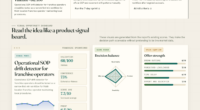
📊 Full opportunity report: A War Room for Your Next Idea: Inside IdeaClyst on ThorstenMeyerAI.com — validation score, market gap, and execution plan.

Get the latest gadgets delivered free with Prime
- Fast, free delivery on millions of items
- Prime Video, Amazon Music and more included
- Member-only deals all year
TL;DR
IdeaClyst introduces a local AI-driven tool that acts as a war room for startup founders, providing structured idea validation, critique, and decision-making. It operates entirely on local machines, ensuring data privacy.
IdeaClyst, a new local-first AI tool for startup founders, has been launched, offering a structured war room to validate, critique, and develop business ideas without data leaving the user’s device.
The platform functions as an AI council that pressure-tests ideas through a five-step deliberation process involving multiple models playing different roles. It also serves as a discovery engine for new ideas and a workspace for refining and documenting concepts. Unlike cloud-based tools, IdeaClyst runs entirely on the user’s machine, storing all data locally, emphasizing privacy and control. The tool is designed to combat common validation pitfalls by providing structured, evidence-based critique rather than uncritical approval, addressing founder concerns about AI-generated feedback being overly agreeable or superficial. It integrates real web research into its analysis, grounding suggestions in current market data.A war room for your next idea
The build isn’t the hard part anymore — conviction is. Knowing which idea deserves the next six months, and being able to defend it. Most founders answer with gut feel and optimistic math. That’s hope wearing a blazer. IdeaClyst replaces it with a process.
The most expensive decision is what to build
The single most valuable thing a tool can do is talk you out of the wrong six months. The numbers make the case better than any pitch.
Three tools in one — on your own machine
Strip away the framing and IdeaClyst is three things at once, all running locally with nothing leaving your laptop.
An AI council
Pressure-tests an idea you bring it — advisors who argue on purpose.
A discovery engine
Finds ideas you didn’t know to look for by hunting real demand signals.
A founder’s workspace
Carries winners from “interesting” all the way to “ready to build.”
Advisors who disagree on purpose
Not one confident, agreeable answer — a structured five-step deliberation where models play different roles and turn on their own work. The disagreement is the feature.
The five-step deliberation
A council that leads with the bad news surfaces the objections you’d otherwise find the expensive way, on month five.
Product strategy
Who’s it for, what’s the wedge, why now, what’s the business model.
Technical architecture
What would it actually take to build — and where’s the risk.
Critique pass
The council turns on its own work. Where’s the hand-waving? What kills this?
Second, independent critique
A different voice, a different angle — so blind spots don’t survive.
Final synthesis
Everything into one coherent founder packet: strategy, architecture, validation, plan.
When IdeaClyst cites a source, it actually fetched it
The hard departure from “ask an AI what it thinks of my startup.” It runs in a strict, real-data-only mode — if it can’t gather genuine evidence, it says so plainly rather than inventing a plausible paragraph.
Confidence with receipts
No fabricated statistics, no imaginary competitors, no made-up citations. The packet survives a skeptical co-founder or a sharp investor because the reasoning has receipts.
Market research first
Scouts the landscape before the council reasons about anything.
Competitor read
Real positioning, pricing signals, feature claims — differentiation vs. reality.
Validation with links
Not “talk to customers” — concrete signals & sources you can click.
From the blank page to build-ready
Evaluation is half the problem; the blank page is the other half. And a plan is worthless if it dies in a tab you never reopen.
Bring a space, not an idea
“AI for accountants,” “tools for indie game studios” — plus your goal and real capacity. It hunts demand signals across HN, Reddit, Product Hunt, GitHub, pricing pages.
- An honest market read — leads with the bad news when a space is hard
- An opportunity map — high pain, thin competition
- Ranked candidates — wedge, who pays, effort, risk, confidence
- each with KILL CRITERIA — when to walk away
A home and a forward path
Every promising idea gets carried forward, with every artifact in plain files on your disk.
- Validation tooling — sprint board, interview list, evidence browser
- Founder profile — a personal-fit lens; same discovery, different advice
- Build workspaces — funnel, personas, landing draft, version history
- “Build this idea” → a PRD + task queue, ready for a coding agent
Why Local-First AI Matters for Startup Validation
IdeaClyst’s local-first design addresses founders’ privacy concerns while offering a powerful, immediate validation and critique process. By providing a structured, multi-model debate, it reduces the risk of confirmation bias and superficial feedback, potentially saving startups from costly missteps. Its ability to operate offline and keep data on the user’s device is a significant advantage in an era of increasing data privacy regulation. This approach could reshape early-stage validation, making it faster, more secure, and more evidence-driven, which is critical given the high failure rate of startups due to misjudged market need.
privacy-focused AI development laptop
As an affiliate, we earn on qualifying purchases.
As an affiliate, we earn on qualifying purchases.
The Evolution of Startup Validation Tools in 2026
Traditional validation methods—surveys, customer interviews, and consultants—are costly and slow. AI tools have promised faster insights but often lack grounding in current data or operate solely in cloud environments, raising privacy concerns. Earlier efforts focused on AI-generated ideas or basic analysis, but none offered the structured, multi-perspective critique that IdeaClyst now provides. The move toward local-first, open-source tools reflects a broader trend emphasizing data control and security, especially as founders become more aware of privacy issues and the costs of building the wrong product. Learn more about IdeaClyst’s approach.
“IdeaClyst is designed to be the war room every founder needs—structured, private, and grounded in real data. It turns the chaos of early ideas into a clear, evidence-based plan.”
— Thorsten Meyer, founder of ThorstenMeyerAI.com
As an affiliate, we earn on qualifying purchases.
Development and Adoption Challenges for IdeaClyst
It is not yet clear how widely founders will adopt the tool, given the niche focus on local operation. The effectiveness of the multi-model council system in real-world validation scenarios remains to be validated through broader user testing and case studies. Additionally, the extent to which it can replace or complement traditional validation methods is still uncertain, as some founders may prefer direct customer engagement over AI critique.
As an affiliate, we earn on qualifying purchases.
Next Steps for IdeaClyst and Its Community
The developers plan to release further updates based on user feedback, including integrations with popular project management tools and enhanced web research capabilities. Broader adoption will depend on ongoing case studies demonstrating its impact on startup success rates. User feedback could accelerate feature development and validation of the tool’s effectiveness in diverse startup contexts. Discover how IdeaClyst functions as a war room.
As an affiliate, we earn on qualifying purchases.
Key Questions
How does IdeaClyst ensure data privacy?
All data remains on the user’s local machine; the platform operates entirely offline, with no data sent to external servers, preserving privacy and control.
Can I use IdeaClyst without technical expertise?
While designed for flexibility, some familiarity with command-line interfaces or Markdown may be helpful. The developers are working on a more user-friendly interface for broader accessibility.
How does the multi-model council improve idea validation?
By staging structured debates between models playing different roles, it surfaces potential flaws and blind spots that a single AI or human reviewer might miss, providing a more robust critique.
Is IdeaClyst suitable for early-stage startups?
Yes, especially for founders seeking a fast, private way to validate and develop ideas before engaging with customers or investors.
What are the limitations of IdeaClyst?
It cannot replace direct customer feedback or market testing. Its effectiveness depends on the quality of input and the founder’s ability to interpret AI-generated critiques.
Source: ThorstenMeyerAI.com
Halloween Picks
halloween
As an affiliate, we earn on qualifying purchases.