
TL;DR

Get the latest gadgets delivered free — and shop member deals
- Fast, free delivery on millions of items
- Access to Prime Big Deal Days deals on October 6–7
- Prime Video, Amazon Music and more included
IdeaClyst acts as a digital war room, giving founders a secure, local-first environment to pressure-test ideas with AI advisors, find new opportunities, and craft actionable plans. It streamlines validation, enhances collaboration, and keeps sensitive data private—making startup decision-making faster and smarter.
When you’re juggling three startup ideas, each one feels like a ticking clock. You wonder which one truly has the juice to go the distance, and which might just be a costly detour. That’s where a dedicated war room — or in this case, a digital one — becomes your secret weapon.
Enter IdeaClyst. It’s not just another AI tool. It’s a focused, secure space where your ideas get the scrutiny they deserve, with real research, honest critique, and a clear plan to move forward. Think of it as your personal command center for shaping the future of your startup, all on your own machine.
A war room for your next idea
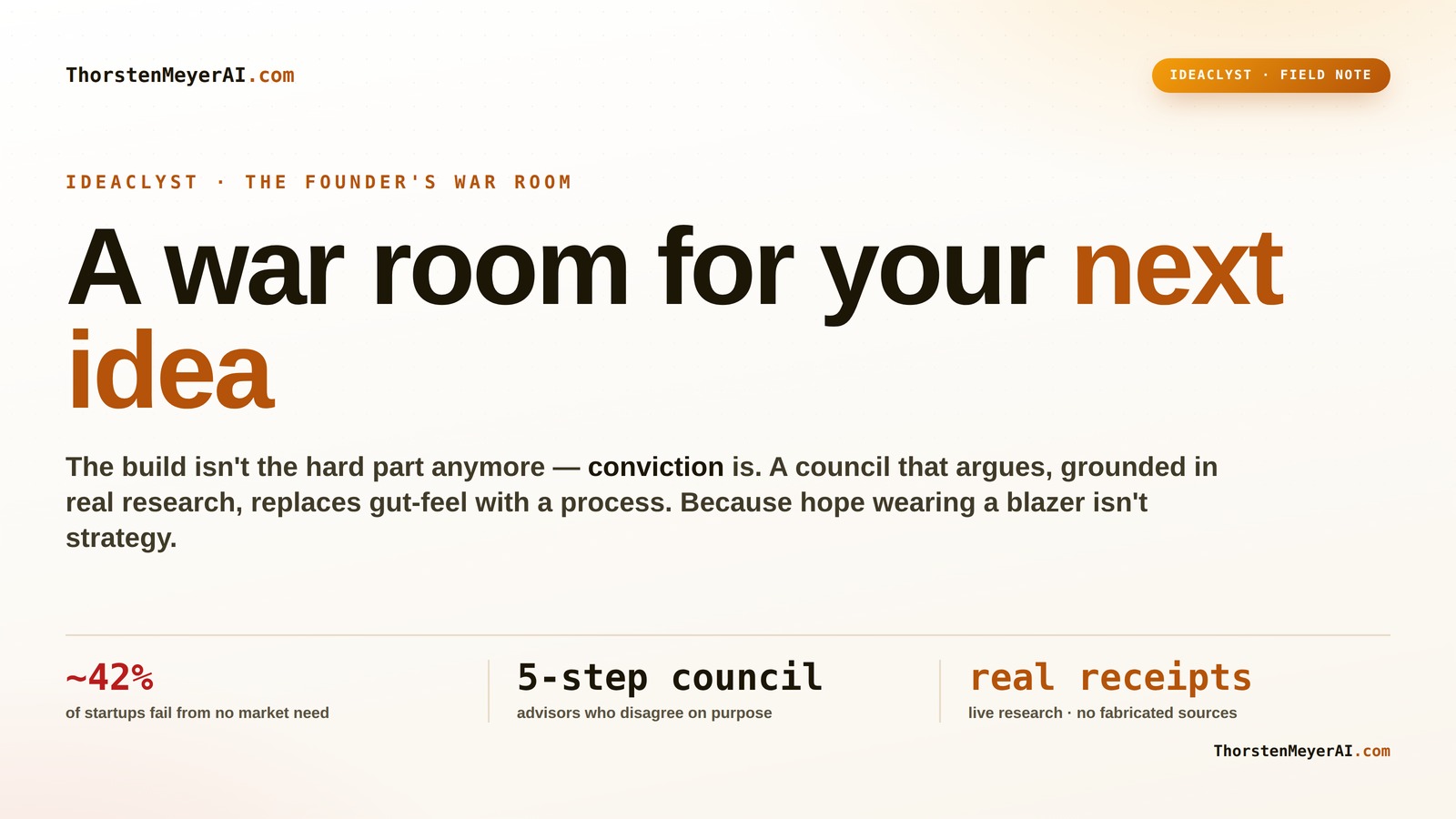
The build isn’t the hard part anymore — conviction is. Knowing which idea deserves the next six months, and being able to defend it. Most founders answer with gut feel and optimistic math. That’s hope wearing a blazer. IdeaClyst replaces it with a process.
The most expensive decision is what to build
The single most valuable thing a tool can do is talk you out of the wrong six months. The numbers make the case better than any pitch.
Three tools in one — on your own machine
Strip away the framing and IdeaClyst is three things at once, all running locally with nothing leaving your laptop.
An AI council
Pressure-tests an idea you bring it — advisors who argue on purpose.
A discovery engine
Finds ideas you didn’t know to look for by hunting real demand signals.
A founder’s workspace
Carries winners from “interesting” all the way to “ready to build.”
Advisors who disagree on purpose
Not one confident, agreeable answer — a structured five-step deliberation where models play different roles and turn on their own work. The disagreement is the feature.
The five-step deliberation
A council that leads with the bad news surfaces the objections you’d otherwise find the expensive way, on month five.
Product strategy
Who’s it for, what’s the wedge, why now, what’s the business model.
Technical architecture
What would it actually take to build — and where’s the risk.
Critique pass
The council turns on its own work. Where’s the hand-waving? What kills this?
Second, independent critique
A different voice, a different angle — so blind spots don’t survive.
Final synthesis
Everything into one coherent founder packet: strategy, architecture, validation, plan.
When IdeaClyst cites a source, it actually fetched it
The hard departure from “ask an AI what it thinks of my startup.” It runs in a strict, real-data-only mode — if it can’t gather genuine evidence, it says so plainly rather than inventing a plausible paragraph.
Confidence with receipts
No fabricated statistics, no imaginary competitors, no made-up citations. The packet survives a skeptical co-founder or a sharp investor because the reasoning has receipts.
Market research first
Scouts the landscape before the council reasons about anything.
Competitor read
Real positioning, pricing signals, feature claims — differentiation vs. reality.
Validation with links
Not “talk to customers” — concrete signals & sources you can click.
From the blank page to build-ready
Evaluation is half the problem; the blank page is the other half. And a plan is worthless if it dies in a tab you never reopen.
Bring a space, not an idea
“AI for accountants,” “tools for indie game studios” — plus your goal and real capacity. It hunts demand signals across HN, Reddit, Product Hunt, GitHub, pricing pages.
- An honest market read — leads with the bad news when a space is hard
- An opportunity map — high pain, thin competition
- Ranked candidates — wedge, who pays, effort, risk, confidence
- each with KILL CRITERIA — when to walk away
A home and a forward path
Every promising idea gets carried forward, with every artifact in plain files on your disk.
- Validation tooling — sprint board, interview list, evidence browser
- Founder profile — a personal-fit lens; same discovery, different advice
- Build workspaces — funnel, personas, landing draft, version history
- “Build this idea” → a PRD + task queue, ready for a coding agent
Key Takeaways
- A digital war room like IdeaClyst consolidates research, critique, and planning into a secure, local environment, speeding up validation and decision-making.
- The structured AI council stages disagreements and critiques, surfacing risks early and avoiding costly mistakes.
- Grounding ideas in real-time web research ensures your plans are based on current market realities, not just assumptions.
- Running on your own machine keeps your sensitive data private and gives you full control over your startup’s strategic insights.
- Transform vague ideas into actionable plans with the workspace that guides you from ‘interesting’ to ‘ready to build’.
secure local-first AI research tool
As an affiliate, we earn on qualifying purchases.
As an affiliate, we earn on qualifying purchases.
Why a Digital War Room Is a Game-Changer for Startups
A war room isn’t just a fancy term — it’s a dedicated space for making ideas visible, debating them fiercely, and tracking progress. Traditionally, teams use physical spaces with whiteboards and sticky notes. But for founders working solo or remotely, a digital war room like IdeaClyst offers the same focus, now on your own device.
Imagine having a space where your brainstorms, research, and critiques all live together, instantly accessible. It’s like having a physical whiteboard, research library, and debate chamber, but without the clutter or the location constraints. It keeps your focus tight and your ideas evolving fast.
Research shows that the biggest reason startups fail is ‘no market need’ — about 42% of the time [1]. A war room helps you keep your finger on the pulse, continuously refining your understanding of the market, your audience, and your assumptions. IdeaClyst turbocharges this process by compressing months of research into hours, thanks to AI-driven insights grounded in real data. IdeaClyst turbocharges this process by compressing months of research into hours, thanks to AI-driven insights grounded in real data.
As an affiliate, we earn on qualifying purchases.
How IdeaClyst’s AI Council Challenges Your Ideas
What makes IdeaClyst unique? Its AI council. Instead of a single, agreeable voice, it stages a structured debate among multiple AI models. Each one plays a different role: some defend your idea, others rip it apart. The goal? Surface blind spots and hidden risks before you commit.
For example, you bring a new SaaS product idea. The council asks: who exactly is this for? How will competitors respond? What’s the technical risk? Then, two more models critique these points from different angles. The final synthesis combines their insights into a clear, actionable plan.
This process mimics a real-world debate, where diverse perspectives and rigorous critique are essential for robust decision-making. By staging these AI-driven debates, you expose assumptions and potential pitfalls that might be overlooked in solo brainstorming. The benefit? You develop a more resilient, well-rounded strategy, reducing the likelihood of costly mistakes or pivoting late in the game. IdeaClyst also helps you prioritize actions based on critical insights, making your planning more precise and effective.
As an affiliate, we earn on qualifying purchases.
Grounding Ideas in Real Data, Not Just Vibes
Many AI tools give you vague advice based on ‘model vibes’ — confidence without evidence. That’s risky. IdeaClyst sidesteps this trap by anchoring its council’s critique in live web research. When evaluating a new market, it pulls current data, competitor analysis, and user feedback, making sure your assumptions are rooted in reality.
This approach is crucial because market conditions and consumer preferences are constantly shifting. Relying solely on static data or assumptions can lead you astray, resulting in products or features that no longer meet market needs. By integrating live research, IdeaClyst ensures your decisions are based on the latest insights, reducing the risk of building something that’s outdated or irrelevant. This real-time data grounding transforms the validation process from a guesswork exercise into a rigorous, evidence-based analysis—saving you time, money, and future pivots.
In an era where rapid iteration and current market insights are key, this live research capability means your ideas are continually tested against the latest trends and competitive landscape. The tradeoff? Slightly more initial effort to gather and interpret real-time data, but the payoff is a significantly more accurate and market-aligned strategy.
As an affiliate, we earn on qualifying purchases.
The Local-First Advantage: Why Your Data Stays Yours
Security and ownership matter. That’s why IdeaClyst runs entirely on your machine, saving all reports, critiques, and plans locally. No cloud accounts, no API keys, no third-party servers. Your raw ideas, competitive secrets, and strategic plans stay private.
Imagine working on a high-stakes project — your plans are sensitive, and you don’t want them floating around in someone else’s cloud. With IdeaClyst, everything lives on your disk, in plain files, under your control. It’s open source, too, so you can customize, version, and review your process at any time.
This local-first setup isn’t just about privacy—it’s about control and peace of mind. In an age where data breaches and leaks are common, having your critical startup information confined to your own device minimizes exposure. It also means you’re not dependent on external providers whose policies or outages could compromise your work. This setup offers founders the flexibility to adapt, audit, and improve their process without external constraints, ultimately fostering a more secure and resilient development environment.
From ‘Interesting’ to ‘Ready to Build’ — Using the Founder’s Workspace
Turning an idea from a vague notion into a clear plan is tricky. IdeaClyst’s workspace guides you through this process. Once the council’s critiques and research are in, it helps you prioritize next steps, sketch prototypes, and prepare to ship.
This systematic approach ensures you don’t get lost in endless refinement without moving forward. By organizing your insights, risks, and validation results in one place, the workspace acts as a roadmap from concept to execution. It helps you identify the most critical features to develop first, plan prototypes, and allocate resources effectively. This reduces the risk of scope creep and ensures your efforts are aligned with validated needs. The interconnected elements—research, critique, planning—empower you to make informed decisions at each stage, minimizing wasted effort and accelerating your startup’s progress.
What Sets IdeaClyst Apart from Other Brainstorming Tools
Many tools help you jot down ideas or run quick polls. But IdeaClyst combines structured critique, real data, local security, and a staged debate — all in one place. It’s like having a strategic boardroom, research lab, and project planner rolled into a single app.
Here’s a quick comparison to traditional brainstorming tools:
| Feature | IdeaClyst | Basic Brainstorming Apps |
|---|---|---|
| Structured critique | Yes, staged AI council debate | No |
| Live data grounding | Yes, real web research | No |
| Local-first security | Yes, runs on your machine | No |
| Versioned reports | Yes, Markdown files | No |
This comprehensive approach offers founders a more rigorous, secure, and evidence-based process for decision-making, reducing the guesswork and increasing confidence in the strategic choices made within the startup.
Frequently Asked Questions
What exactly is a digital war room?
A digital war room is a dedicated online workspace where teams or founders gather to focus on idea development, critique, and planning. It’s like a physical war room but virtual, designed for continuous visibility and collaboration, often with tools that keep everything organized and secure.How does IdeaClyst help validate ideas faster?
IdeaClyst uses AI to stage structured debates, critiques, and real-time web research, condensing months of validation work into hours. It surfaces risks early and grounds your plans in current data, saving you time and money.Can I use IdeaClyst for remote or solo work?
Absolutely. IdeaClyst is designed to run entirely on your local machine, making it perfect for remote founders or teams who want a private, secure environment without relying on cloud services.What kinds of ideas are best suited for IdeaClyst?
Any startup idea, product concept, or strategic plan that benefits from critique, validation, and detailed planning. It’s especially useful for early-stage founders wanting to minimize risk and make data-backed decisions.Conclusion
If you’re serious about turning ideas into reality, a dedicated, secure war room is a must. IdeaClyst isn’t just a tool — it’s your strategic command center, built to make smarter decisions faster.
Remember: the best ideas don’t just happen. They’re fought for, debated, validated, and refined. Your next breakthrough could start with a click — inside your own war room.
Fall Picks
fall essentials
As an affiliate, we earn on qualifying purchases.