
🔍 Read the full analysis: A Guide To Using NVIDIA Warp And MjWarp In Robotics Workflows on ThorstenMeyerAI.com

Get the latest gadgets delivered free — and shop member deals
- Fast, free delivery on millions of items
- Access to Prime Big Deal Days deals on October 6–7
- Prime Video, Amazon Music and more included
TL;DR
Hugging Face’s second article in its State of Simulation for Physical AI series walks through moving an SO-101 follower arm from a standard MuJoCo workflow to MuJoCo Warp (MJWarp), with up to 2,048 parallel environments. The tutorial covers setup and scaling, not policy training, and gives no comparative performance benchmark.
Hugging Face’s second article in its State of Simulation for Physical AI series shows how to move an SO-101 follower arm from a familiar MuJoCo workflow into MuJoCo Warp (MJWarp), reaching a demonstrated scale of up to 2,048 parallel environments, building on the original analysis of Warp and MJWarp. The guide covers preparing and scaling a simulation; it does not train a robot policy or report a measured speedup, so the environment count does not establish how fast the setup runs.
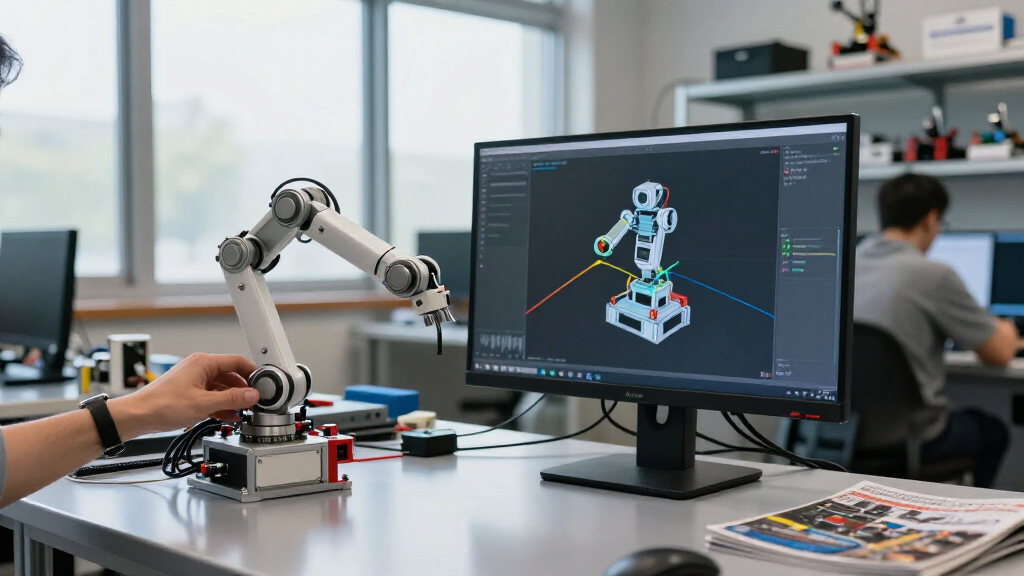
The walkthrough describes a division of work between MuJoCo and NVIDIA Warp. MuJoCo loads and compiles the robot’s MJCF model, while MJWarp uses Warp kernels to run compatible MuJoCo physics on NVIDIA GPUs. The SO-101 model and task geometry come from robot assets, including Menagerie or Robot Studio. The tutorial’s reported scale is 2,048 environments, but the supplied material does not include a simulation rate or a comparison with another setup.
Warp is a framework for writing kernels in Python for execution on CPUs or GPUs. The article explains that Warp compiles the code for execution: a first kernel launch builds and caches a native module, and later launches can reuse it. It also describes a data-handling concern: copying a CUDA array to NumPy synchronizes execution and moves data to the CPU. Warp adapters or DLPack-compatible sharing can keep data on the device.
The article presents the SO-101 exercise as simulation preparation, not a complete learning pipeline. It does not report trained policies, task success rates, or results showing that GPU execution improves learning outcomes. The source also gives no detailed hardware configuration, workload settings, or comparative benchmark for the example.
Scaling Robot Simulation on GPUs
Running many copies of a simulation can help robotics teams gather experience across varied starting states or evaluate candidate actions in parallel. MJWarp offers one route to that kind of batched workload by advancing multiple compatible worlds on a GPU. The tutorial makes the implementation path concrete for teams already working with MuJoCo models, while also showing that moving computation to a GPU involves decisions about data placement and framework compatibility.
The environment count alone is not a performance result. Without a measured simulation rate, hardware details, workload settings, and a comparison baseline, readers cannot infer throughput, cost, or how the example would perform on a different robot task. Nor does the demonstration show that scaling simulation improves a policy’s quality. Its value is a practical setup example and a scale marker that teams can use to frame their own measurements.
Hugging Face’s guidance ties tool choice to the workload. The article points to familiar CPU MuJoCo for single-robot model-predictive control or teleoperation, and to MJWarp or mjlab when the goal is raw MuJoCo physics throughput. For JAX-oriented training recipes, it points readers toward MuJoCo Playground or MJX with the Warp implementation. These are recommendations in the source, not benchmark conclusions for every application.
Where MJWarp Fits the Series
This is the second article in Hugging Face’s series on simulation for physical AI. The earlier installment introduced robot simulation; this one focuses on preparing a MuJoCo scene for batched execution through MJWarp. The supplied material does not state when the article was published.
In the described stack, MuJoCo provides model loading and physics definitions, Warp supplies the kernel language and device execution, and MJWarp connects the compatible MuJoCo physics to Warp. Hugging Face positions the exercise as a step toward later coverage of Newton and Isaac Lab, which is intended to address broader integration layers. The article also points teams seeking a multi-solver API and Isaac Lab integration toward Newton.
Warp includes features such as autodifferentiation and deterministic execution, but the source does not present them as guarantees for every MJWarp rollout. A framework capability does not by itself show that a whole simulation or training pipeline is differentiable or deterministic. The example’s stated scope remains environment setup and scale.
““Here, we prepare and scale the simulation environment; we do not train a policy.””
— Hugging Face
Benchmark and Compatibility Gaps
The supplied source does not identify the GPU model, measured simulation rate, workload settings, or comparison baseline behind the 2,048-environment demonstration. It also does not show how performance changes with different robot scenes, contact conditions, or hardware. The source describes support for compatible models, but does not establish that every MuJoCo model will work with MJWarp without modification.
There are also no policy-training results, task success rates, or measurements of learning quality. The article discusses Warp’s autodifferentiation and deterministic execution as framework capabilities; it does not show that an entire MJWarp rollout has either property by default. Those limits leave open how much adaptation a particular robotics workflow would require and whether it would gain measurable benefits.
Further Integration and Measurements
Hugging Face says later installments will cover Newton and Isaac Lab, including topics such as multi-solver APIs, USD, sensors, managers, and training loops. That coverage is intended to show how prepared simulation scenes connect with larger robotics and learning systems. The source does not give dates for those articles.
For teams weighing the workflow, useful next evidence would include reproducible throughput measurements that name the hardware, task, and comparison baseline; guidance on model compatibility; and results from an actual policy-training run. None of those results is included in the supplied material. Until then, the tutorial supports evaluation of the setup path, while performance and training outcomes remain questions for further measurement.
Key Questions
What does the Hugging Face article demonstrate?
It walks through preparing an SO-101 follower arm simulation with MJWarp and reports a demonstration of up to 2,048 parallel environments.
Does the article show a speedup or train a policy?
No. The source says the article prepares and scales the simulation but does not train a policy. It provides no measured speedup, simulation rate, or policy-training result.
How do MuJoCo and MJWarp work together?
MuJoCo loads and compiles the MJCF robot model. MJWarp uses NVIDIA Warp kernels to run compatible MuJoCo physics in batched environments on GPUs.
What information is missing from the 2,048-environment figure?
The supplied source does not name the GPU, simulation rate, workload settings, or comparison baseline. The figure indicates demonstrated scale, not a quantified throughput comparison.
Primary source: Hugging Face · via ThorstenMeyerAI.com
Fall Picks
fall essentials
As an affiliate, we earn on qualifying purchases.