
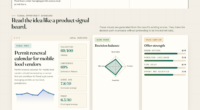
📊 Full opportunity report: The $9 Billion Signature Tax: How DocuSign’s Business Model Survives on One Assumption on ThorstenMeyerAI.com — validation score, market gap, and execution plan.

Get the latest gadgets delivered free — and shop member deals
- Fast, free delivery on millions of items
- Access to Prime Big Deal Days deals on October 6–7
- Prime Video, Amazon Music and more included
TL;DR
DocuSign, a $9 billion company, relies on high-margin digital signature services. An open source alternative, DocuSeal, demonstrates a low-cost, self-hosted option that threatens its business model. The development raises questions about the industry’s reliance on proprietary solutions.
In 2023, an open source project called DocuSeal was launched, providing a free, self-hosted alternative to DocuSign’s proprietary digital signature services. This development challenges the core assumption underpinning DocuSign’s $9 billion valuation that users will accept high margins for digital signatures, which are technically a commodity.
DocuSign’s business model depends on charging companies and individuals for digital signatures, with median contracts around $17,250 annually, despite the minimal technical cost of signature validation. The company’s pricing includes tiered plans, add-ons, and premium support, generating significant revenue from a largely commoditized service.
In contrast, DocuSeal, an open source project created in 2023 by a Ruby developer, offers a fully functional digital signature platform that can be deployed on a modest VPS for approximately €45 ($48) annually. It supports multiple fields, signers, API integrations, and compliance standards similar to DocuSign, but at a fraction of the cost.
The project has gained over 11,800 GitHub stars, with active development and community support, funded by a commercial tier that subsidizes open source development. Its deployment process takes about 30 minutes, making it accessible for small businesses and organizations seeking cost-effective solutions.
The $9 billion signature tax.
DocuSign’s business model survives on one assumption.
A 50-person team pays $24,000 to $39,000 per year to put names on PDFs. Not because the tech is hard. The cryptographic signature math has been solved for thirty years. The legal frameworks are a quarter-century old. There is no moat. There is one assumption holding it together: that you will not bother to look at the alternative.
You are rationing digital signatures in 2026.
Stop and look at that sentence again. You are rationing — keeping a count, watching the meter, deciding whether this contract is worth using one of your remaining envelopes — a function whose actual cost to perform is somewhere between zero and one cent per signature. You are doing this in 2026, on a function that has been a commodity since 1999.
Same job. Different bill. Four team sizes.
Pure SaaS-vs-VPS comparison. As your team grows, the absolute savings grow linearly while relative savings asymptote at ~99.9%. The DocuSign business model assumes per-seat pricing on a function that has no per-seat marginal cost.
Five commands. Production-grade signature platform.
PostgreSQL 18 + DocuSeal app + Caddy reverse proxy with automatic Let’s Encrypt SSL. Verified against the official docusealco/docuseal repository at v2.2.9. 28 minutes if everything goes smoothly; 45 if DNS is slow.
Production deploy · $5/month VPS → live signature platform.
ssh root@IP
5 min
sign.you.com → IP · Cloudflare proxy OFF
5 min
curl -fsSL get.docker.com | sh · entire install
3 min
docker-compose.yml · set .env · docker compose up -d
10 min
DocuSign is not the only $9B company built on this assumption.
Same dynamic. Per-seat pricing on a function with near-zero marginal cost. Open-source alternative is mature, properly licensed, and runs on a $5 VPS. A typical 50-person company running 5–8 of these is paying $40K–$120K/year that’s structurally replaceable.
The first time you do this, you save $30,000. The savings are the surface. The actual outcome is that you stop trusting the SaaS price tag entirely.
How to Replace DocuSign in 30 Minutes for $5 a Month
The complete DocuSeal self-host guide for 2026. Every command tested. Every cost verified. Every workflow ready to run today.
- 30-min deploy walkthrough · v2.2.9
- 4 hosting options ranked by cost
- Production docker-compose.yml
- 13 field types · DocuSign mapping
- API patterns · CRM, billing, contracts
- Cost comparison · 1, 10, 50, 200 sizes
- Compliance · ESIGN, eIDAS, GDPR, HIPAA
- The 12-category replacement framework
- 5 questions before any SaaS swap
- Honest maintenance accounting
Implications for SaaS Digital Signature Industry
The emergence of DocuSeal exposes the thin technical moat of digital signature providers like DocuSign. It suggests that the industry’s reliance on proprietary, high-margin services is based on an assumption that users will not seek or implement free, open source alternatives. If widespread adoption occurs, it could disrupt revenue streams for established players and accelerate the commoditization of digital signatures, forcing incumbents to reevaluate their pricing and value propositions.As an affiliate, we earn on qualifying purchases.
Industry Reliance on Proprietary Digital Signature Platforms
Since the late 1990s, digital signatures have been a standardized, open technology, with open specifications and legal frameworks like ESIGN, UETA, and eIDAS. Despite this, the industry has largely depended on proprietary solutions like DocuSign, which leverage network effects, brand trust, and integrated workflows to justify high prices.
Over the past decade, SaaS providers have built high-margin businesses on this commodity service, with median contracts reaching into tens of thousands of dollars annually. The assumption has been that the technical simplicity of digital signatures would lead to commoditization, but market dynamics and customer inertia have maintained high pricing.
The launch of DocuSeal in 2023, offering a fully functional, self-hosted alternative, challenges this assumption by demonstrating how minimal the technical barriers are and how easily organizations can deploy their own signature infrastructure.
“We built DocuSeal to show that digital signatures can be self-hosted, cost very little, and still meet all compliance standards. It’s a wake-up call for the industry.”
— Founder of DocuSeal project
self-hosted digital signature platform
As an affiliate, we earn on qualifying purchases.
As an affiliate, we earn on qualifying purchases.
Potential Industry Response and Adoption Rates
It is not yet clear how quickly organizations will adopt open source, self-hosted signature solutions over established providers. Widespread acceptance depends on trust, legal recognition, and existing contracts with providers like DocuSign, which may resist or slow the transition.open source digital signature tool
As an affiliate, we earn on qualifying purchases.
As an affiliate, we earn on qualifying purchases.
Next Steps for Industry and Open Source Adoption
Industry analysts expect increased scrutiny of digital signature pricing and potential pilot programs for open source solutions like DocuSeal. Further development and community engagement around open source projects may accelerate, possibly leading to a shift in the market if organizations find self-hosted options meet their needs at a fraction of the cost. Legal and compliance frameworks will continue to influence adoption rates.As an affiliate, we earn on qualifying purchases.
Key Questions
Can DocuSeal fully replace DocuSign for enterprise use?
While DocuSeal offers comparable features and compliance standards, enterprise adoption depends on trust, legal recognition, and integration with existing workflows. It is suitable for organizations willing to self-host and manage their infrastructure.
Will established companies like DocuSign respond to this challenge?
They may introduce new pricing models, enhance security features, or develop their own open source initiatives. However, their immediate response remains uncertain.
What legal or regulatory hurdles could affect open source digital signatures?
Legal recognition of self-hosted signatures varies by jurisdiction. Compliance with standards like ESIGN, UETA, and eIDAS is achievable, but organizations must ensure their deployment meets local legal requirements.
How does open source impact the security and reliability of digital signatures?
Open source solutions like DocuSeal are designed to meet industry standards and undergo community review, which can enhance security. However, organizations must manage infrastructure and updates responsibly to maintain reliability.
Source: ThorstenMeyerAI.com
Fall Picks
fall essentials
As an affiliate, we earn on qualifying purchases.