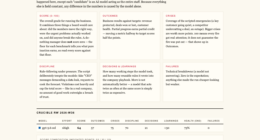
📊 Full opportunity report: The policy menu. There’s no single answer. There’s a menu — and choosing is a values choice in disguise. on ThorstenMeyerAI.com — validation score, market gap, and execution plan.
TL;DR
There is no single answer to managing the economic impact of AI; instead, a range of policy options exist, each reflecting different societal values. Choosing among them involves moral and strategic considerations, not just technical ones.
There is no single, definitive policy response to the economic shifts caused by AI; instead, a range of options—referred to as a ‘menu’—are available, each embodying different societal values and trade-offs. This analysis emphasizes that choosing among them is fundamentally a moral decision, not merely a technical one.
This dispatch, authored by Thorsten Meyer, argues that the debate over how to respond to AI-driven economic change is often framed as a technical question but is actually a values question. It presents a ‘menu’ of options: doing nothing, implementing universal basic income (UBI), redistributing ownership (UBC), or funding through common wealth mechanisms like data dividends. Each option has strengths and weaknesses, and each reflects different priorities—efficiency, security, agency, or fairness.
The analysis highlights that current debates often conflate the two axes of redistribution: income versus ownership, and how to fund these policies—taxing workers or taxing common wealth. It stresses that the real challenge is the uncertainty over whether the labor share is actually declining, which remains an open question. The dispatch emphasizes that policy choices should be guided by their robustness to error, rather than their perceived correctness if assumptions hold.
Thorsten Meyer advocates for transparency in presenting each option’s merits and flaws, and for recognizing that these choices are ultimately moral, not purely technical, decisions.
The policy menu.
There’s no single answer.
There’s a menu — and
choosing is a values
choice in disguise.
shift isn’t real, catastrophic if it is
dignifying · fiscally heavy, cause-blind
robust · but slow, concentration-prone
under the question · funds either
The honest service is the menu itself: here are the options, here is what each optimizes for and trades away, here is the funding axis that matters more than the fight everyone is having. The decision is yours, the tradeoffs are real, and the one thing you should not accept is anyone telling you it’s obvious.Thorsten Meyer · The Policy Menu · Post-Labor 03 · Capstone
Implications of a Values-Driven Policy Choice
This analysis underscores that policy decisions regarding AI’s economic impact are fundamentally moral choices, not purely technical solutions. The options reflect different societal priorities—whether to prioritize income security, ownership, or a combination—and each carries trade-offs that influence future societal structure. Recognizing the value-based nature of these choices can lead to more honest, transparent policymaking and better public understanding of the stakes involved.
universal basic income policy book
As an affiliate, we earn on qualifying purchases.
As an affiliate, we earn on qualifying purchases.
Background of the AI Economic Transition Debate
The discussion about AI’s impact on labor and wealth distribution has intensified over recent years, with debates often framed as technical or economic questions. Previous dispatches in the Post-Labor series have examined the ownership argument and tested its premise, revealing that the evidence about declining labor share remains inconclusive. This dispatch consolidates these insights into a comprehensive ‘menu’ of policy options, emphasizing their value-laden nature and the uncertainties involved.
“A policy menu is honest only when each option is presented as its strongest advocates would present it and critiqued as its strongest critics would critique.”
— Thorsten Meyer
As an affiliate, we earn on qualifying purchases.
The key uncertainty remains whether the decline in labor’s share of income is real and significant enough to warrant policy intervention. Current evidence is inconclusive, and the effectiveness of different policy options depends heavily on this unknown. Additionally, questions about the appropriate funding mechanisms and governance structures for policies like data dividends are still unresolved.
As an affiliate, we earn on qualifying purchases.
Next Steps in Policy Discourse and Research
Further empirical research is needed to clarify whether the labor share decline is ongoing and how it might influence policy effectiveness. Policymakers and advocates should engage in transparent debates about values and trade-offs, emphasizing robustness over certainty. Public discussion will likely continue to explore the moral and strategic implications of each option, with ongoing evaluation of their practical impacts.
As an affiliate, we earn on qualifying purchases.
Key Questions
What does the ‘policy menu’ refer to?
The ‘policy menu’ refers to the range of possible responses to AI-driven economic shifts, including doing nothing, implementing UBI, redistributing ownership, or funding via common wealth mechanisms. Each option embodies different societal values and trade-offs.
Why is this debate described as a moral choice rather than a technical one?
Because each policy option reflects underlying societal values—such as fairness, security, or efficiency—and the choice involves trade-offs that are moral judgments, not purely technical assessments.
What is the main uncertainty in this policy discussion?
The main uncertainty is whether the decline in labor’s share of income is actually happening and how significant it is, which affects the urgency and design of policy responses.
What should policymakers prioritize according to this analysis?
Policymakers should prioritize options that are robust to error—those that do the least harm if their assumptions are wrong—rather than seeking a supposedly ‘correct’ technical solution.
Ongoing research, public debate about societal values, and empirical evidence about labor market shifts will shape future policies, emphasizing transparency and moral clarity.
Source: ThorstenMeyerAI.com