
📊 Full opportunity report: How To Explore ADU Options For Your Backyard on IdeaNavigator AI — validation score, market gap, and execution plan.

Get the latest gadgets delivered free — and shop member deals
- Fast, free delivery on millions of items
- Access to Prime Big Deal Days deals on October 6–7
- Prime Video, Amazon Music and more included
TL;DR
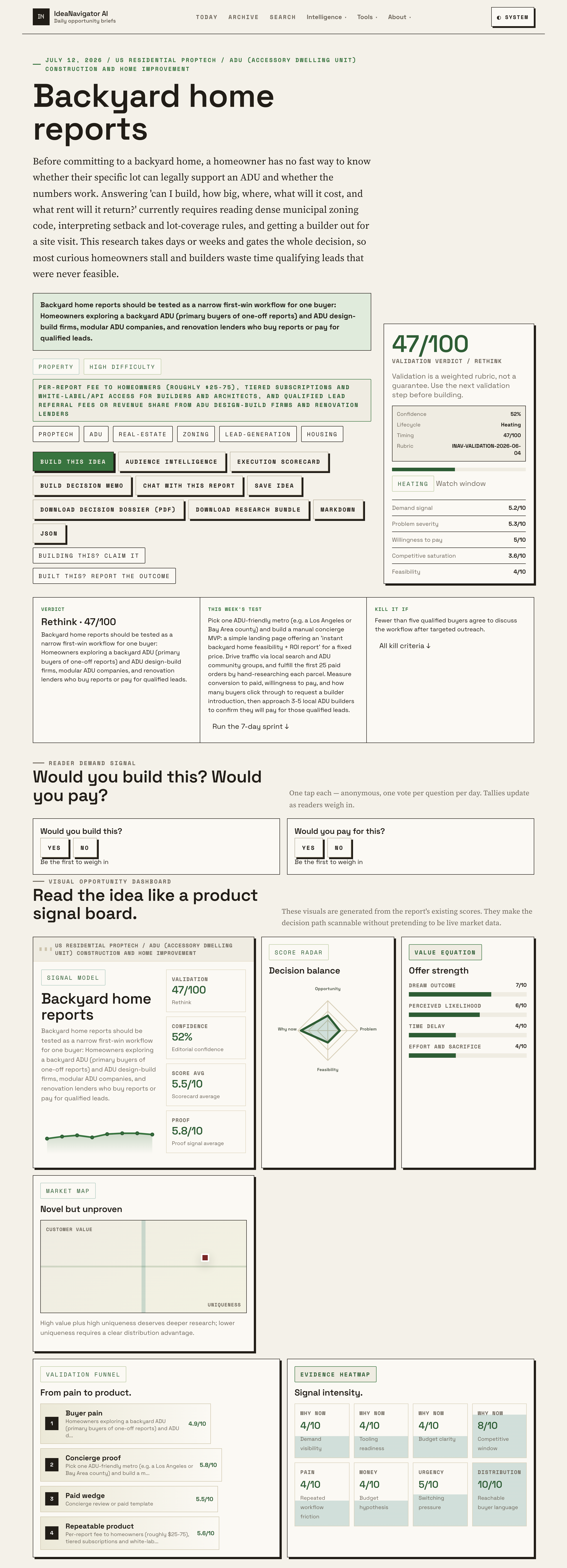
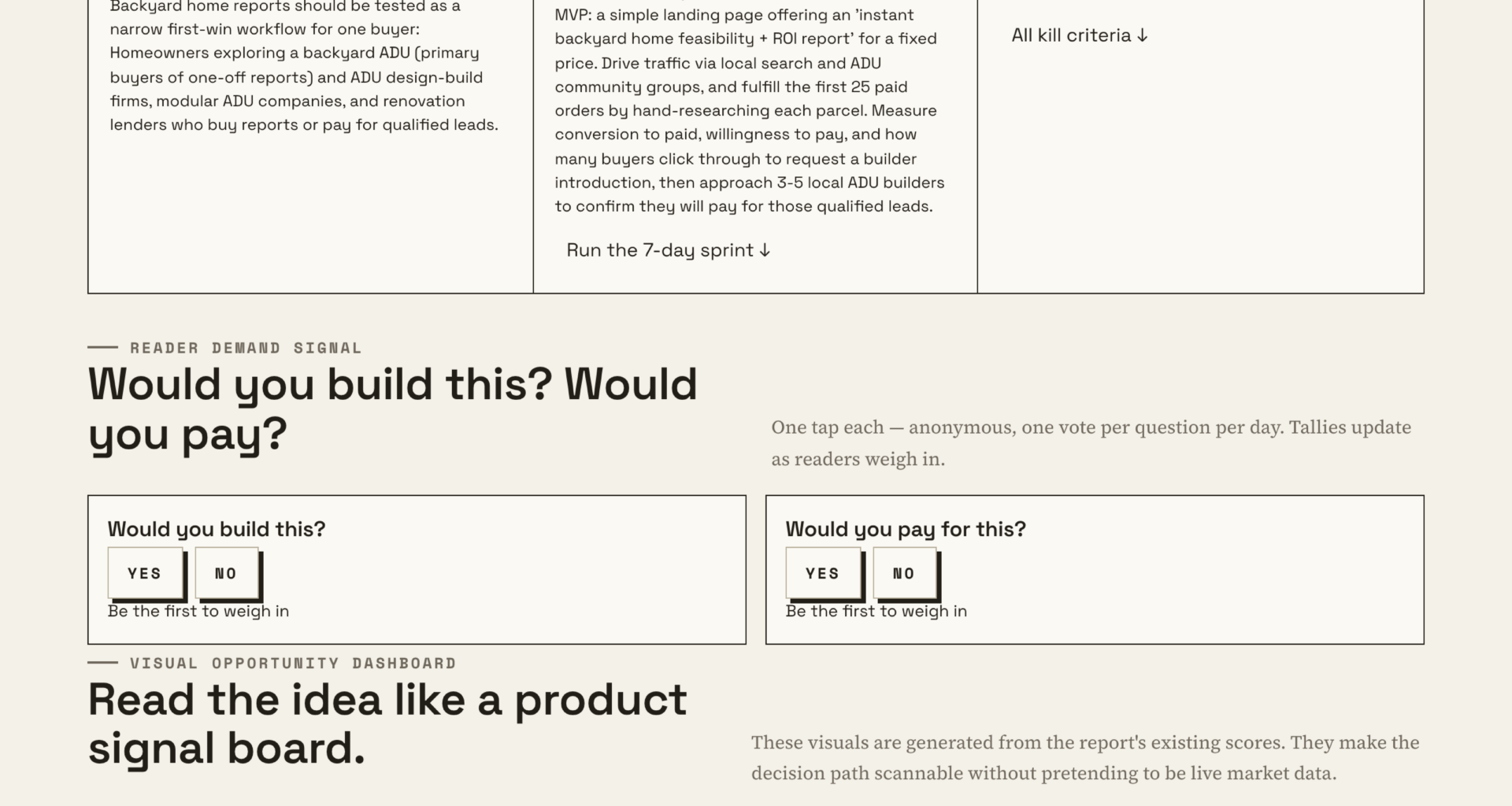
IdeaNavigator AI proposes testing address-specific reports that estimate whether a backyard accessory dwelling unit may fit a property, what it could cost and what rent it might bring. The concept has not been shown to be a launched service or validated business; its suggested next step is to fulfill 25 paid reports by hand in one California market.
IdeaNavigator AI has proposed testing paid backyard ADU feasibility reports that would assess a homeowner’s property address for potential building rules, estimated costs and rental income. The proposal matters to homeowners weighing a backyard unit and to builders seeking qualified customers, but it describes a business idea and validation plan, not a service already on the market.
The proposed report would answer practical early questions: whether an ADU may be allowed on a specific lot, how large it could be, where it might fit, what construction could cost and what rent it could generate. IdeaNavigator AI says homeowners currently need to interpret municipal zoning rules, examine setbacks and lot coverage, and often arrange a builder site visit. That process can take days or weeks, according to the proposal.
The suggested minimum product is a web app where a homeowner enters an address and buys a PDF report for roughly $25 to $75. It would combine county parcel information, such as lot boundaries and existing building footprints, with state ADU law and a manually curated set of local rules. It could also provide a buildable-area estimate, a construction cost range and projected rent based on local comparisons.
The plan calls for starting in one California metro or county, checking the first reports by hand and adding an option to request an introduction to a vetted builder. Potential revenue would come from one-off homeowner purchases, subscriptions or white-label tools for building professionals, and fees for qualified referrals. These are proposed models; no prices, customers or builder agreements have been confirmed.
A Faster First ADU Check
An address-based assessment could give homeowners an earlier indication of whether a backyard unit merits further investigation. That may help them decide whether to spend time and money on professional design and permitting work. For builders, architects and renovation lenders, the proposed reports could help identify prospects whose lots appear more suitable for a project.
The central question is whether a report can be both useful and reliable without overstating what parcel data and summarized rules can establish. A preliminary estimate cannot by itself settle a property’s legal eligibility, replace a site inspection or guarantee project cost or rental returns. The idea’s commercial case also depends on whether homeowners will pay and whether local businesses value the resulting leads.
California Rules and ADU Demand
The proposal points to California’s statewide ADU law, which took effect in 2016 and has been loosened in subsequent years. It says Los Angeles County permitted more than 45,000 ADUs in 2023 and that ADUs account for roughly one in five new housing units produced in California. Those figures are presented as context for the opportunity; the proposal does not provide links or detailed definitions for either measure.
IdeaNavigator AI argues that broader housing shortages, parcel data and language-model tools for parsing codes make address-specific reports more practical to attempt. It recommends limiting the first version to a small area and hand-curating local zoning rules, rather than trying to automate coverage across many jurisdictions from the outset.
Accuracy and Demand Still Unproven
No evidence is provided that the report has been built, that homeowners have purchased one, or that builders or lenders have agreed to pay for leads. The suggested 25 paid orders are a validation target, not completed sales. The proposal also gives no measured report accuracy, customer conversion rate, construction cost data or rental forecast performance.
Local rules and property conditions can affect what is feasible, and the outline does not explain how a report would handle exceptions, outdated records or conflicting requirements. It is also unclear how rental comparisons would be selected and whether estimates would account for financing, operating expenses, permitting costs or changes in market conditions.
A 25-Report Market Test
The proposed next step is a manual concierge test in one ADU-friendly county, such as an area of Los Angeles or the Bay Area. The operator would offer a fixed-price feasibility and return report through a landing page, attract local homeowners through search and ADU community groups, and research the first 25 paid properties by hand.
The test would track whether visitors buy, what they are willing to pay and how many request an introduction to a builder. The proposal also recommends speaking with three to five local ADU firms about paying for qualified leads. No dates or results for that test have been announced.
Source: IdeaNavigator AI
Key Questions
Is an address-specific ADU report available now?
The described report is a proposed product. No launch or availability information is provided.
What would the report estimate?
It is intended to assess potential ADU types and size, setbacks, lot coverage, buildable area, construction cost and local rental income for a property.
Would a report confirm that a homeowner can build?
No such guarantee is described. The proposal outlines a preliminary assessment based on parcel data and local rules; final feasibility would still depend on the property’s circumstances and applicable requirements.
How would the business idea be tested?
The proposed test is to sell 25 manually researched reports in one California market, measure purchases and builder-introduction requests, and ask three to five local firms whether they would pay for qualified leads.
Source: IdeaNavigator AI
Fall Picks
fall essentials
As an affiliate, we earn on qualifying purchases.