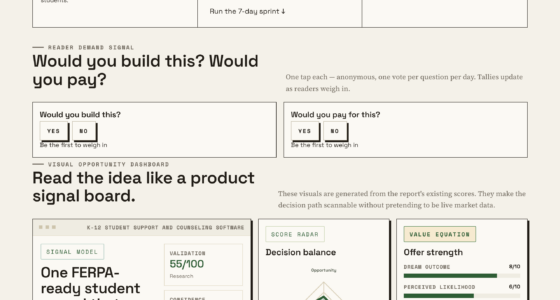

📊 Full opportunity report: IdeaClyst: The Validation Council on ThorstenMeyerAI.com — validation score, market gap, and execution plan.

Get the latest gadgets delivered free with Prime
- Fast, free delivery on millions of items
- Prime Video, Amazon Music and more included
- Member-only deals all year
TL;DR
IdeaClyst has launched a new validation council that uses opposing AI models to stress-test and evaluate ideas. This process aims to improve decision-making by identifying weak ideas early. The approach emphasizes structured disagreement over simple approval.
IdeaClyst has introduced a new structured decision-making process called the Validation Council, designed to rigorously evaluate ideas before they are prioritized for development. This process involves two opposing AI models, Claude and Codex, which challenge each other’s reasoning to identify weak points and strengthen the final recommendation. The initiative aims to improve decision quality and reduce costly failures caused by untested, plausible-sounding ideas.
The Validation Council is a core component of IdeaClyst’s platform, which separates the idea generation phase from the validation process. It begins with a research pre-step that gathers relevant context, prior art, and evidence about the idea. Following this, the council runs through five deliberate steps: framing the idea, steelmanning it, red-teaming it, evidence-checking, and synthesizing a verdict. Each step involves detailed argumentation, with the models tasked to provide evidence-based challenges and defenses.
The process is designed to be provider-agnostic, requiring the use of multiple models to avoid vendor lock-in. It runs locally on owned compute, making it cost-effective and accessible for regular use. The goal is to identify weak ideas early, avoiding unnecessary investment in concepts that are only superficially plausible. The verdict produced is an auditable recommendation, not just a binary yes/no, emphasizing transparency and accountability in decision-making.
IdeaClyst — the validation council
Most ideas don’t die from being bad — they die from being plausible and untested. A research pre-step, then two models cross-examining the idea before it earns a roadmap slot.
Independent commentary, produced with AI assistance under human editorial oversight. The views are the author’s own and may change. IdeaClyst is developed privately and is not publicly available. The council’s research, deliberation and verdicts are produced by automated models and may contain errors or shared blind spots — a verdict is auditable reasoning, not validated demand; verify independently before committing. Product and company names are trademarks of their respective owners; mention does not imply endorsement.
Why Structured AI Disagreement Enhances Decision-Making
The Validation Council addresses a key challenge in innovation and product development: avoiding costly investments in ideas that seem promising but are fundamentally flawed. By forcing opposing AI models to argue for and against an idea based on evidence, the process reduces the risk of agreement based on superficial consensus or confirmation bias. This structured disagreement provides a more reliable filter, enabling organizations to focus resources on ideas with proven merit. It also democratizes decision-making, making rigorous evaluation accessible and repeatable without extensive human oversight.
While not infallible, this approach offers a significant leverage point for operators seeking to improve their strategic choices, especially in fast-moving or uncertain environments. It shifts the decision process from gut feeling or unstructured debate to a transparent, evidence-based dialogue that can be audited and refined over time.
As an affiliate, we earn on qualifying purchases.
Background and Development of IdeaClyst’s Validation Approach
IdeaClyst originated from the need to improve idea vetting within organizations, moving beyond simple approval or rejection. The platform’s core innovation is its use of multiple AI models—specifically Claude and Codex—to simulate a debate, exposing weaknesses and strengths in proposed ideas. This approach builds on existing practices of peer review and critical evaluation but automates and scales them using AI.
The concept of structured disagreement is rooted in the recognition that single-model assessments often suffer from confirmation bias and blind spots. By requiring models to challenge each other, IdeaClyst aims to surface hidden flaws and improve the quality of decisions. The platform is developed privately and is not publicly available. Learn more in A War Room for Your Next Idea: Inside IdeaClyst.
“The Validation Council replaces the unstructured debate with a rigorous, evidence-based fight between models, making idea vetting more reliable and repeatable.”
— Thorsten Meyer, founder of IdeaClyst
As an affiliate, we earn on qualifying purchases.
Limitations and Potential Risks of Model-Based Disagreement
While the Validation Council aims to improve idea vetting, it remains susceptible to the inherent limitations of AI models. Both Claude and Codex share training data and blind spots, which can lead to confidently wrong conclusions. The process cannot verify market validity or real-world feasibility, as it is limited to internal argumentation based on available evidence.
Additionally, the structured process might create an illusion of rigor, potentially discouraging further questioning if the verdict appears authoritative. The effectiveness depends heavily on the quality of the initial research and the diversity of models used.
decision-making validation platform
As an affiliate, we earn on qualifying purchases.
As an affiliate, we earn on qualifying purchases.
Next Steps for Adoption and Refinement of the Validation Council
IdeaClyst is developed privately and is not publicly available. The focus will be on integrating additional models, refining the research pre-step, and developing user interfaces that make the deliberation process more transparent and accessible. Organizations interested in adopting this approach can start implementing it on their own ideas, with the expectation that ongoing refinements will enhance its reliability.
Further testing in real-world decision environments will be critical to validate its effectiveness and identify areas for improvement. The company also intends to explore integrations with existing product development pipelines and decision-support tools.
As an affiliate, we earn on qualifying purchases.
Key Questions
How does the Validation Council differ from traditional idea review?
The Validation Council uses opposing AI models to rigorously challenge each idea based on evidence, rather than relying on a single opinion or informal review. It emphasizes transparency, structured disagreement, and auditable reasoning.
Can the council guarantee that an idea is truly viable?
No, the council can only evaluate internal consistency, evidence, and logical robustness. It cannot assess market demand or real-world feasibility, which require human judgment and external validation.
Is the process expensive or complex to run?
No, because it runs on local compute and is designed to be nearly free for regular use. Its local-first architecture encourages widespread adoption without significant cost barriers.
Will this replace human decision-makers?
No, it is intended as a decision-support tool that enhances human judgment by providing structured, evidence-based critique of ideas.
What are the limitations of using multiple AI models in this way?
Models can share blind spots and confidently produce incorrect conclusions. The process improves scrutiny but does not eliminate the need for human oversight and external validation.
Source: ThorstenMeyerAI.com
Halloween Picks
halloween
As an affiliate, we earn on qualifying purchases.